Explain the factors responsible for inefficiency of agri-produce marketing. How does e-commerce help to reduce inefficiency of agri-produce marketing? Explain.
Explain the factors responsible for inefficiency of agri-produce marketing. How does e-commerce help to reduce inefficiency of agri-produce marketing? Explain.
India's agricultural sector faces systemic marketing hurdles, yet the Economic Survey 2025-26 highlights that reforms like the Agriculture Infrastructure Fund (AIF) and the National Agriculture Market (e-NAM) are modernizing value chains to enhance farmer remuneration.
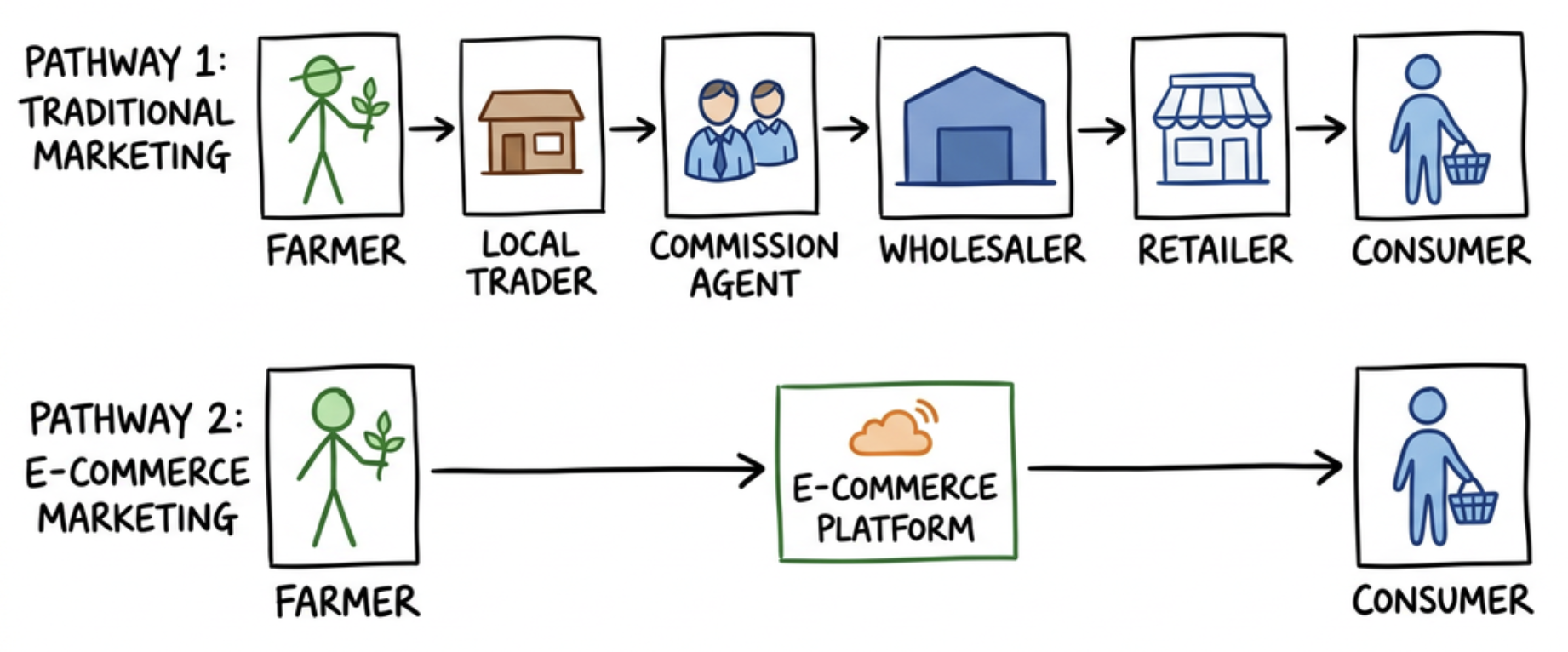
Comparing Traditional and E-commerce Agricultural Marketing Channels
Factors Responsible for Inefficiency of Agri-Produce Marketing
-
Fragmented Landholdings: Small plots limit economies of scale.
- Eg: Mordor Intelligence 2026 report cites fragmentation as growth barrier.
-
Excessive Intermediation: Middlemen in mandis extract high commissions.
- Eg: 2025 analysis confirms price gaps between farm-gate and retail.
-
Inadequate Cold-Chain Infrastructure: Lack of temperature-controlled storage leads to post-harvest losses.
- Eg: Current data indicates shortfall in cold chain capacity.
-
Information Asymmetry: Farmers lack real-time price data across regions.
- Eg: Traditional marketing lacks transparent price discovery at local levels.
-
Gender Productivity Gaps: Unequal credit access leads to lower surpluses.
- Eg: Arya.ag 2026 report notes 24% productivity gap costing 2 lakh crore annually.
Role of E-commerce in Reducing Inefficiencies
-
Disintermediation: Digital platforms connect producers directly to consumers.
- Eg: Farm-to-table platforms saw market revenue increase by 26% in 2026.
-
Price Discovery: Electronic portals facilitate real-time bidding for competitive prices.
- Eg: e-NAM reached a trade value of 4.84 lakh crore by March 2026.
-
Digital Infrastructure: Networks provide guidance for timing sales profitably.
- Eg: Bharat-VISTAAR network uses AI for advisory and market data.
-
Traceability and Standardization: E-commerce promotes quality grading and seed traceability.
- Eg: SATHI platform ensures seed authenticity.
-
Fintech Integration: Financial services on portals provide liquidity.
- Eg: Agricultural e-commerce projected to grow at 9.6% CAGR through 2035.
Strengthening the Digital Agriculture Mission and expanding AgriStack will bridge the rural-urban digital divide, ensuring that the PM-KISAN ecosystem fosters a resilient, transparent, and globally competitive Indian Agri-Export Policy framework.
Answer Length
Model answers may exceed the word limit for better clarity and depth. Use them as a guide, but always frame your final answer within the exam’s prescribed limit.
Evaluate this PYQ now
Write your answer & evaluate in just 60 seconds




500+ students evaluated
Model Answers from
- 2026Economy15 MarksView Answer
Discuss the different types of subsidies and support provided by the Government of India to the agricultural sector. Examine the related issues pertaining to the Agreement on Agriculture of the World Trade Organisation (WTO).
- 2026Economy15 MarksView Answer
How has Indian agriculture been transformed from food scarcity to food surplus level? Explain the various government policies implemented for diversification of Indian agriculture.
- 2026Economy15 MarksView Answer
How are startups in India promoting entrepreneurship, innovation and employment? Discuss the global and domestic challenges in their working and suggest suitable measures to overcome these challenges.
- 2026Economy15 MarksView Answer
Explain the key challenges for India's energy security. What measures do you suggest for ensuring energy security along with economic growth and sustainability?
- 2026Economy10 MarksView Answer
Describe the various Technology Missions initiated in Indian agriculture and examine their role in food security.
- 2026Economy10 MarksView Answer
Examine the view that financial inclusion is an integral part of social and economic inclusion in a country like India. Also throw light on the usefulness of the R.B.I.'s Financial Inclusion Index.
Model Answers by Subject


Crack UPSC with your
Personal AI Mentor
An AI-powered ecosystem to learn, practice, and evaluate with discipline