What is the phenomenon of cloudbursts? Explain.
What is the phenomenon of cloudbursts? Explain.
Subject: Physical Geography
Indian Meteorological Department (IMD) defines cloud burst as an extreme, localized precipitation event recording 100 mm or more per hour over a small geographical area of 10 to 30 square kilometres.
Understanding the Phenomenon of Cloudbursts
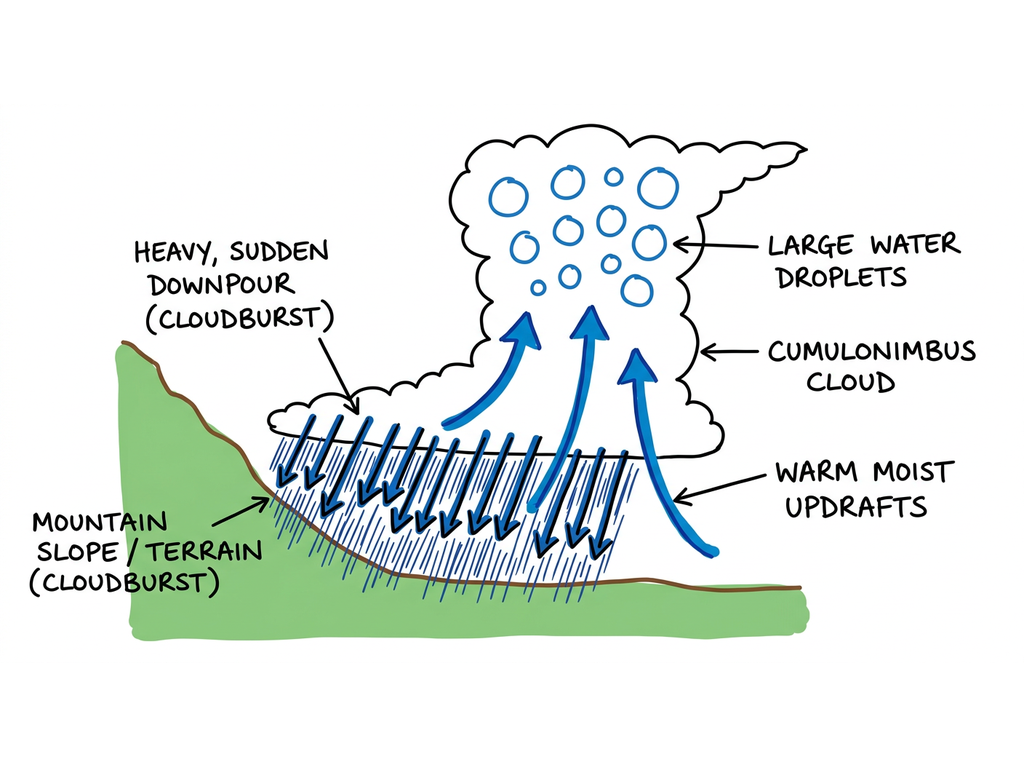
Cloudburst
- Orographic Lifting: Moisture-laden winds hitting mountain barriers are rapidly forced upwards, condensing into massive cumulonimbus clouds.
- Convective Instability: Strong vertical updrafts suspend water droplets until they become too heavy, triggering violent and sudden downpours.
- Clausius-Clapeyron Effect: Global warming intensifies this mechanism, as every 1°C temperature rise allows the atmosphere to hold 7% more moisture.
- Geographical Expansion: The phenomenon is spreading beyond the Himalayas to the orographically lifted Western Ghats, contributing to catastrophes like the Wayanad landslides (2024).
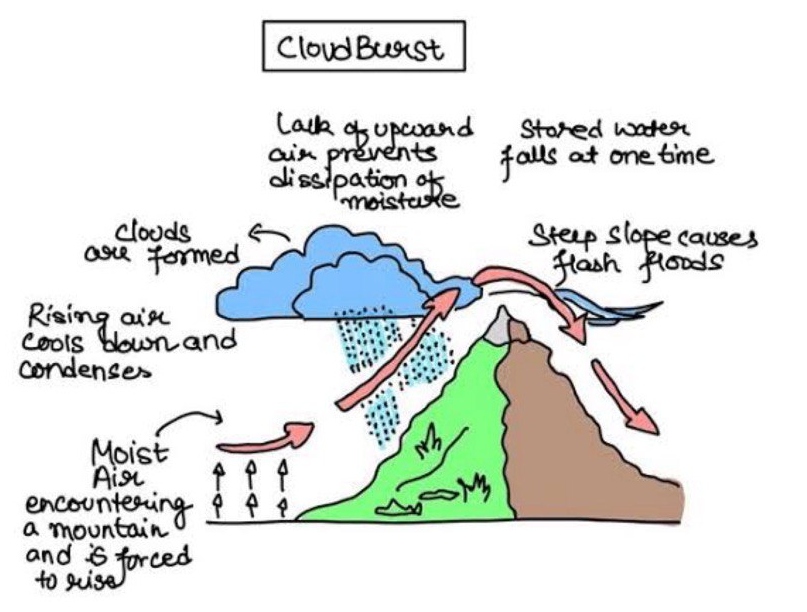
Formation of Cloudburst
Impacts and Mitigation Strategies
- Micro-climatic Extremes: Increasing "mini-cloudbursts" cause sudden urban flooding, like the September 2025 Dehradun event which recorded 192 mm of rainfall in hours.
- Economic Devastation: Sudden flash floods wipe out critical infrastructure, causing ₹541 crore in damages in Himachal Pradesh during a single July 2025 spell.
- Anthropogenic Aggravation: Unplanned highway expansion worsens slope instability, as highlighted by the SC-Appointed High-Powered Committee on Char Dham.
- Nowcasting Capabilities: The government is expanding the Doppler Weather Radar network to 126 by 2026 for hyper-local early warnings.
- Sustainable Limits: The Supreme Court (2024) ordered carrying capacity evaluations for 13 Himalayan states to halt unsustainable tourist and infrastructure influx.
Mitigating cloudbursts requires transitioning from reactive rescue to proactive climate resilience, integrating real-time hydrodynamic modeling and aligning local developmental policies with the Sendai Framework.
Answer Length
Model answers may exceed the word limit for better clarity and depth. Use them as a guide, but always frame your final answer within the exam’s prescribed limit.
Evaluate this PYQ now
Write your answer & evaluate in just 60 seconds




500+ students evaluated
Model Answers by Subject


Crack UPSC with your
Personal AI Mentor
An AI-powered ecosystem to learn, practice, and evaluate with discipline