Why is the South-West monsoon called ‘Purvaiya’ (easterly) in Bhojpur Region? How has this directional seasonal wind system influenced the cultural ethos of the region?
Why is the South-West monsoon called ‘Purvaiya’ (easterly) in Bhojpur Region? How has this directional seasonal wind system influenced the cultural ethos of the region?
The South-West monsoon, though generally westerly in origin, is locally referred to as ‘Purvaiya’ (easterly) in the Bhojpur region of Bihar and eastern Uttar Pradesh. This nomenclature is a reflection of local perception shaped by geography and wind direction relative to the region.
Why South-West Monsoon is Called 'Purvaiya' in Bhojpur Region
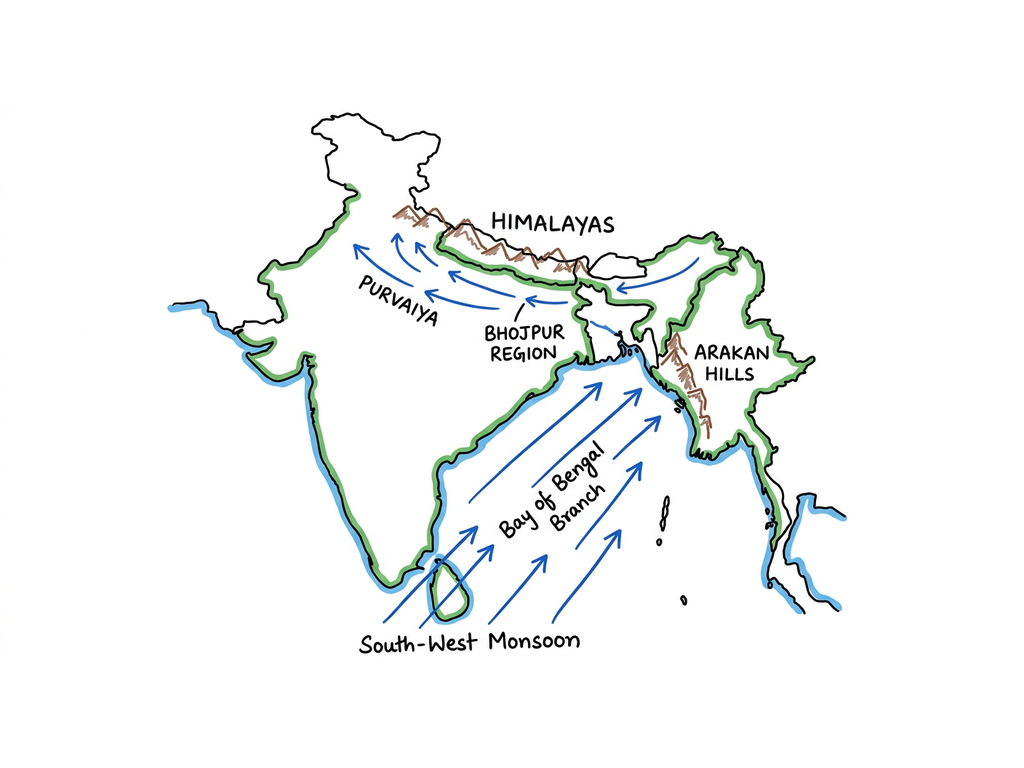
Indian Monsoon and Topography Interaction Diagram
-
Relative Direction of Windflow:
- The South-West monsoon winds, after deflecting around the Bay of Bengal, move northwestwards into the middle Ganga plains.
- In Bhojpur, these winds arrive from the east/southeast direction, and thus are locally perceived as easterlies or Purvaiya.
-
Geographic Orientation:
- Bhojpur lies east of the Vindhyas and west of the Bay of Bengal. The wind, after travelling from the Bay, approaches from the east.
- Hence, villagers name it from their experiential geography, not its true origin.
-
Oral Traditions and Linguistic Custom:
- Local languages like Bhojpuri use cardinal directions in ways that reflect experiential association, not meteorological precision.
- The term ‘Purvaiya’ is embedded in folklore, songs, and idioms passed through generations.
Influence on Cultural Ethos of Bhojpur Region
-
Agricultural Festivals and Rhythms:
- The arrival of Purvaiya heralds kharif sowing, especially paddy cultivation.
- Festivals like Asadh and Sawan celebrate the joy of monsoon rains through folk songs and rituals.
-
Folk Songs and Music:
- Kajri and Birha songs often personify the Purvaiya as a messenger of longing and fertility.
- Example: Purvaiya bahar laage la, piya ke sandesh laage la – expressing love and seasonal change.
-
Architecture and Lifestyle:
- Traditional homes in the region have verandahs and sloping roofs, adapted to monsoon rains.
- Cultural practices like rainwater harvesting in ponds (ahars and pynes) evolved with the monsoon cycle.
-
Religious Significance:
- Chhath Puja, though post-monsoon, celebrates the sun and water—elements deeply tied to monsoon ecology.
- Monsoon-fed rivers like the Ganga are considered sacred lifelines.
-
Migration and Memory: During monsoon, Bhojpuri migrants often sing songs yearning for home, connecting climate and emotion.
The term Purvaiya reflects how geographical phenomena are internalized and named culturally. In Bhojpur, the South-West monsoon is not just a meteorological event but a life-structuring force—deeply embedded in its agriculture, folklore, and seasonal identity.
Answer Length
Model answers may exceed the word limit for better clarity and depth. Use them as a guide, but always frame your final answer within the exam’s prescribed limit.
Evaluate this PYQ now
Write your answer & evaluate in just 60 seconds




500+ students evaluated
Model Answers from
- 2023Indian Geography15 MarksView Answer
Comment on the resource potentials of the long coastline of India and highlight the status of natural hazard preparedness in these areas.
- 2023Indian Geography15 MarksView Answer
From being net food importer in 1960s, India has emerged as a net food exporter to the world. Provide reasons.
- 2023Indian Geography15 MarksView Answer
Why did human development fail to keep pace with economic development in India?
- 2023Indian Geography15 MarksView Answer
Identify and discuss the factors responsible for diversity of natural vegetation in India. Assess the significance of wildlife sanctuaries in rain forests regions of India.
Model Answers by Subject


Crack UPSC with your
Personal AI Mentor
An AI-powered ecosystem to learn, practice, and evaluate with discipline



