Discuss the main contributions of Gupta period and Chola period to Indian heritage and culture
Discuss the main contributions of Gupta period and Chola period to Indian heritage and culture
The Gupta (4th–6th CE) and Chola (9th–13th CE) periods represent two high points in India’s cultural history. While the Guptas ushered in a classical age of Sanskrit literature, scientific advancements, and refined art, the Cholas epitomized the grandeur of Dravidian architecture, maritime power, and Tamil literary efflorescence. Together, they shaped the composite heritage of India.
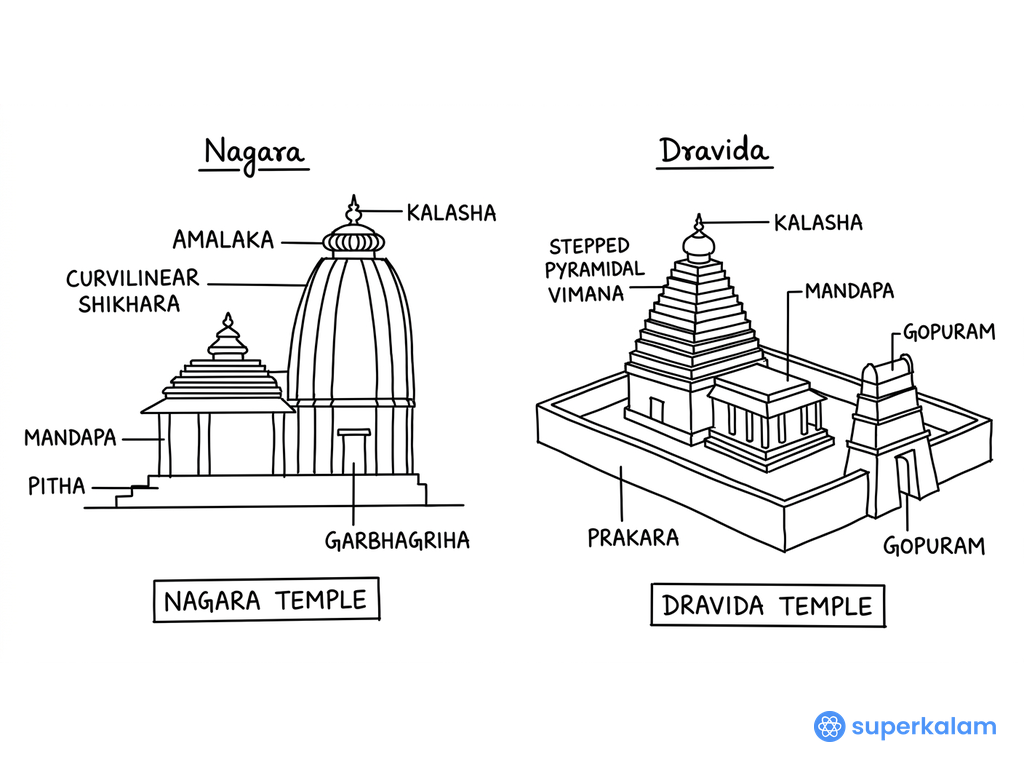
Nagara and Dravida Temple Architectural Comparison
Gupta Period (4th–6th Century CE) – Golden Age of India
The Gupta age marked the consolidation of classical Indian culture in art, architecture, science, and literature.
-
Art and Architecture
- The Guptas pioneered the Nagara style of temple architecture with a square sanctum (garbhagriha), flat-roofed mandapa, and shikhara.
- Example – Dashavatara Temple, Deogarh depicts Vishnu’s incarnations in high-relief panels.
- Buddhist sites like Ajanta Caves (Cave 1, 2, 16, 17) saw refined murals with naturalistic human figures, delicate expressions, and narrative scenes from Jataka tales.
-
Sculpture
- Gupta sculpture is marked by idealized human form, smooth finish, and spiritual expression.
- Example – Sarnath Buddha image (Dharmachakra mudra) represents serenity and meditative calm, influencing Southeast Asian Buddhist art.
- Introduction of standing Vishnu and Matsya-Kurma-Varaha reliefs that became pan-Indian icons.
-
Literature
- Court poet Kalidasa elevated Sanskrit drama and poetry (Abhijnanashakuntalam, Meghadutam), blending human emotions with nature.
- Aryabhata’s Aryabhatiya systematized mathematics and astronomy.
- Amarasimha compiled the Amarakosha, a standard Sanskrit thesaurus still referenced today.
-
Science and Technology
- Aryabhata calculated π (3.1416), explained solar/lunar eclipses, and asserted Earth’s rotation.
- Varahamihira in Brihat Samhita documented meteorology, hydrology, architecture, and astrology.
- Decimal numeral system and the concept of zero were refined and popularized in this era.
-
Education and Knowledge Networks
- Nalanda University became a global hub attracting scholars from China (Xuanzang), Korea, and Central Asia.
- Specialized studies in medicine, logic, philosophy, and grammar flourished, influencing Asian academic traditions.
Chola Period (9th–13th Century CE) – Pinnacle of Tamil Culture and Maritime Power
The Cholas combined statecraft, temple-centered economy, and overseas trade to create a culturally vibrant empire.
-
Architecture
- Reached the zenith of Dravida style – massive vimanas, intricate sculptures, and symmetrical temple complexes.
- Brihadeshwara Temple, Thanjavur (Rajaraja I) – built in granite with a 66-metre high vimana, showcasing engineering precision.
- Gangaikondacholapuram Temple (Rajendra I) and Airavatesvara Temple (Rajendra II) expanded on the grandeur.
-
Sculpture and Bronze Casting
- Perfected the lost-wax technique for bronze idols – fluid grace, idealized body proportions, and devotional aura.
- Nataraja of Chidambaram – symbol of cosmic rhythm and spiritual transcendence; exported as cultural icons to Southeast Asia.
-
Literature and Religious Movements
- Patronized Tamil Bhakti literature – hymns of Nayanars (Shaiva saints) and Alvars (Vaishnava saints) compiled in Tevaram and Divya Prabandham.
- Kamban’s Ramavataram adapted the Ramayana into rich Tamil poetic tradition, influencing South Asian literature.
-
Maritime Trade and Cultural Expansion
- Maintained strong naval fleets to control Indian Ocean trade routes.
- Expeditions to Sri Lanka, Malaya Peninsula, and Srivijaya Empire spread Indian art, temple styles, and script systems to Southeast Asia.
-
Administration and Local Governance
- Introduced detailed land surveys for taxation; linked temple revenue to irrigation projects.
- Village assemblies (Sabha, Ur, Nagaram) functioned as local self-governing bodies – an early form of grassroots democracy.
Both the Gupta and Chola periods contributed immensely to India’s cultural heritage — the Guptas through a classical Sanskrit and scientific renaissance, and the Cholas through temple architecture, sculpture, maritime trade, and Tamil cultural patronage. Together, they shaped much of what is celebrated as the Indian civilizational ethos today.
Answer Length
Model answers may exceed the word limit for better clarity and depth. Use them as a guide, but always frame your final answer within the exam’s prescribed limit.
Evaluate this PYQ now
Write your answer & evaluate in just 60 seconds




500+ students evaluated
Model Answers from
Model Answers by Subject


Crack UPSC with your
Personal AI Mentor
An AI-powered ecosystem to learn, practice, and evaluate with discipline



