What are the forces that influence ocean currents? Describe their role in the fishing industry of the world.
What are the forces that influence ocean currents? Describe their role in the fishing industry of the world.
Ocean currents are large-scale horizontal movements of seawater that distribute heat, nutrients, and marine life across the globe. They are driven by a combination of atmospheric, geographical, and astronomical forces, and play a crucial role in regulating climate and sustaining global fisheries.
Forces Influencing Ocean Currents
World Map Showing Different Ocean Currents
-
Planetary Winds (Trade Winds & Westerlies)
- Push surface waters in consistent directions; e.g., Trade Winds drive the North and South Equatorial Currents.
- Seasonal reversal of winds (monsoons) alters currents in the Indian Ocean.
-
Coriolis Force (Earth’s Rotation)
- Deflects moving water to the right in the Northern Hemisphere and left in the Southern Hemisphere.
- Causes circular gyres and influences the direction of current loops (e.g., North Atlantic Gyre).
-
Temperature and Salinity Differences (Thermohaline Circulation)
- Cold, saline water is denser and sinks, driving deep ocean currents; warm water rises and flows poleward.
- Example: North Atlantic Deep Water formation off Greenland.
-
Configuration of Coastlines and Ocean Basins
- Land masses block currents, deflecting them (e.g., South Equatorial Current deflected northward along Brazil).
-
Gravity and Tides
- Tidal forces generated by the Moon and Sun influence local current patterns, especially in coastal areas.
-
Upwelling and Downwelling
- Wind-driven movement of surface waters away from coasts brings nutrient-rich cold water up (e.g., Peruvian coast).
- Enhances biological productivity and fishing grounds.
Role in the Global Fishing Industry
-
Nutrient Enrichment through Upwelling
- Cold currents (e.g., Humboldt Current, Benguela Current) bring nutrients to the surface, supporting plankton growth—the base of the marine food chain.
- Example: Peru’s anchovy fisheries thrive due to Humboldt Current upwelling.
-
Creation of Productive Fishing Grounds
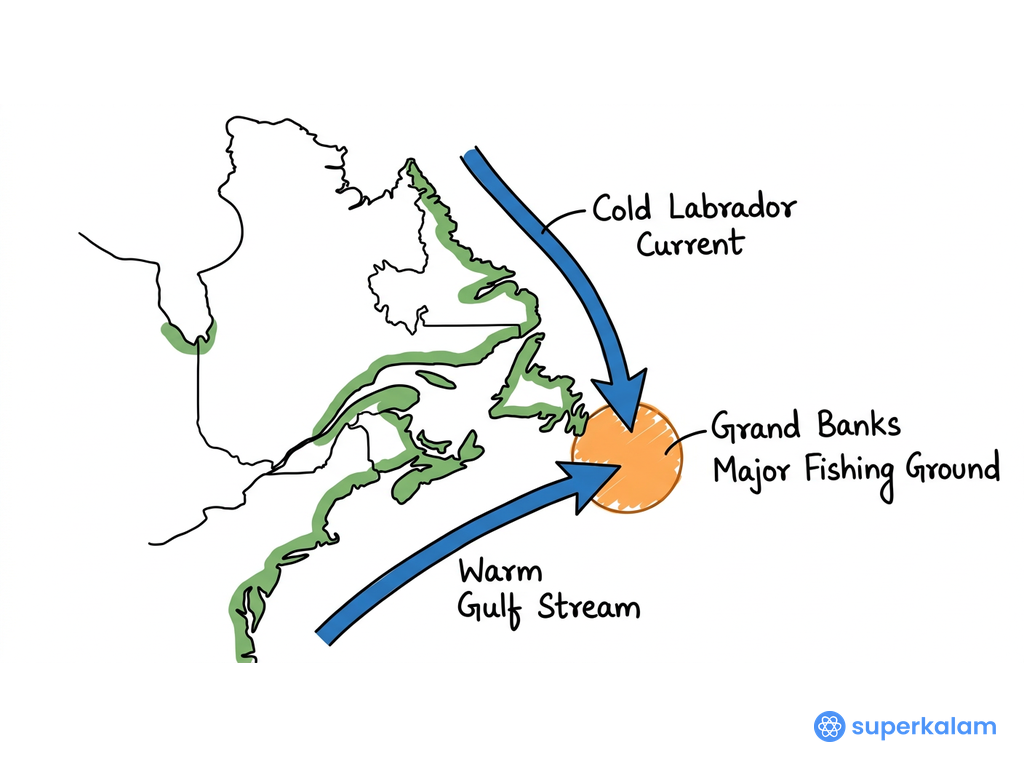
- Meeting points of warm and cold currents (convergence zones) promote rich biodiversity.
- Example: Grand Banks (Labrador + Gulf Stream) and Dogger Bank (North Sea).
-
Seasonal Variability and Migration of Fish
- Currents influence fish breeding and migration routes (e.g., sardine migration along South Africa due to Agulhas Current).
-
Stabilizing Marine Ecosystems
- Currents regulate water temperature and oxygen levels, maintaining favorable habitats for commercial fish species.
-
Impact of Climate Phenomena on Fisheries
- El Niño disrupts the Humboldt Current, reducing nutrient upwelling and causing major fishery collapses in Peru and Chile.
-
Support for Coastal Livelihoods
- Fishing-dependent economies (Namibia, Japan, Norway) rely on cold current regions for export-oriented fishing industries.
Ocean currents are the lifelines of the world’s fishing industry, determining the distribution, abundance, and seasonal movement of fish stocks. Understanding their patterns is vital for sustainable fisheries management, especially as climate change and ocean warming alter current systems, threatening global food security.
Answer Length
Model answers may exceed the word limit for better clarity and depth. Use them as a guide, but always frame your final answer within the exam’s prescribed limit.
Evaluate this PYQ now
Write your answer & evaluate in just 60 seconds




500+ students evaluated
Model Answers from
- 2022Physical Geography15 MarksView Answer
Mention the significance of straits and isthmus in international trade.
- 2022Physical Geography15 MarksView Answer
Troposphere is a very significant atmospheric layer that determines weather processes. How?
- 2022Physical Geography10 MarksView Answer
Discuss the natural resource potentials of ‘Deccan trap’.
- 2022Physical Geography10 MarksView Answer
Describe the characteristics and types of primary rocks.
Model Answers by Subject


Crack UPSC with your
Personal AI Mentor
An AI-powered ecosystem to learn, practice, and evaluate with discipline



