Examine the status of forest resources of India and its resultant impact on climate change.
Examine the status of forest resources of India and its resultant impact on climate change.
India's forests play a critical role in climate regulation and carbon sequestration. Current forest and tree cover stands at 827,357 sq km (25.17% of geographical area), showing gradual progress toward environmental sustainability goals.
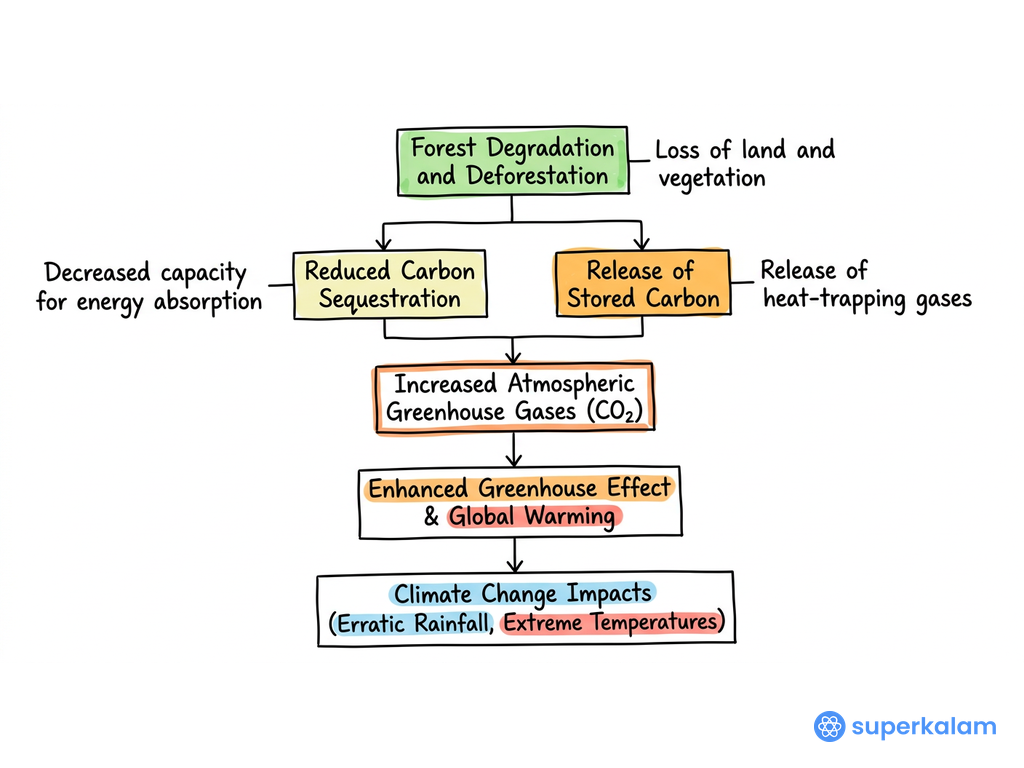
Forest Climate Change Feedback Loop Flowchart
Current Status of Forest Resources
- Forest Cover Distribution: Total forest cover is 715,343 sq km (21.76%), while tree cover accounts for 112,014 sq km (3.41%) of India's geographical area
- Regional Variations: Madhya Pradesh leads with 77,493 sq km, followed by Arunachal Pradesh and Chhattisgarh; northeastern states have highest forest density
- Forest Types: Tropical wet evergreen, deciduous, thorn forests, and montane forests distributed across different climate zones
- Quality Assessment: 40% of forests are degraded, affecting their carbon storage capacity and biodiversity conservation potential
- Recent Trends: Net increase of 1,540 sq km since 2021, with Telangana, Andhra Pradesh showing maximum gains
| State | Forest Cover (sq km) | Percentage of Geographical Area |
|---|---|---|
| Madhya Pradesh | 77,493 | 25.15% |
| Arunachal Pradesh | 66,431 | 79.33% |
| Chhattisgarh | 55,717 | 41.18% |
| Odisha | 52,156 | 33.56% |
Impact on Climate Change
- Carbon Storage: Indian forests store approximately 4.5 billion tonnes of carbon, serving as crucial carbon sinks for global climate stability
- Deforestation Impact: Annual loss of 668,400 hectares during 2015-2020 released significant CO₂, contributing to greenhouse gas emissions
- Temperature Regulation: Forest loss increases local temperatures by 2-3°C, disrupting regional weather patterns and monsoon cycles
- Rainfall Patterns: Deforestation reduces local precipitation by 15-20%, affecting agricultural productivity and water security
- Extreme Weather: Forest degradation increases vulnerability to floods, droughts, and cyclones in affected regions
Mitigation and Conservation Initiatives
- Green India Mission: Targets additional 5 million hectares of forest cover, focusing on degraded forest restoration and afforestation
- CAMPA Implementation: ₹47,000 crores allocated for compensatory afforestation, supporting 1.5 million hectares of plantation activities
- Mangrove Conservation: MISHTI Scheme promotes coastal forest restoration, with mangroves sequestering 4 times more carbon than terrestrial forests
- Community Participation: Joint Forest Management involves 1.18 lakh committees, covering 24.6 million hectares for sustainable forest governance
- NDC Commitments: India pledges 2.5-3 billion tonnes CO₂ equivalent additional carbon sink through forests by 2030
India's forest conservation aligns with Paris Agreement commitments and supports achievement of carbon neutrality by 2070, demonstrating integration of environmental protection with climate action strategies.
Answer Length
Model answers may exceed the word limit for better clarity and depth. Use them as a guide, but always frame your final answer within the exam’s prescribed limit.
Evaluate this PYQ now
Write your answer & evaluate in just 60 seconds




500+ students evaluated
Model Answers from
- 2020Indian Geography15 MarksView Answer
India has immense potential for solar energy though there are regional variations in its developments. Elaborate.
- 2020Indian Geography15 MarksView Answer
The interlinking of rivers can provide viable solutions to the multi-dimensional inter-related problems of droughts, floods and interrupted navigation. Critically examine.
- 2020Indian Geography10 MarksView Answer
Account for the present location of iron and steel industries away from the source of raw material, by giving examples.
- 2020Indian Geography10 MarksView Answer
How will the melting of Himalayan glaciers have a far- reaching impact on the water resources of India?
Model Answers by Subject


Crack UPSC with your
Personal AI Mentor
An AI-powered ecosystem to learn, practice, and evaluate with discipline



