India is well endowed with fresh water resources. Critically examine why it still suffers from water scarcity.
India is well endowed with fresh water resources. Critically examine why it still suffers from water scarcity.
Despite receiving 4,000 billion cubic meters of annual precipitation, India faces acute water scarcity due to systemic management failures and growing demand pressures.
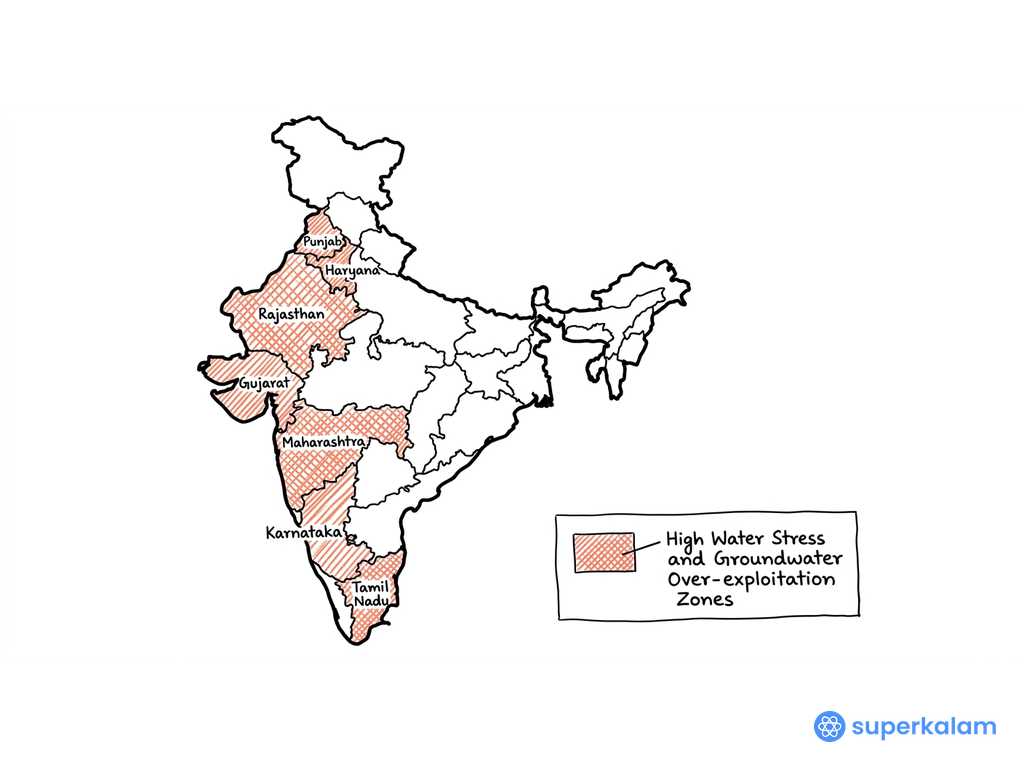
Map of India Showing Western Regions
Spatial and Temporal Distribution Issues
Uneven Geographic Distribution
- 85% of rainfall concentrated during 4-month monsoon period (June-September)
- Western Ghats receive over 2,500mm annually while Rajasthan desert gets less than 150mm
- Flood-drought cycle: Excessive water during monsoons, severe shortage in dry periods
- Regional disparity: Water-surplus states like Assam versus water-stressed regions like Bundelkhand
Seasonal Concentration
- Pre-monsoon groundwater levels declined in 61% of monitoring wells (Central Groundwater Board, 2024)
- Reservoir storage drops to 20-30% capacity during summer months
- Inter-annual variability: Drought years like 2016 and 2019 severely impacted water availability
Groundwater Over-exploitation
| Category | Percentage of Assessed Area | States Affected |
|---|---|---|
| Over-exploited | 17% | Punjab, Haryana, Rajasthan |
| Critical | 5% | Gujarat, Tamil Nadu |
| Semi-critical | 14% | Karnataka, Telangana |
- Annual depletion rate: 0.3 meters in northwestern states
- Green Revolution impact: Intensive agriculture in Punjab-Haryana depleted water tables by 10-15 meters
Infrastructure and Management Deficits
Storage Inadequacy
- Current storage capacity: Only 257 BCM against requirement of 450 BCM
- Dam efficiency: Many reservoirs operate at 60-70% capacity due to siltation
- Traditional water bodies: Over 1 lakh tanks and ponds lost in past 50 years
Distribution Inefficiency
- Water losses in urban distribution: 40-50% due to leakages
- Irrigation efficiency: Only 35-40% compared to global standard of 60-70%
- Interstate disputes: Cauvery, Ravi-Beas conflicts affecting water sharing
Demand-Side Pressures
Population and Urbanization
- Per capita availability declined from 5,177 cubic meters (1951) to 1,486 cubic meters (2021)
- Urban water demand expected to double by 2030
- Industrial consumption growing at 4.2% annually
Agricultural Intensification
- Agriculture consumes 78% of total water usage
- Water-intensive crops: Sugarcane in Maharashtra, rice in Punjab despite unsuitable agro-climatic conditions
- Groundwater irrigation: Increased from 12% to 65% of irrigated area
Quality Degradation
- Groundwater contamination: 60% of districts report quality issues (NITI Aayog, 2024)
- Industrial pollution: Rivers like Yamuna, Ganga severely contaminated
- Agricultural runoff: Pesticide and fertilizer contamination affecting potable water sources
Addressing India's water paradox requires integrated management through National Water Mission, improved storage infrastructure, and sustainable agricultural practices to ensure equitable water security.
Answer Length
Model answers may exceed the word limit for better clarity and depth. Use them as a guide, but always frame your final answer within the exam’s prescribed limit.
Evaluate this PYQ now
Write your answer & evaluate in just 60 seconds




500+ students evaluated
Model Answers from
- 2015Indian Geography12.5 MarksView Answer
How far do you agree that the behaviour of the Indian monsoon has been changing due to humanising landscape? Discuss.
- 2015Indian Geography12.5 MarksView Answer
The states of Jammu and Kashmir, Himachal Pradesh and Uttarakhand are reaching the limits of ecological carrying capacity due to tourism. Critically evaluate.
- 2015Indian Geography12.5 MarksView Answer
Mumbai, Delhi and Kolkata are the three Megacities of the country but the air pollution is a much more serious problem in Delhi as compared to the other two. Why is this so?
Model Answers by Subject


Crack UPSC with your
Personal AI Mentor
An AI-powered ecosystem to learn, practice, and evaluate with discipline



