Mumbai, Delhi and Kolkata are the three Megacities of the country but the air pollution is a much more serious problem in Delhi as compared to the other two. Why is this so?
Mumbai, Delhi and Kolkata are the three Megacities of the country but the air pollution is a much more serious problem in Delhi as compared to the other two. Why is this so?
Delhi's air pollution crisis significantly exceeds Mumbai and Kolkata's levels due to unique geographical and meteorological disadvantages. Understanding these factors reveals why Delhi consistently ranks among the world's most polluted cities.
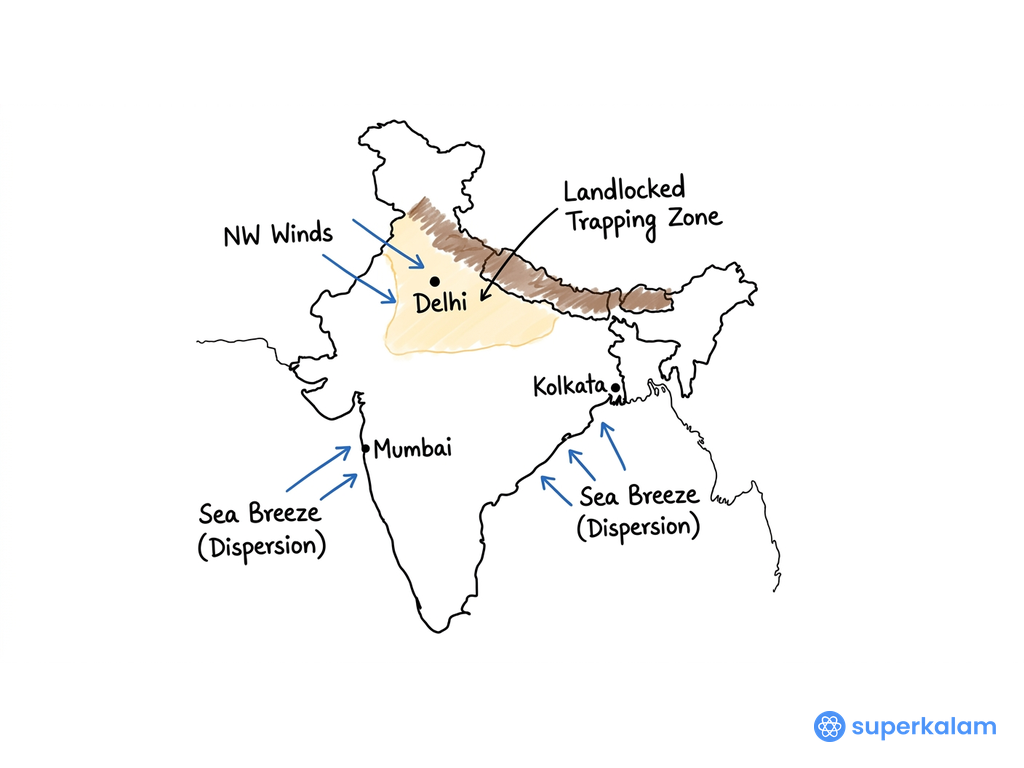
India's Major Cities Map: Delhi Mumbai Kolkata
Geographical and Topographical Disadvantages
- Landlocked Location: Delhi's inland position lacks natural ventilation, unlike coastal Mumbai and Kolkata which benefit from sea breeze circulation that disperses pollutants effectively
- Basin Topography: Surrounded by Aravalli Hills and distant Himalayas, Delhi sits in a natural bowl that traps pollutants with limited escape routes
- Indo-Gangetic Plain Position: Located in the densely populated plain, Delhi receives pollution influx from neighboring industrial regions
- Altitude Factor: Delhi's higher elevation (216m) compared to Mumbai (14m) and Kolkata (17m) affects air circulation patterns
- Urban Heat Island: Extensive concrete development creates temperature variations that worsen pollution concentration
Meteorological Conditions
- Winter Inversions: Cold surface air gets trapped under warm upper air, creating a pollution cap that prevents vertical mixing
- Wind Speed Deficit: Delhi experiences lower average wind speeds (8-12 km/h) compared to Mumbai's coastal winds (15-20 km/h)
- Seasonal Stagnation: Pre-winter months witness atmospheric stagnation with minimal air movement
- Humidity Levels: Lower humidity (60-70%) compared to Mumbai (75-80%) reduces natural pollutant washout
- Temperature Extremes: Sharp seasonal variations affect pollution dispersion mechanisms
Anthropogenic and Regional Factors
- Stubble Burning Impact: Agricultural waste burning in Punjab and Haryana contributes 20-30% of Delhi's winter pollution
- Trans-boundary Pollution: Delhi receives pollutants from entire National Capital Region (NCR) covering 55,000 sq km
- Vehicle Density: Highest per capita vehicle ownership among the three megacities
- Industrial Clustering: Dense industrial activities in surrounding areas like Gurgaon, Faridabad, and Ghaziabad
- Construction Boom: Massive infrastructure projects generate significant particulate matter (PM2.5 and PM10)
Recent Data Comparison (2024):
| City | PM2.5 (µg/m³) | AQI Average |
|---|---|---|
| Delhi | 104.7 | 310-400 |
| Mumbai | 36.1 | 150-200 |
| Kolkata | 44.8 | 180-220 |
Delhi's unique combination of geographical disadvantages, meteorological conditions, and regional pollution sources creates a pollution trap effect. The Commission for Air Quality Management (CAQM) and Graded Response Action Plan (GRAP) represent ongoing efforts to address this complex challenge.
Answer Length
Model answers may exceed the word limit for better clarity and depth. Use them as a guide, but always frame your final answer within the exam’s prescribed limit.
Evaluate this PYQ now
Write your answer & evaluate in just 60 seconds




500+ students evaluated
Model Answers from
- 2015Indian Geography12.5 MarksView Answer
How far do you agree that the behaviour of the Indian monsoon has been changing due to humanising landscape? Discuss.
- 2015Indian Geography12.5 MarksView Answer
The states of Jammu and Kashmir, Himachal Pradesh and Uttarakhand are reaching the limits of ecological carrying capacity due to tourism. Critically evaluate.
- 2015Indian Geography12.5 MarksView Answer
India is well endowed with fresh water resources. Critically examine why it still suffers from water scarcity.
Model Answers by Subject


Crack UPSC with your
Personal AI Mentor
An AI-powered ecosystem to learn, practice, and evaluate with discipline