Minimum Support Price (MSP)- UPSC Notes
Minimum Support Price (MSP) is the minimum assured price at which the government procures crops from farmers. Learn MSP meaning, crops covered, calculation, and issues for UPSC. Read now!
Feb, 2026
•8 min read
Minimum Support Price (MSP) is a key component of India’s agricultural price policy aimed at ensuring remunerative returns to farmers and strengthening food security.
MSP is highly relevant under UPSC Mains GS Paper III (Agriculture). Questions in both Prelims and Mains often examine MSP’s objectives, cost concepts and crops. Let's study this topic in detail
What is Minimum Support Price (MSP)?
Minimum Support Price (MSP) is the minimum price fixed by the Government of India at which it purchases crops from farmers, irrespective of market fluctuations. MSP acts as a price guarantee to farmers to protect them from distress sales and sharp price falls.
The concept of MSP was introduced in the 1960s during the Green Revolution to ensure food security and encourage higher agricultural production. Key objectives of MSP include:
- Ensure remunerative prices to farmers.
- Protect farmers from price volatility.
- Encourage crop diversification.
- Ensure food security for the nation.
- Maintain buffer stock for the Public Distribution System (PDS).
- Support the functioning of the PDS and NFSA.
Historical Background of Minimum Support Price (MSP)
Minimum Support Price (MSP) emerged as a policy response to food shortages, price instability, and farmer distress in the 1960s. India was heavily dependent on food imports and faced recurring droughts. To ensure food security and incentivise farmers to adopt new agricultural technologies, the government introduced a structured price support system.
1. Food Crisis and Policy Shift (Early 1960s)
- India faced severe food shortages and relied on imports under PL-480 from the United States.
- Frequent droughts exposed the vulnerability of Indian agriculture.
- There was an urgent need to incentivise domestic production.
2. Introduction of MSP (1966–67)
- MSP was formally introduced in 1966–67, initially for wheat.
- The main objective was to encourage farmers to adopt High-Yielding Variety (HYV) seeds and modern inputs.
- Later extended to paddy and other crops.
3. Green Revolution Phase
- MSP became a core pillar of the Green Revolution strategy.
- Assured prices reduced the risk for farmers adopting new technology.
- Helped transform India from a food-deficient to a food-surplus nation.
4. Institutional Framework – CACP
- The Commission for Agricultural Costs and Prices (CACP) was established in 1965 (initially as the Agricultural Prices Commission).
- It recommends MSP after analysing production costs, demand-supply trends, and market conditions.
- Renamed as CACP in 1985.
5. Procurement Mechanism – FCI
- The Food Corporation of India (FCI) was set up in 1965.
- Responsible for the procurement, storage, and distribution of food grains.
- Plays a key role in maintaining buffer stocks and implementing the Public Distribution System (PDS).
6. Administrative Oversight
- The Government of India announces MSP under the framework of the Ministry of Agriculture & Farmers Welfare.
- Final approval is given by the Cabinet Committee on Economic Affairs (CCEA).
Also read: Millets: Types, Production, Benefits & Initiatives (UPSC Notes)
Crops Covered Under Minimum Support Price (MSP)
The Government of India announces Minimum Support Price (MSP) for 23 major crops every year before the sowing season. MSP is declared separately for Kharif and Rabi seasons, along with certain commercial crops.
The recommendations are made by the Commission for Agricultural Costs and Prices (CACP) and approved by the Cabinet Committee on Economic Affairs (CCEA).
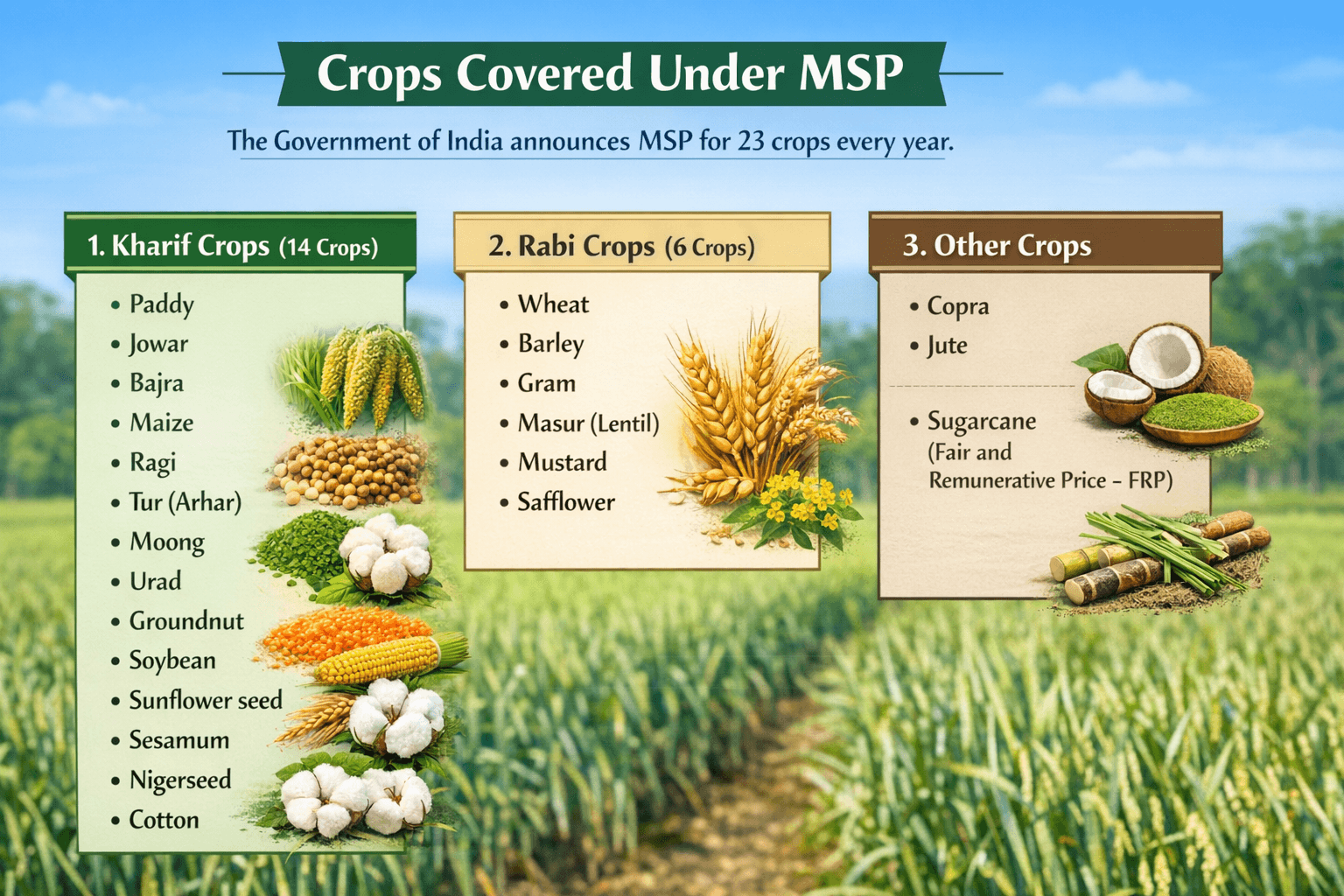
Kharif Crops (14 Crops)
Sown in June–July, harvested in October–November
| S. No. | Crop | Category |
|---|---|---|
| 1 | Paddy | Cereal |
| 2 | Jowar | Cereal |
| 3 | Bajra | Cereal |
| 4 | Maize | Cereal |
| 5 | Ragi | Cereal (Millet) |
| 6 | Tur (Arhar) | Pulse |
| 7 | Moong | Pulse |
| 8 | Urad | Pulse |
| 9 | Groundnut | Oilseed |
| 10 | Soybean | Oilseed |
| 11 | Sunflower Seed | Oilseed |
| 12 | Sesamum | Oilseed |
| 13 | Nigerseed | Oilseed |
| 14 | Cotton | Commercial Crop |
Rabi Crops (6 Crops)
Sown in October–November, harvested in March–April
| S. No. | Crop | Category |
|---|---|---|
| 1 | Wheat | Cereal |
| 2 | Barley | Cereal |
| 3 | Gram (Chana) | Pulse |
| 4 | Masur (Lentil) | Pulse |
| 5 | Mustard | Oilseed |
| 6 | Safflower | Oilseed |
Other Crops (3 Crops)
| S. No. | Crop | Type of Price Support |
|---|---|---|
| 1 | Copra | MSP |
| 2 | Jute | MSP |
| 3 | Sugarcane | Fair and Remunerative Price (FRP) |
Note: Sugarcane is not covered under MSP but under Fair and Remunerative Price (FRP), which is announced separately by the Government of India.
Must read: Rabi and Kharif Crops Examples, Differences and MSP | UPSC Notes
What is Fair and Remunerative Price (FRP)?Fair and Remunerative Price (FRP) is the minimum price fixed by the Government of India for sugarcane, which sugar mills must legally pay to farmers. It is announced annually based on the recommendations of the Commission for Agricultural Costs and Prices (CACP) and approved by the Cabinet Committee on Economic Affairs. Key Features of FRP:
Unlike MSP, which is mainly a procurement-based support system, FRP guarantees payment directly from sugar mills to farmers. |
Also read: UNGA Declares 2026 International Year of the Woman Farmer
How is MSP Determined?
MSP is recommended by the CACP based on these six factors given below:
- Cost of Production: MSP is based on the estimated cost incurred by farmers (A2, A2+FL, C2 concepts) to ensure remunerative returns.
- Demand and Supply: The government assesses domestic production levels and consumption needs to avoid shortages or excess supply.
- Market Price Trends: Prevailing mandi prices and national/international price trends are studied to prevent large deviations from market reality.
- Inter-Crop Price Parity: MSP is fixed to maintain a reasonable price balance among different crops so farmers are not overly incentivised to grow only one crop.
- Terms of Trade between Agriculture and Non-Agriculture: The relative profitability of farming compared to other sectors is considered to ensure agriculture remains economically viable.
- Impact on Consumers and Inflation: MSP decisions account for potential inflationary pressures to balance farmer welfare with consumer interests.
MSP and Food Security
Minimum Support Price (MSP) is a central pillar of India’s food security architecture. MSP supports both producer welfare and consumer protection. Here's how MSP strengthens food security:
- Ensures Stable Income for Farmers: Assured prices reduce the risk of distress sales, encouraging farmers to continue producing essential food grains like wheat and rice.
- Maintains Adequate Buffer Stocks: Procurement at MSP allows the government, through agencies like the Food Corporation of India (FCI), to maintain buffer stocks to tackle droughts, crop failures, and emergencies.
- Supports the Public Distribution System (PDS): Food grains procured under MSP are distributed at subsidised rates through the PDS, ensuring affordable food access for vulnerable populations.
- Enables Implementation of the National Food Security Act, 2013: The National Food Security Act (NFSA) provides legal entitlement to subsidised food grains to nearly two-thirds of India’s population. MSP-backed procurement ensures sufficient supply for this statutory commitment.
UPSC Prelims PYQs on Minimum Support Price (MSP)
QUESTION 1
Consider the following statements:
- The Government of India provides Minimum Support Price for niger (Guizotia abyssinica) seeds.
- Niger is cultivated as a Kharif crop.
- Some tribal people in India use niger seed oil for cooking.
How many of the above statements are correct?
QUESTION 2
Which of the following factors/policies were affecting the price of rice in India in the recent past?
- Minimum Support Price
- Government’s trading
- Government’s stockpiling
- Consumer subsidies
Select the correct answer using the code given below:
QUESTION 3
Consider the following statements:
- In the case of all cereals, pulses and oil-seeds, the procurement at Minimum Support Price (MSP) is unlimited in any State/UT of India.
- In the case of cereals and pulses, the MSP is fixed in any State/UT at a level to which the market price will never rise.
Which of the statements given above is/are correct?
Issues Associated with Minimum Support Price (MSP)
While the Minimum Support Price (MSP) has strengthened India’s food security and farmer income stability, its implementation reveals several structural and economic challenges. It is important to critically examine both the benefits and limitations of MSP for UPSC.
1. Limited Crop Coverage in Practice
- Although MSP is announced for 23 crops, effective and large-scale procurement is concentrated mainly in wheat and rice.
- Pulses, oilseeds, and coarse cereals receive comparatively minimal procurement support.
- This reduces the practical impact of MSP for farmers cultivating non-cereal crops.
2. Regional Imbalance
- MSP procurement is heavily concentrated in a few states, such as Punjab, Haryana, and parts of Madhya Pradesh.
- Farmers in eastern and northeastern states often lack adequate procurement infrastructure.
- This creates an unequal distribution of MSP benefits across regions.
3. Environmental Concerns
- The MSP-driven procurement of wheat and paddy has distorted cropping patterns.
- Excessive rice cultivation in water-scarce states has led to groundwater depletion.
- Intensive monocropping has resulted in soil degradation and declining soil fertility.
- Overuse of fertilisers and stubble burning further aggravate ecological stress.
4. Fiscal Burden on the Government
- The MSP system involves high financial costs.
- Rising procurement leads to a high food subsidy bill.
- Maintaining large buffer stocks increases storage, transportation, and handling expenses.
- Food subsidy forms a major component of the Union Budget.
5. Not a Legal Guarantee
- MSP is an administrative decision, not a statutory right.
- Farmers are not legally entitled to sell all their produce at MSP.
- In many regions, crops are sold below MSP due to a lack of procurement access.
6. Market Distortion
- The current MSP framework may distort agricultural markets.
- It encourages overproduction of certain crops, particularly wheat and rice.
- It can crowd out private traders and reduce the role of competitive markets.
- Crop diversification toward high-value crops is often discouraged.
The challenge is not whether MSP should exist, but how to reform it to make it more inclusive, fiscally sustainable, and environmentally balanced while ensuring farmer income security.
Debate on Legal Status of MSP
There has been a demand to make MSP a legal right for farmers. The issue gained attention during the 2020–21 farm law protests.
Arguments in favour:
- Income security
- Prevention of exploitation
Arguments against:
- Fiscal pressure
- WTO compliance concerns
- Market distortion
MSP and WTO Issues
India's MSP is often questioned at the World Trade Organisation (WTO) under the Agreement on Agriculture.
- Subsidy limits are capped at 10% of production value.
- India demands a permanent solution to public stockholding.
UPSC Mains Practice Question on Minimum Support Price
Critically examine the role of Minimum Support Price (MSP) in ensuring farmers’ income security and food security in India. Suggest reforms.
Evaluate your Answer within 60 SecondsConclusion
Minimum Support Price (MSP) remains a cornerstone of India’s agricultural policy. While it has played a crucial role in ensuring food security and protecting farmers from distress sales, structural issues such as limited procurement, regional imbalance, and fiscal stress require comprehensive reforms. A balanced approach combining price support, income transfers, and market reforms is essential for sustainable agricultural growth.
Start your UPSC Preparation 2026/2027 with SuperKalam
SuperKalam is your personal mentor for UPSC preparation, guiding you at every step of the exam journey. Practice, revise, and evaluate– all in one place.
Download Now