Millets: Types, Production, Benefits & Initiatives (UPSC Notes)
Millets are nutritious, climate-resilient cereals. Learn about types, production, benefits, & govt initiatives, a key topic for UPSC GS-III: agriculture, food security & sustainability.
Jan, 2026
•8 min read
Millets are traditional, climate-resilient crops that have been cultivated in India for centuries. India is the world’s largest producer of millets, with varieties such as jowar, bajra, and ragi grown mainly in dry regions.
Millets are an important topic for UPSC Prelims and Mains under Agriculture, Environment & Ecology, Food Security, and current affairs related to sustainable development and nutrition.
Let’s study this topic in detail!
What are Millets?
Millets are small-grained cereal crops that belong to the grass family and have been cultivated in India for thousands of years. They are officially called "Nutri-Cereals" because of their exceptional nutritional value.
They grow in harsh conditions, require minimal water and inputs, and pack more nutrition than rice or wheat.
- India is the world's largest producer of millets, contributing 38.4% of global millet production.
- The government classifies millets as "Shree Anna" (श्री अन्न) (golden grains) to promote cultural and nutritional recognition.
- The United Nations General Assembly declared 2023 as the International Year of Millets, recognising their importance for food and nutritional security.
- Production reached 180.15 lakh tonnes in 2024-25, an increase of 4.43 lakh tonnes from the previous year.
- Bajra and Ragi are mainly Kharif (monsoon-grown) crops, while Jowar is more flexible as it grows in both Kharif (rainfed) and Rabi (irrigated) seasons.
- Millets are rich in protein, vitamins and minerals and are naturally gluten-free.
- They have a low glycaemic index, making them suitable for people with diabetes and celiac disease.
Also read: Western Ghats of India: UPSC Notes
Types of Millets
India cultivates several millet varieties, each adapted to different climatic zones and soil conditions.
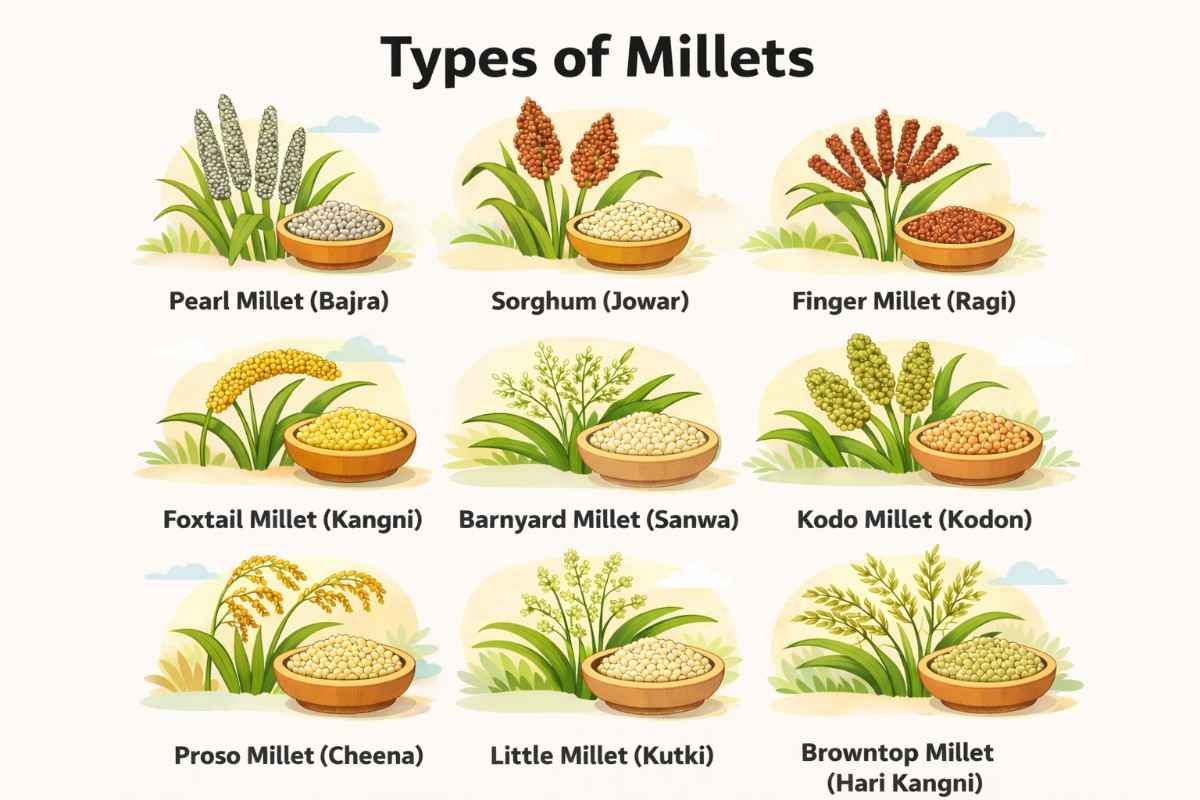
1. Pearl Millet (Bajra)
- Climate: Thrives in warm, dry conditions with 40-50 cm annual rainfall.
- Temperature: Requires a temperature range of 20-30°C for optimal growth.
- Soil: Grows well in sandy soils and shallow black soil.
- Largest Producer: Rajasthan is the largest producer of bajra in india.
- Characteristics: Drought-resistant, short-duration crop (70-90 days)
2. Sorghum (Jowar)
- Climate: Prefers warm, arid regions receiving 45-100 cm of rainfall.
- Temperature: Requires 20-35°C during the Kharif season and 15°C during the Rabi season.
- Soil: Sandy loam with good drainage; pH 6-7.5.
- Largest Producer: Maharashtra dominates jowar cultivation.
- Characteristics: Dual-purpose crop (grain and fodder), 110-120 days duration.
3. Finger Millet (Ragi)
- Climate: Grows in high altitudes with extreme conditions.
- Temperature: Requires 25-30°C and a dry spell during grain ripening.
- Rainfall: Needs 70-120 cm annually.
- Soil: Adaptable to red, black, sandy, and lateritic soils; pH 4.5-8.
- Largest Producer: Karnataka produces most of India's ragi
- Characteristics: Highest calcium content among cereals, excellent for children and the elderly.
4. Foxtail Millet (Kangni)
- Climate: Warm, arid tropical regions
- Rainfall: 50-75 cm annually
- Temperature: 15-30°C range
- Soil: Sandy loam; pH 5.5-7
- Largest Producer: Andhra Pradesh leads production
5. Barnyard Millet (Sanwa)
- Climate: Tropical and sub-tropical regions up to 2100m altitude
- Rainfall: 60-80 cm annually
- Temperature: 18-27°C
- Soil: Sandy loam to loamy with organic matter; pH 5.5-7.5
- Largest Producer: The Himalayan hills region
6. Kodo Millet (Kodon)
- Climate: Warm, dry conditions; extremely drought-tolerant
- Rainfall: 50-60 cm annually
- Temperature: 26-29°C
- Soil: Gravelly, stony, hilly terrain; pH 5.5-7.5
- Largest Producer: Madhya Pradesh
7. Proso Millet (Cheena)
- Climate: Warm, arid, non-irrigated regions
- Rainfall: 20-50 cm annually
- Temperature: Wide range of 10-45°C
- Soil: Adaptable to many soil types; pH 5.5-6.5
- Largest Producer: Madhya Pradesh
8. Little Millet (Kutki)
- Climate: Warm, humid conditions
- Characteristics: Short duration (60-90 days), suitable for intercropping
9. Browntop Millet (Hari Kangni)
- Climate: Warm, dry conditions
- Characteristics: Excellent for soil conservation, prevents erosion
Also read: Circular Economy: Meaning, Significance and Benefits [UPSC]
Production of Millets in India: Recent Developments
The Indian millet sector has experienced remarkable growth over the past few years, transforming into a national priority.
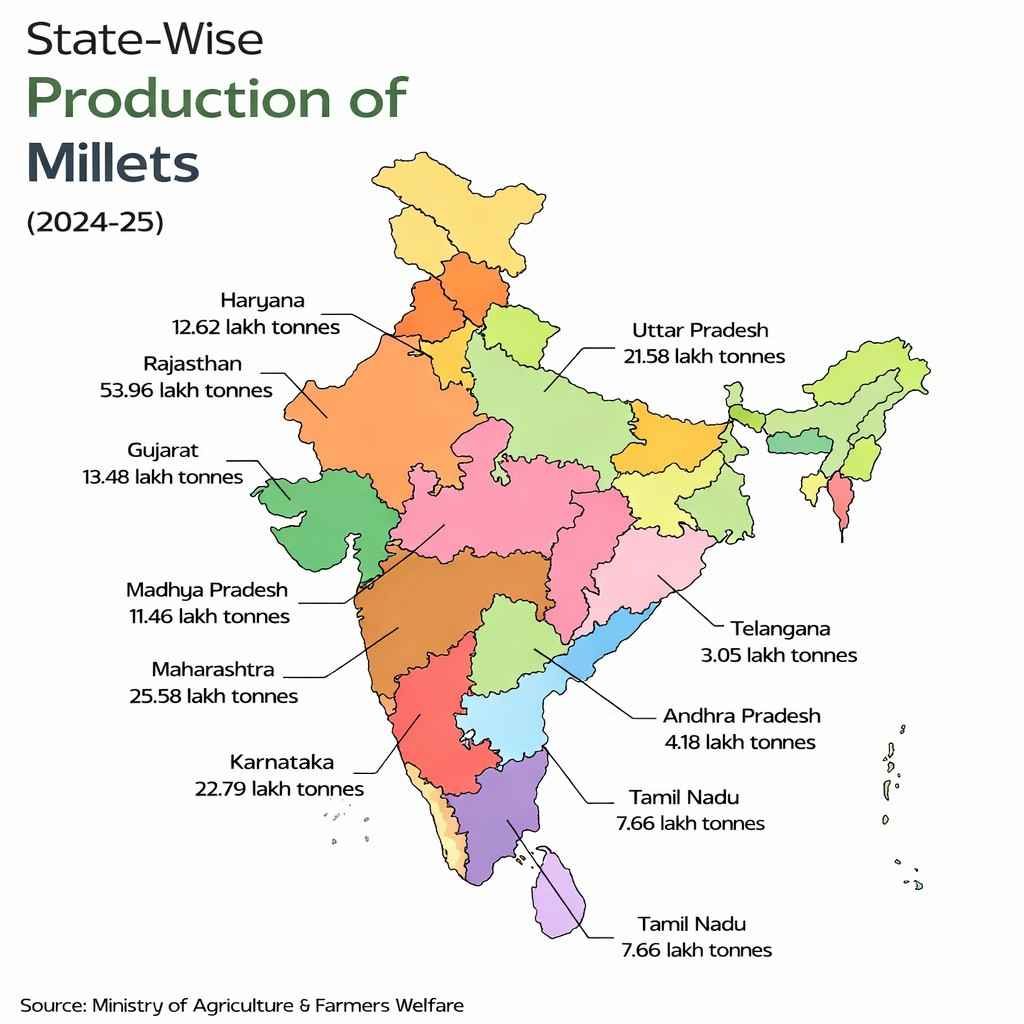
- India produced 180.15 lakh tonnes during 2024-25, recording a growth of 4.43 lakh tonnes year-on-year.
- Rajasthan remains the largest producer, generating approximately 29.86% of the total national output.
- State-wise contribution shows Rajasthan (53.96 lakh tonnes), Maharashtra (25.58 lakh tonnes), and Karnataka (22.79 lakh tonnes).
- The nation exported 89,164.96 tonnes of millets valued at USD 37 million in 2024-25.
- Productivity across the country averages around 1,200-1,400 kg per hectare, though this remains below potential.
Also read: El NINO and LA NINA UPSC Notes: Meaning, Impact and Important Terms
Health Benefits of Millets: Nature's Nutritional Powerhouse
Millets deliver concentrated nutrition in every serving, making them exceptional for addressing India's persistent malnutrition challenges, particularly among children and women.
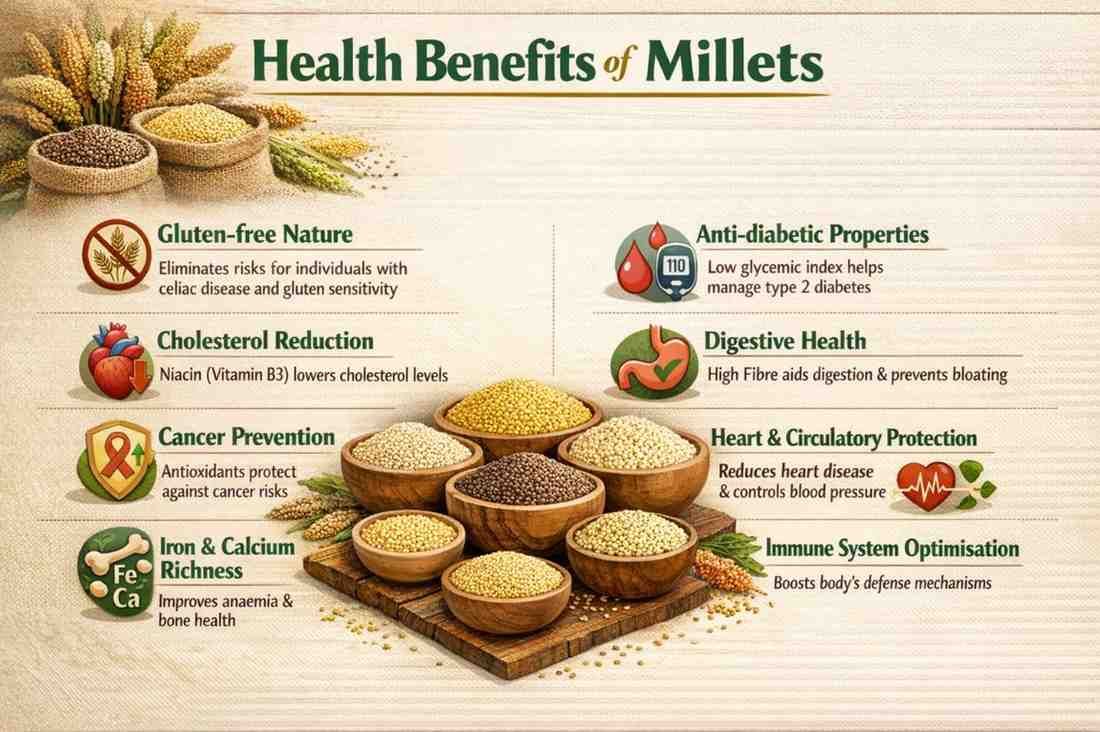
- Gluten-free Nature: Eliminates risks for individuals with celiac disease and gluten sensitivity
- Anti-diabetic Properties: The low glycemic index prevents sudden blood sugar spikes, helping manage type 2 diabetes effectively
- Cholesterol Reduction: Niacin (Vitamin B3) content actively lowers cholesterol levels, protecting cardiovascular health
- Digestive Health: High fibre content aids digestion, prevents constipation, and eliminates bloating and gas-related discomfort
- Cancer Prevention: Antioxidant compounds provide protective effects against various cancer risks
- Heart and Circulatory Protection: Regular consumption reduces the risk of heart disease and manages blood pressure
- Iron and Calcium Richness: Addresses anaemia and bone health concerns across all age groups.
- Immune System Optimisation: Mineral composition strengthens the body's defence mechanisms.
Also read: Make in India UPSC Notes: Pillars, Objectives, and Key Infrastructure Schemes
Government Initiatives to Promote Millets in India
The government treats millet promotion as a multi-stakeholder mission, implementing schemes across production, processing, and consumption value chains.
1. National Food Security & Nutrition Mission (NFSNM)
The National Food Security Mission (NFSM) was renamed the National Food Security & Nutrition Mission (NFSNM) during the 2024-25 fiscal year to reflect its broader nutrition focus.
- The scheme operates across 28 States and two Union Territories (Jammu & Kashmir and Ladakh).
- NFSNM supports the production of four major millet types:
- Jowar (sorghum)
- Bajra (pearl millet)
- Ragi (finger millet)
- Small millets (kutki, kodo, barnyard millet, foxtail millet, proso millet, browntop millet)
- The mission delivers support through state governments in these areas:
- Distribution of certified seeds and hybrid varieties
- Modern farm equipment supply
- Water management technologies (drip irrigation, sprinkler systems)
- Soil health and plant protection inputs
- Training programs on improved farming practices
- Cluster-based demonstrations
- Formation of Farmer-Producer Organisations (FPOs)
2. Prime Minister Dhan-Dhaanya Krishi Yojana (PMDDKY)
The Union Cabinet approved this scheme on 16 July 2025 as a flagship six-year agricultural initiative.
- Districts Covered: 100 districts selected based on:
- Low agricultural productivity
- Low cropping intensity
- Low credit disbursement rates
- The scheme converges 36 existing government schemes across 11 ministries.
- Under this convergence, NFSM-Nutri Cereals and PM RKVY provide direct support for millet cultivation through:
- Crop diversification initiatives
- Provision of seeds and equipment
- Credit support
- Post-harvest storage infrastructure
- Irrigation development
3. Minimum Support Price (MSP) for Millets
The government guarantees minimum purchase prices for millets from farmers, protecting them against market price fluctuations.
- MSP Formula: Fixed at a minimum of 1.5 times the cost of production.
- Purpose: Guarantee remunerative prices and protect farmers from market fluctuations.
4. PM POSHAN Shakti Nirman (Mid-Day Meal Scheme)
The PM POSHAN scheme is being implemented by the Ministry of Education.
- Millet Inclusion: Government advisory to include Shree Anna (millets) at least once weekly.
- Approach: "Vocal for Local" prioritises locally grown millets.
- Impact: Supports both child nutrition and farmer incomes.
5. Production Linked Incentive for Millet‑Based Products (PLISMBP)
Production Linked Incentive Scheme for Millet-Based Products (PLISMBP) was introduced to encourage:
- The use of millets in branded Ready‑to‑Eat (RTE) and Ready‑to‑Cook (RTC) products.
- To encourage value addition in millet-based food items by supporting their manufacture for both domestic and export markets.
- To connect millet growers with food processors by boosting production demand for the grain.
6. Export Promotion Measures
Export Promotion Forum (EPF): Dedicated platform for stakeholders to collaborate and explore global markets.
- APEDA Support: Provides assistance for infrastructure development, quality certification, and market development.
- Global Campaign: Virtual trade fair operational 24/7; participation in international fairs like BIOFACH Germany, Gulfood Dubai.
UPSC Prelims PYQ on Millets
QUESTION 1
With reference to ‘Initiative for Nutritional Security through Intensive Millets Promotion’, which of the following statements is/are correct?
- This initiative aims to demonstrate the improved production and post-harvest technologies and to demonstrate value addition techniques, in an integrated manner, with a cluster approach.
- Poor, small, marginal and tribal farmers have a larger stake in this scheme.
- An important objective of the scheme is to encourage farmers of commercial crops to shift to millet cultivation by offering them free kits of critical inputs of nutrients and micro-irrigation equipment.
Select the correct answer using the code given below.
Challenges Faced by Millets in India
Despite growing momentum, millet farmers and producers confront significant hurdles that limit expansion and profitability.
- Water Stress and Drought: Unpredictable monsoons and erratic rainfall patterns damage crops, particularly during critical growth stages.
- Low Soil Fertility: Sandy soils traditionally used for millet cultivation lack organic matter and essential nutrients like nitrogen and phosphorus.
- Soil Salinity Issues: High salt concentrations in certain regions restrict cultivation expansion.
- Limited Market Linkages: Farmers struggle to access organised buyers and fair pricing mechanisms.
- Poor Post-harvest Infrastructure: Inadequate processing facilities and storage capacity lead to significant losses.
- Transportation Difficulties: Inadequate road and logistics networks delay supply and increase costs.
UPSC Mains Previous year Practice Question
Explain the role of millets for ensuring health and nutritional security in India. (2024)
Evaluate Your Answers nowWay Forward
India must institutionalise millet production and consumption to achieve food security and nutritional targets by 2030.
- Establish processing units and manufacturing hubs in every major millet-producing region to create high-margin employment.
- Guarantee fair prices for all millet varieties, not just major crops, to incentivise farmer participation.
- Develop climate-resilient varieties through intensive breeding programs addressing future temperature and rainfall scenarios.
- Encourage youth entrepreneurs to build D2C millet brands and modern food products.
Unlock your UPSC Success with SuperKalam
Get instant doubt clearance, customised study plans, unlimited MCQ practice, and fast Mains answer feedback.
Join thousands of aspirants learning with India’s AI-powered mentor today!