Western Ghats of India: UPSC Notes
Western Ghats are India’s ancient biodiversity hotspot, crucial for monsoon, rivers, climate, and environment—comprehensive UPSC notes for Prelims and Mains preparation. Click now!
Jan, 2026
•8 min read
“The Western Ghats are the living spine of India’s ecological security.”
Running parallel to India’s western coast, the Western Ghats are one of the world’s oldest mountain ranges. They are a global biodiversity hotspot and a key regulator of the Indian monsoon. Major rivers, forests, and diverse livelihoods support the region.
For UPSC, the Western Ghats are important for Prelims and Mains under Indian Geography, Environment & Ecology, and current affairs related to conservation and sustainable development.
Let’s study this topic in detail!
About the Western Ghats of India
The Western Ghats are a mountain range running parallel to the western coast of India. They are renowned for their rich biodiversity, unique landscapes, and significant impact on climate and human life.
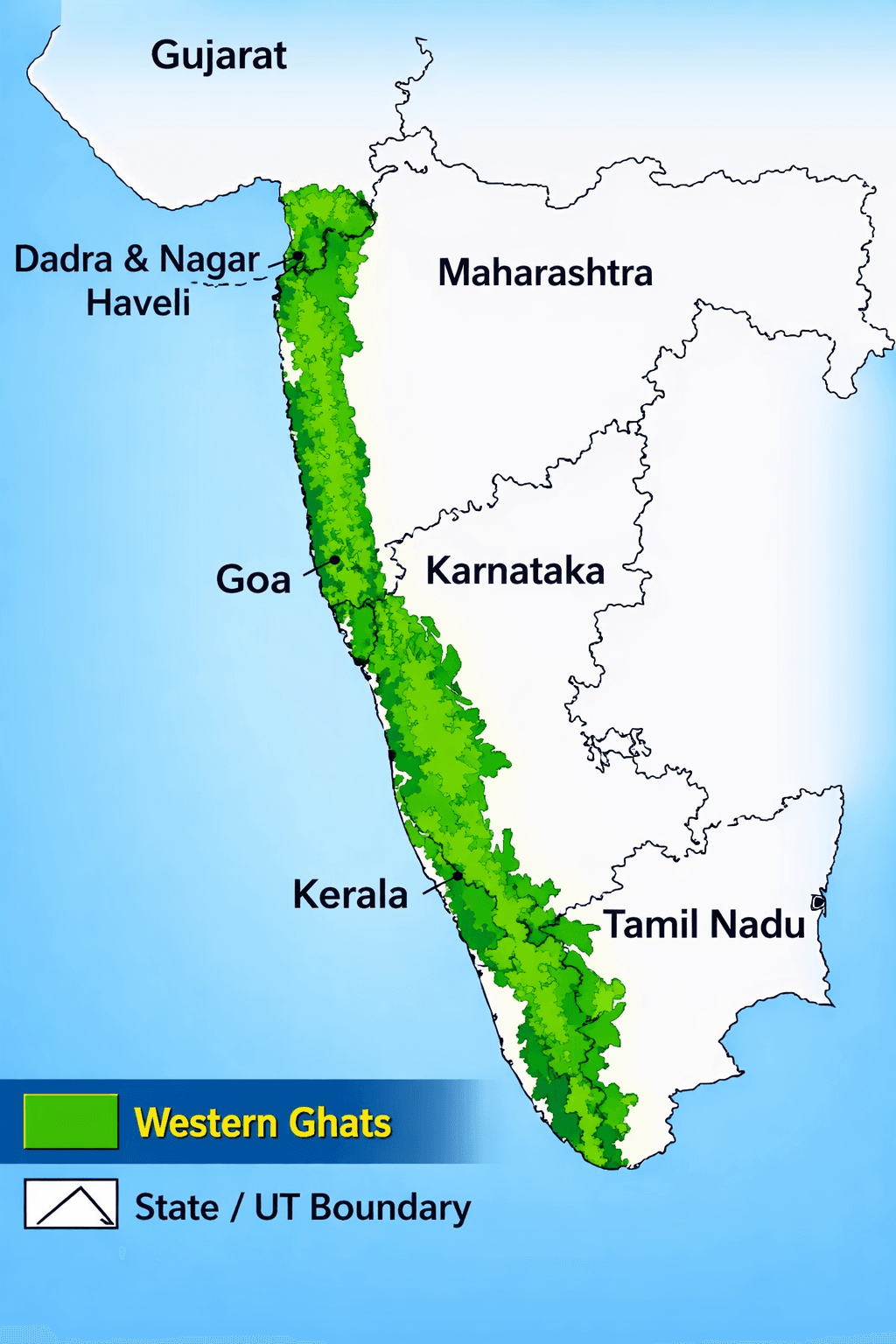
- The Western Ghats are also called Sahyadri Hills in northern Maharashtra and Sahya Parvatham in Kerala.
- They extend for about 1,600 km from the Tapi Valley in Gujarat to Kanyakumari in Tamil Nadu.
- The range passes through six states: Gujarat, Maharashtra, Goa, Karnataka, Kerala, and Tamil Nadu.
- The Western Ghats are older than the Himalayas and were formed during the breakup of the Gondwana landmass.
- In Tamil Nadu, the southern part of the range is known as Nilgiri Malai.
- The narrow coastal plain between the Western Ghats and the Arabian Sea is regionally divided:
- The northern part is called the Konkan Coast.
- The central part is known as the Kanara Coast.
- The southern part is called the Malabar Coast or Malabar region.
- The foothill region east of the Ghats in Maharashtra is known as Desh.
- The eastern foothills of central Karnataka are called Malanadu.
Understanding the Geology of the Western Ghats
The geology of the Western Ghats explains their unique structure, age, and landscape features. Their origin is explained through two main geological views:
- One view suggests that the Western Ghats are block mountains, formed due to the downwarping of a part of the Indian landmass towards the Arabian Sea.
- According to another view, the Western Ghats are not true mountains but represent the faulted western edge of the Deccan Plateau.
Formation of the Western Ghats
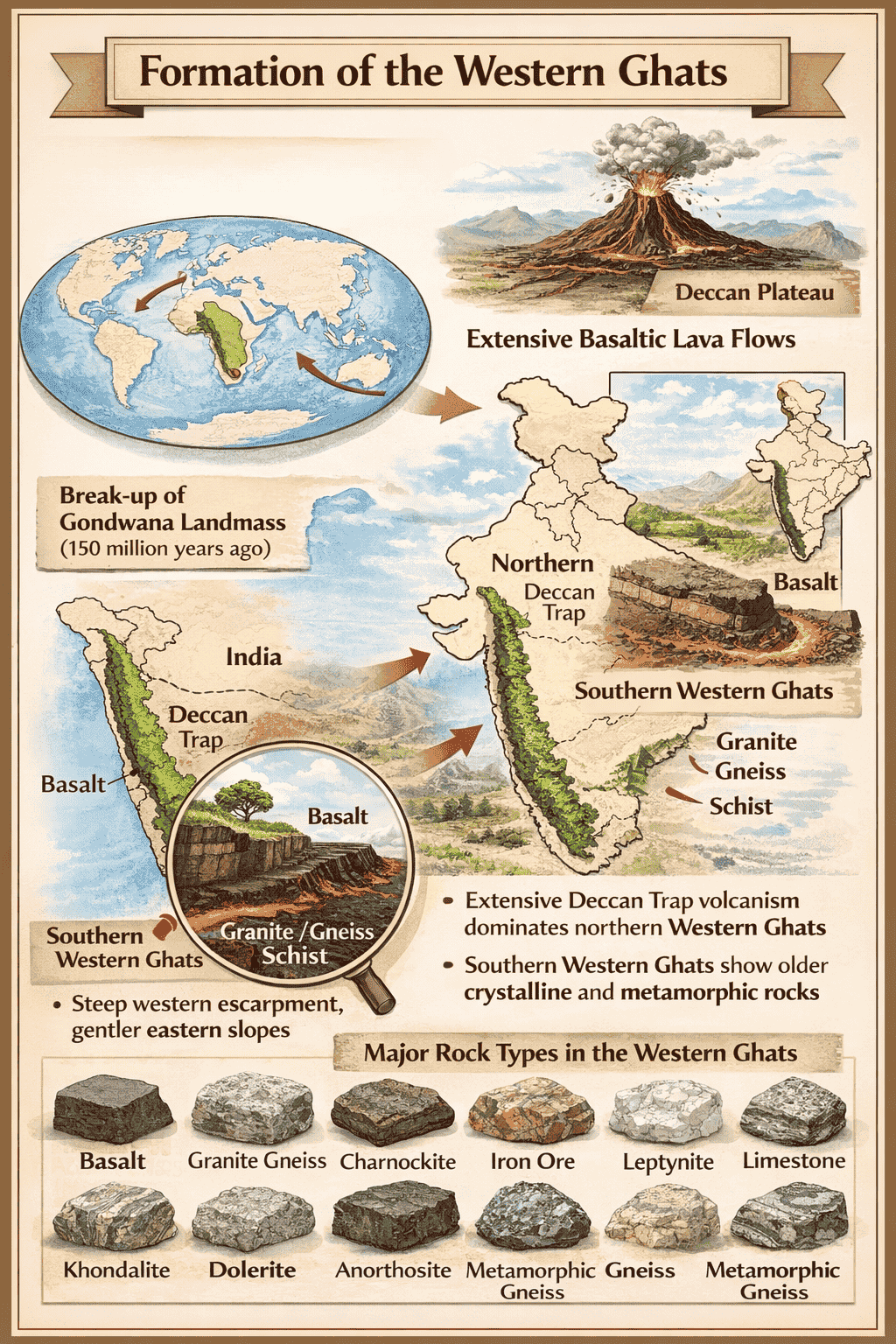
- The Ghats were formed mainly during the breakup of the Gondwana landmass and the volcanic activity of the Deccan Traps.
- Extensive basaltic lava flows from Deccan Trap volcanism dominate the northern Western Ghats.
- The southern Western Ghats show older crystalline and metamorphic rocks, indicating greater geological age.
- Major rock types found in the region include basalt, charnockites, granite gneiss, khondalites, leptynite, and metamorphic gneisses.
- There are also detached occurrences of crystalline limestone, iron ore, dolerites, and anorthosites in some areas.
- The presence of hard, resistant rocks contributes to the steep western escarpment and gentler eastern slopes.
Basic Topography of the Western Ghats
The Western Ghats are a complex physical and ecological system. Their topography, river systems, climate, vegetation, and wildlife together explain their national and global importance.
1. Geographical Extent and Location
- The Western Ghats extend from the Satpura Range in the north and run southwards past Goa, through Karnataka, Kerala, and Tamil Nadu, finally ending at Kanyakumari, embracing the Indian Ocean.
- They form a continuous chain of mountains running parallel to India’s western coast.
- The range lies about 30–50 km inland from the Arabian Sea.
- The Western Ghats stretch for nearly 1,600 km and cover an area of about 1,40,000 km².
2. Major Mountain Ranges and Peaks
- The Nilgiri Hills, located southeast of Mysore in Karnataka, are a key part of the Western Ghats.
- The Nilgiris meet the Shevaroy (Servarayan) Range and the Tirumala Range further east.
- This linkage forms a natural connection between the Western Ghats and the Eastern Ghats.
- Anamudi Peak (Kerala) is the highest peak of the Western Ghats and also the highest peak in India outside the Himalayan region.
3. Important Hill Stations
The Western Ghats are known for their pleasant climate and scenic hill stations, many of which are popular tourist and ecological centres:
- Matheran
- Lonavala–Khandala
- Mahabaleshwar
- Panchgani
- Amboli Ghat
- Kudremukh
- Kodagu (Coorg)
River Systems of the Western Ghats
The Western Ghats are the source of several important rivers that drain both westward and eastward.
(a) West-Flowing Rivers:
Periyar, Bharathappuzha, Netravati, Sharavathi, Mandovi
- These rivers are short and fast-flowing due to the steep gradient and short distance to the sea.
- Because of this steep slope, the Western Ghats are highly suitable for hydroelectric power generation.
(b) East-Flowing Rivers
Godavari, Krishna, and Kaveri
- Important tributaries include Tunga, Bhadra, Bhima, Malaprabha, Ghataprabha, Hemavathi, Kabini, etc.
- These rivers are longer and slower-moving and eventually merge into large river systems like the Krishna and Kaveri.
Climate and Vegetation
The Western Ghats strongly influence the Indian monsoon system. Here’s how:
- They act as a climatic barrier, intercepting the south-west monsoon winds and causing heavy rainfall on the western slopes.
- The region contains some of the best examples of non-equatorial tropical evergreen forests in the world.
Vegetation Pattern
| Slope | Type of Forest | Major Tree Species |
|---|---|---|
| Western Slopes | Tropical & subtropical moist evergreen forests | Rosewood, Mahogany, Cedar |
| Eastern Slopes | Moist and dry deciduous forests | Teak, Sal, Shisham, Sandalwood |
The western slopes remain green throughout the year due to high rainfall.
- Trees in these regions do not have a fixed leaf-shedding season.
- The eastern slopes receive less rainfall, leading to deciduous forest cover.
Wildlife and Biodiversity of Western Ghats
The Western Ghats are one of the eight global biodiversity hotspots. Many species found here are endemic, meaning they are found nowhere else in the world.
Important Faunal Species
- Small carnivores include Nilgiri marten, brown palm civet, stripe-necked mongoose, Indian brown mongoose, small Indian civet, and leopard cat.
- Endemic species include the Nilgiri tahr (Hemitragus hylocrius) and the lion-tailed macaque (Macaca silenus).
Globally Threatened Species
At least 325 globally threatened species (IUCN Red Data List) occur in the Western Ghats:
229 plant species
- 31 mammal species
- 15 bird species
- 43 amphibian species
- 5 reptile species
- 1 fish species
Also see: El NINO and LA NINA UPSC Notes: Meaning, Impact and Important Terms
Protected Areas in the Western Ghats
The Western Ghats host two Biosphere Reserves, 13 National Parks, several Wildlife Sanctuaries, and numerous Reserve Forests.
Nilgiri Biosphere Reserve
It is the largest contiguous protected area in the Western Ghats. It includes:
- Evergreen forests of Nagarahole
- Deciduous forests of Bandipur National Park and Nugu (Karnataka)
- Wayanad (Kerala)
- Mudumalai National Park (Tamil Nadu)
Silent Valley National Park
- Located in Kerala, it is one of the last remaining tracts of virgin tropical evergreen forest in India.
- It is globally important for biodiversity conservation and ecological research.
Also read: National Parks in India for UPSC: Complete List and Key Facts
UPSC Prelims Practice MCQ on Western Ghats of India
QUESTION 1
Consider the following statements:
- Amarkantak Hills are at the confluence of Vindhya and Sahyadri Ranges.
- Biligirirangan Hills constitute the easternmost part of Satpura Range.
- Seshachalam Hills Constitute the southernmost part of Western Ghats.
How many of the statements given above the correct?
Significance of the Western Ghats
The Western Ghats are one of the most ecologically important regions of India. The multidimensional importance of the ghats is frequently asked in UPSC Prelims, Mains, and Essay papers.
1. Role in Climate Regulation and Monsoon System
- The Western Ghats act as a climatic barrier to the south-west monsoon winds.
- They force moisture-laden winds to rise, causing orographic rainfall on the western slopes.
- This rainfall sustains agriculture, forests, rivers, and groundwater in peninsular India.
- The dense forest cover helps in carbon sequestration and moderates regional temperatures.
Example: Heavy rainfall along the Konkan and Malabar coasts is directly linked to the presence of the Western Ghats.
2. Water Security and River Systems
- The Western Ghats are the source region of major peninsular rivers, both east-flowing and west-flowing.
- Forested catchments help in groundwater recharge and reduce soil erosion.
Example: The Kaveri River, originating in the Western Ghats, supports millions of farmers in Karnataka and Tamil Nadu.
3. Hydroelectric and Energy Importance
- The steep slopes and fast-flowing rivers of the Western Ghats make them ideal for hydroelectric power generation.
- Several major dams and projects are located in this area, contributing to regional energy security.
Example: The Sharavathi Hydroelectric Project in Karnataka is one of the major power-generating stations in South India.
4. Agricultural and Livelihood Support
- The Western Ghats support plantation agriculture, including tea, coffee, rubber, spices (pepper, cardamom), and arecanut.
- Fertile soils, high rainfall, and a suitable climate benefit both subsistence and commercial farming.
- Forest-based livelihoods, such as the collection of non-timber forest products (NTFPs), sustain tribal and rural communities.
Example: Kodagu (Coorg) is globally known for coffee cultivation due to the favourable conditions created by the Western Ghats.
5. Cultural, Social, and Historical Value
- The Western Ghats have been home to tribal and indigenous communities such as the Todas, Kattunayakan, Kurumba, and others.
- Many sacred groves and forest patches are protected through traditional beliefs and practices.
- Rivers originating in the Ghats are deeply linked with religious and cultural traditions.
Example: Sacred groves in Kerala and Karnataka have helped conserve rare plant and animal species for centuries.
6. Economic and Tourism Value
- The scenic landscapes of the Western Ghats attract eco-tourism and hill tourism.
- Hill stations like Mahabaleshwar, Munnar, Ooty, and Coorg generate employment and regional income.
- Nature-based tourism promotes awareness about conservation when managed sustainably.
Example: Munnar is a major tourist destination known for tea gardens, biodiversity, and a cool climate.
7. Disaster Regulation and Environmental Stability
- Dense forests of the Western Ghats help in preventing soil erosion, landslides, and floods by stabilising slopes.
- Healthy ecosystems act as natural buffers against extreme rainfall events.
- The degradation of forests has been linked to an increase in frequent floods and landslides in recent years.
Example: Floods and landslides in Kerala highlight the protective role of intact forest cover in the Western Ghats.
Threats to the Western Ghats of India
Despite their immense ecological value, the Western Ghats are under severe pressure due to human activities and developmental interventions. Here’s why:
- Deforestation and Forest Degradation: Large-scale clearing of forests for agriculture, plantations, infrastructure, and settlements has fragmented habitats.
- Mining and Quarrying: Illegal and unregulated mining, especially for iron ore and bauxite, leads to land degradation and water pollution.
- Hydroelectric and Large Infrastructure Projects: Dams, roads, railways, and power lines disturb fragile ecosystems and displace wildlife.
- Urbanisation and Tourism Pressure: Unplanned urban growth and mass tourism lead to waste generation, water stress, and habitat destruction.
- Agricultural Expansion and Monoculture Plantations: Replacement of native forests with rubber and eucalyptus plantations.
- Climate Change: Changing rainfall patterns, rising temperatures, and extreme weather events threaten sensitive species and ecosystems.
- Invasive Alien Species: Non-native species outcompete indigenous flora and fauna. Spread of Lantana camara affecting forest regeneration.
- Poaching and Illegal Wildlife Trade: Wildlife is threatened due to hunting and illegal trade. Poaching of endangered species like the Nilgiri tahr.
Must cover this latest news: Aravali Range in News [UPSC 2025]
UPSC Mains Practice Question on Western Ghats of India
Why are the Western Ghats considered ecologically significant for India? Briefly discuss the major threats they face and suggest measures for their conservation.
Evaluate Your Answer within 60 SecondsHow to Save the Western Ghats from Destruction?
Protecting the Western Ghats requires a balanced approach that integrates conservation with sustainable development.
- Strict Implementation of Environmental Laws: Enforce the Forest Conservation Act, the Wildlife Protection Act, and the Environmental Impact Assessment norms effectively.
- Sustainable Development Planning: Promote eco-sensitive zone (ESZ) regulations to limit harmful activities in fragile areas.
- Control on Mining and Quarrying: Ban illegal mining and adopt scientific, regulated extraction where unavoidable.
- Promoting Sustainable Tourism: Encourage eco-tourism with limits on tourist numbers and strict waste management.
- Community Participation and Livelihood Support: Involve local and tribal communities in conservation through incentives and alternative livelihoods.
- Restoration and Afforestation: Restore degraded forest areas using native species rather than monocultures.
- Climate-Resilient Conservation Strategies: Integrate climate adaptation measures such as watershed management and slope stabilisation.
- Scientific Monitoring and Research: Use GIS, remote sensing, and biodiversity monitoring to assess ecological changes.
“Save the Western Ghats today, or pay the price of floods, droughts, and biodiversity loss tomorrow.”
Start your UPSC Preparation with SuperKalam
Your Personal AI Mentor that teaches, instantly evaluates handwritten answers & builds daily discipline
Download the App Now