Aravali Range in News [UPSC 2025]
Aravalli Range, one of the world’s oldest mountain ranges, is in the news due to the Aravali Green Wall Project. Read now for Prelims & Mains (GS Paper I & III) preparation.
Dec, 2025
•4 min read
Why in the News?
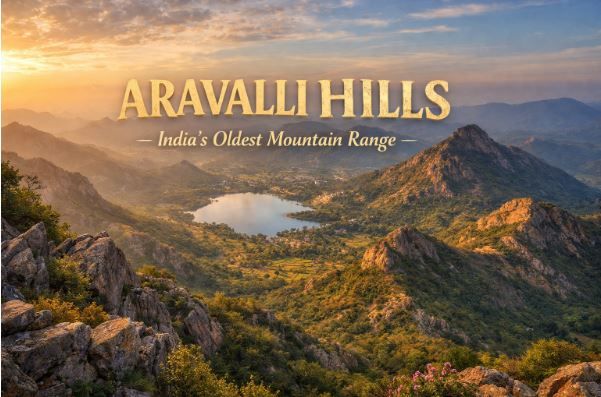
In November 2025, the Supreme Court ruled that all land above 100 metres in height is part of the Aravali Hills, and new mining is not allowed there. At the same time, the government is developing the 1,400 km Aravali Green Wall Project to stop the Thar Desert from spreading eastwards.
Why Cover this Topic for UPSC?
- High relevance for Prelims & Current Affairs
- GS Paper I: Indian Geography (conceptual + map-based linkage)
- GS Paper III: Environment, Ecology & Sustainable Development
- Ethics Paper (GS IV): Human–nature relationship, intergenerational equity
- Essay Paper: Environment, development, ethics, climate resilience themes
About Aravali Hills
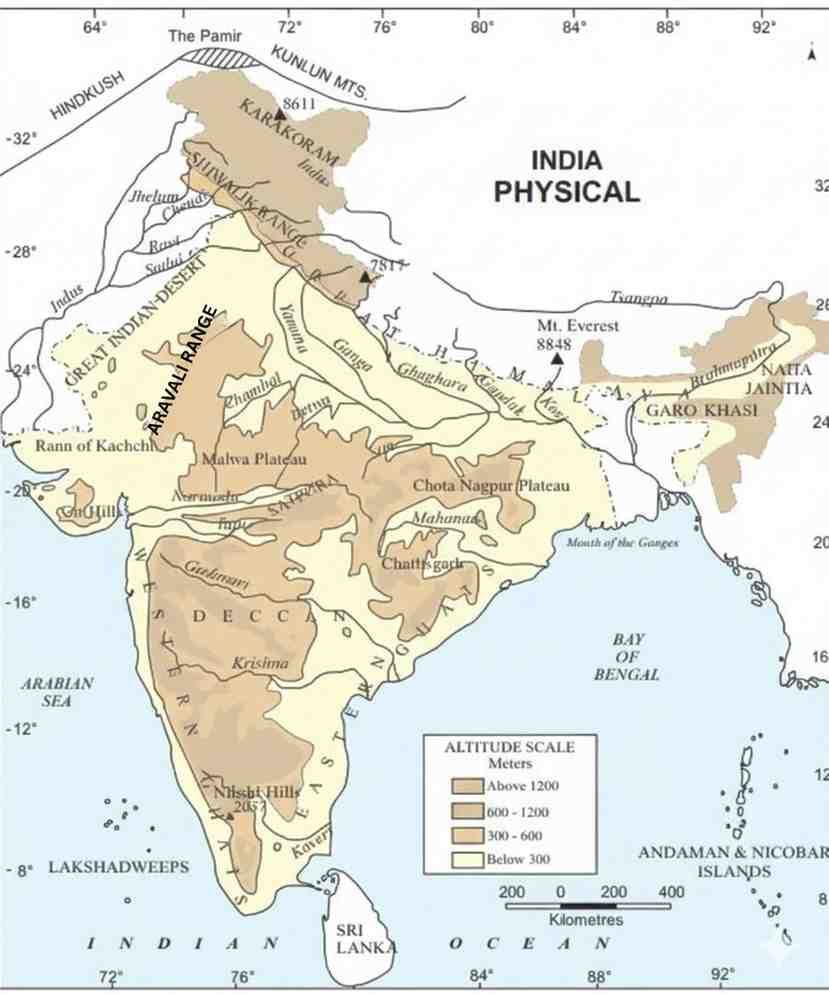
The Aravalli Range is the world's oldest fold mountain system, spanning approximately 700 kilometres across four Indian states: Delhi, Haryana, Rajasthan, and Gujarat.
It is an ancient mountain chain that acts as a natural barrier protecting northern India from desertification and plays a crucial role in maintaining the region's water systems and biodiversity.
- One of the oldest fold mountain ranges in the world, older than the Himalayas.
- The range forms the physiographic boundary between the Thar Desert and the Indo-Gangetic Plains.
- Guru Shikhar (1,722 meters) in Mount Abu, Rajasthan, is the highest peak of the Aravalis.
- The Aravallis influence monsoon patterns by blocking moisture-laden winds, causing rainfall on its eastern side.
Also read: National Pollution Control Day 2025: History, Significance, Theme & Relevance for UPSC
Formation of the Aravalli Range
The Aravalli Range is one of the oldest fold mountain systems in the world, formed during the Proterozoic Era. It represents a highly eroded, ancient orogenic belt in north-western India.
Process of Formation
1. Proterozoic Era (≈ 3.2 to 1.8 billion years ago)
- The Aravalli Range originated during the Proterozoic Aeon, one of the earliest phases of Earth’s geological history.
- This era witnessed the formation of the first stable continental crust (cratons).
- The Aravallis are much older than the Himalayas, making them among the oldest fold mountains in the world.
2. Orogeny (Mountain-Building Process)
- The range was formed through orogeny, a process involving tectonic plate collision, compression, and folding.
- The Bundelkhand Craton collided with the Marwar Craton, both being ancient continental blocks.
- This collision led to intense folding, faulting, and uplift of sedimentary and volcanic rocks.
- The mountain-building event is known as the Aravalli–Delhi Orogeny.
As a result, a long, linear fold mountain system, the Aravalli Range, was created.
3. Rock Composition
The Aravalli Range is primarily composed of ancient rocks that have been transformed over billions of years:
- Granite: A hard, crystalline rock formed from molten magma.
- Gneiss: A banded metamorphic rock created under intense heat and pressure.
- Schist: Another metamorphic rock with visible mineral layers.
- Quartzite: Extremely hard rock formed from compressed sand.
- Marble: Beautiful metamorphic rock sometimes found in special areas.
4. The Aravalli Supergroup - Geological Layers
- Beneath and within the main Aravalli Range lies the Aravalli Supergroup, which consists of:
- Multiple layers of sedimentary and metamorphic rocks.
- Evidence of ancient water-based sedimentation (showing that this area was once underwater).
- Fossil records include stromatolites (ancient structures created by living organisms).
- Lead-zinc mineral deposits formed in these layers.
5. Erosion Over Time – Why the Aravallis Are Shorter Today
- The Aravalli Range was once much higher, possibly comparable to or taller than the Alps.
- Over 1–2 billion years, prolonged erosion by water, wind, and weathering processes reduced their height.
- Continuous denudation removed the softer rock layers faster than the harder ones.
- Presently, the range has an average elevation of about 600 metres.
- This long erosional history has given the range its rounded hills and subdued relief.
6. Structure – Why the Range Is Discontinuous
The Aravalli Range does not form a single continuous mountain chain.
- It consists of disconnected ridges, isolated hills, and residual ranges.
- These are separated by valleys, plains, and basins.
The discontinuous nature is due to:
- Geological faulting (fracturing of the Earth’s crust),
- Tectonic disturbances, and
- Differential erosion over millions of years.
- Harder rocks resisted erosion, forming ridges, while softer rocks were eroded into plains.
Also read: Ethanol Blending in India: E20 Policy, Benefits, Implementation, and Challenges
Rivers Flowing from the Aravalli Range
The Aravalli Range acts as an important watershed in western India, giving rise to several rivers that flow both eastward and westward.
1. BANAS RIVER
- Originates from the Khamnor Hills, Aravalli Range (Rajsamand district, Rajasthan).
- Joins the Chambal River
- Called "Van Ki Asha" (Hope of Forest)
2. LUNI RIVER
- Originates from the western slopes of the Aravalli (Pushkar valley, Ajmer).
- Flows through the Thar Desert (the only significant river in Western Rajasthan).
- Ends in the Rann of Kutch (marshy salt region)
3. SABARMATI RIVER
- Originates from the western slopes of the Aravalli (Udaipur district, Rajasthan).
- Ends in the Gulf of Khambhat (Arabian Sea).
Also read: Mount Lewotobi Laki Laki: Indonesia's Active Volcano
Significance of the Aravalli Range
The Aravalli Range is a life-support system that sustains millions of people in northern India through its ecological, water, cultural, and strategic importance.
- Climate Barrier: It stops the Thar Desert from expanding eastward towards the fertile plains of Haryana, Delhi, and UP (The Great Green Wall concept).
- Water Recharge: It acts as a major groundwater recharge zone for the water-starved NCR region (Gurgaon/Faridabad).
- Biodiversity Corridor: It is a habitat for leopards, hyenas, and jackals, acting as a wildlife corridor between sanctuaries like Sariska.
- Rainfall Impact: The Aravalli Range runs parallel to the Southwest Monsoon, so it does not block the winds, resulting in low rainfall in western Rajasthan.
- Mineral Resources: The Aravalli Range contains significant mineral deposits like Granite, marble, Lead and zinc, etc.
UPSC Prelims MCQ on Aravali Range
QUESTION 1
The highest peak of the Aravali Range, Guru Shikhar, is located in:
Challenges and Issues Concerning the Aravalli Range
Despite its great ecological value, the Aravalli Range is under serious threat due to human activities, weak law enforcement, and development pressures.
- Illegal Mining: Excessive mining for quartzite and construction material has literally "vanished" entire hills in Rajasthan and Haryana.
- Real Estate Encroachment: In areas like Gurgaon and Faridabad, high-rise buildings have encroached upon the forest land (e.g., the Kant Enclave case).
- Loss of 'Green Lungs': Destruction of the forest cover increases dust storms and pollution in Delhi-NCR.
- Man-Animal Conflict: As habitats shrink, leopards are frequently sighted entering human settlements in Gurgaon.
UPSC Mains Practice Question
The most significant achievement of modern law in India is the constitutionalisation of environmental problems by the Supreme Court. Discuss this statement with the help of relevant case laws.
Evaluate Your Answers nowRecent Developments
Supreme Court approved new Aravalli definition in November 2025: only hills rising 100m+ above the surrounding land qualify as protected.
- Sustainable Mining Plan: A detailed management framework is being prepared to mark no-mining zones vs regulated areas.
- Temporary Lease Ban: No new mining approvals until the plan is ready – seen by some as protection, others as a future mining loophole.
- Govt Claim vs Concerns: Centre says 90% area stays protected, but activists fear low ridges lose safeguards, risking mining & fragmentation.
- Green Wall Project: Proposed afforestation from Delhi to Gujarat to combat desertification & dust storms.
Conclusion
The Aravalli Range faces critical threats from mining and needs urgent protection. Remember its role as India's ancient ecological shield, key for water security, desert barrier, and biodiversity. Strong enforcement of the 2025 Supreme Court order is essential for its survival.
Start Your UPSC Preparation with SuperKalam
SuperKalam is your AI-powered personal mentor, keeping your preparation disciplined, focused, and effective with:
- Instant Mains answer evaluation
- Instant doubt resolution
- Personalised guidance
- Unlimited MCQs and PYQs
- Progress tracking through daily goals, streaks, and leaderboards.