Circular Economy: Meaning, Significance and Benefits [UPSC]
The Circular economy is a sustainable system that promotes reuse, repair, and recycling. Click now to access complete UPSC notes on the Circular economy.
Dec, 2025
•4 min read
Think of a world where we don’t just throw things away after using them once. Instead, a broken chair gets repaired, an old phone is reused, and waste from one product becomes the raw material for another. That’s the idea behind a circular economy. Products are designed to last longer, materials are reused again and again, and repair and recycling become the norm.
The Circular Economy is a crucial topic for both the UPSC Prelims (principles, pillars, and government initiatives) and the Mains (role in sustainable development, job creation, resource security, and policy measures). Let’s explore this topic in detail!
What is the Circular Economy?
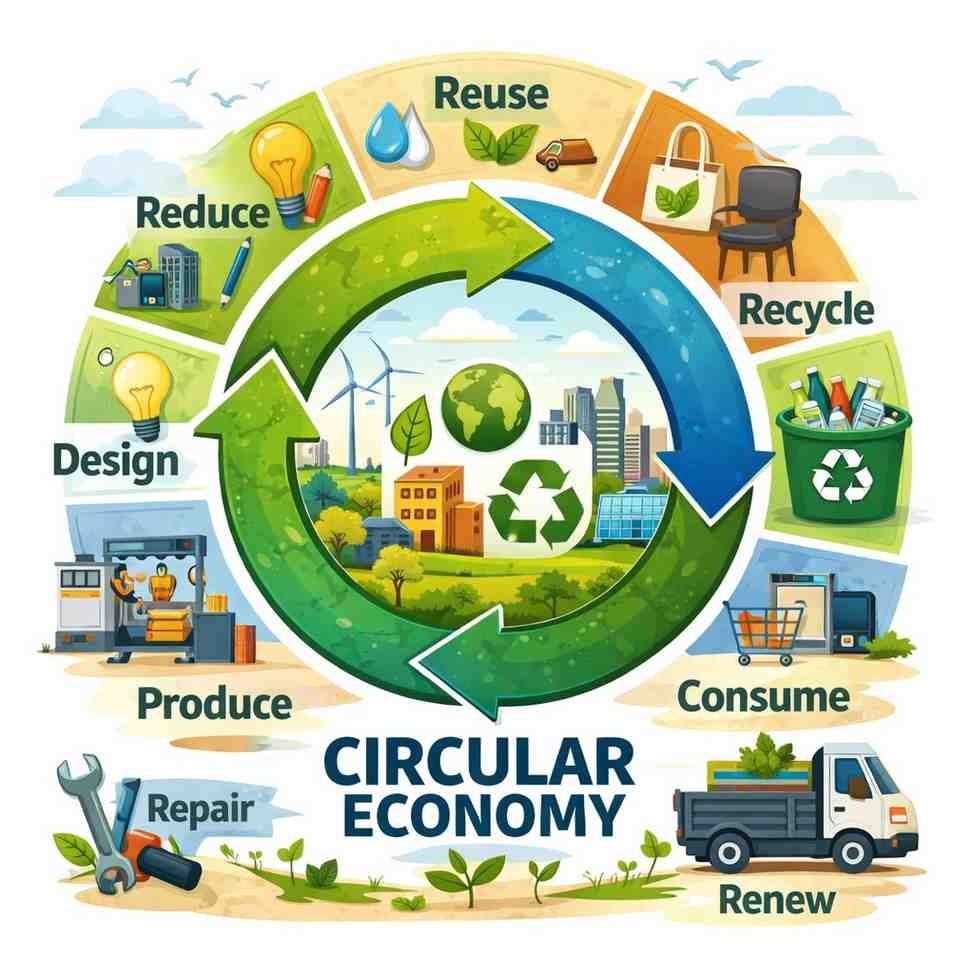
A circular economy is an economic model where products are designed to be reused, repaired, refurbished, and recycled, keeping them in use for as long as possible, rather than being thrown away.
- It is nature's own system where nothing is wasted. Dead leaves become soil, which nourishes new growth.
It replaces the traditional "take-make-dispose" approach with the "reduce-reuse-recycle" approach. - The Ellen MacArthur Foundation has championed this concept, with major corporations worldwide adopting circular principles.
- India generates over 160,000 tonnes of municipal solid waste daily, making this transition urgent.
- According to the 2025 Circularity Gap Report, only 6.9% of the global economy is circular, while 93.1% remains linear, marking a further decline from 7.2% in 2024.
- Helps reduce resource extraction and environmental impacts such as pollution and carbon emissions.
Also read: National Pollution Control Day 2025: History, Significance, Theme & Relevance for UPSC
Objectives of Circular Economy
The objective of the circular economy is to change how we use and value natural resources, making economic growth environmentally sustainable and socially inclusive.
- Waste Reduction: Reduce waste at the source by better product design and responsible consumption, lowering pressure on landfills and incinerators.
- Resource Efficiency: Use resources wisely at every stage, from production to disposal, to get more output with fewer inputs.
- Closed-Loop Systems: Keep materials in use for longer through reuse, repair, remanufacturing, and recycling.
- Pollution Prevention: Cut pollution and harmful emissions from manufacturing and waste disposal.
- Economic Decarbonization: Lower energy use and emissions to support a low-carbon economy.
- Resource Security: Reduce reliance on scarce resources, ensuring long-term sustainability.
- Job Creation: Create new jobs in sectors like recycling, repair, reverse logistics, and remanufacturing.
Also read: New Labour Codes 2025 in India | UPSC Notes
7 Pillars of Circular Economy
The circular economy is founded on a set of core principles that guide the production, use, and management of resources sustainably.
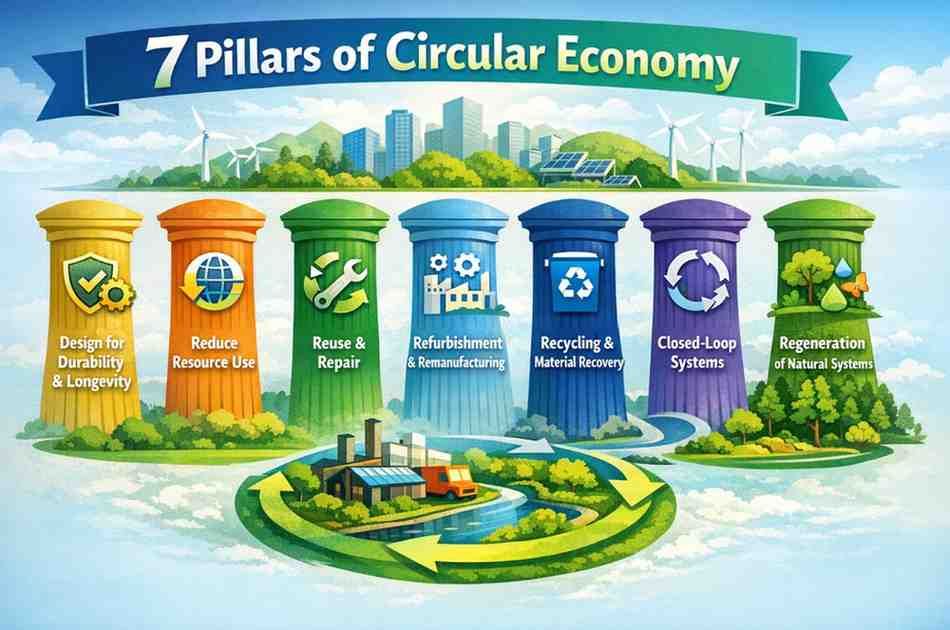
- Design for Durability and Longevity: Products should be designed to last longer, be easy to repair, and resist early damage, reducing the need for frequent replacement.
- Reduce Resource Use: Use fewer raw materials, water, and energy in production by improving efficiency and avoiding unnecessary consumption.
- Reuse and Repair: Encourage reuse of products and repair instead of disposal, extending the life of goods such as electronics, furniture, and vehicles.
- Refurbishment and Remanufacturing: Old or used products are restored, upgraded, or rebuilt to make them usable again, saving materials and energy compared to making new products.
- Recycling and Material Recovery: Waste materials are collected and processed to recover valuable resources, which can be used again in manufacturing.
- Closed-Loop Systems: Waste from one process becomes input for another, ensuring materials continuously circulate within the economy instead of being discarded.
- Regeneration of Natural Systems: Economic activities should restore nature by improving soil health, conserving water, and protecting ecosystems, not just reducing harm.
These pillars together help shift the economy from a “use and throw” model to a sustainable, resource-efficient system.
Also read: Ethanol Blending in India: E20 Policy, Benefits, Implementation, and Challenges
Importance of the Circular Economy
The circular economy helps improve living standards while protecting the Earth, benefiting the environment, economy, and society.
1. Environmental Benefits
- Minimises landfill pressure by treating waste as a resource rather than disposal.
- Prevents biodiversity loss and habitat disruption through reduced mining and extraction.
- Reduces emissions from manufacturing, transportation, and waste disposal.
- Eliminates toxic substances through proper waste segregation in biological and technical cycles.
2. Economic Benefits
- Reduces operating costs through material reuse and optimised resource utilisation.
- Reduces reliance on virgin inputs and global supply chains prone to disruption.
- Opens innovative revenue streams through product-as-service, leasing, and refurbishment.
3. Social Benefits
- Creates diverse employment in repair services, recycling, resource management, and sustainable design.
- Empowers local communities through repair cafes, local production, and community-led initiatives.
- Strengthens community ties through shared environmental responsibility.
- Reduces pollution-related health risks and improves quality of life.
4. Strategic & Systemic Benefits
- Encourages cutting-edge, eco-friendly technologies and manufacturing processes.
- Mitigates risks of supply disruption for critical raw materials and reduces import dependency and geopolitical vulnerabilities.
Also read: Inclusive Growth UPSC Notes: Definition, Objectives and Government Schemes
India and the Circular Economy
As of 2025, India is moving fast from a “use and throw” model to a circular economy. The focus is on saving resources, strengthening national security, and creating jobs.
1. Union Budget 2025-26:
- Critical Mineral Exemptions: To promote domestic recycling and manufacturing, the Basic Customs Duty (BCD) was fully exempted on cobalt powder, waste/scrap of lithium-ion batteries, lead, zinc, and 12 other critical minerals.
- Capital Goods Support: Additional capital goods for EV and mobile battery manufacturing were exempted from duties to boost the domestic circular ecosystem.
- Bioe3 Policy: A new policy framework launched to drive circularity in bio-manufacturing and bio-foundries, promoting "Wealth from Waste".
2. National Critical Mineral Mission (NCMM)
Launched in January 2025 with a proposed expenditure of ₹16,300 crore.
- Capacity: Aim to build 270 kilo tonnes of annual recycling capacity for e-waste and battery scrap.
- Production: Target to produce 40 kilo tonnes of critical minerals from secondary sources.
- Employment: Expected to generate 70,000 jobs in the recycling sector.
3. Regulatory Reforms & Amendments
- Battery Waste Management Rules 2025:
- Digital Labelling: Producers can now use QR codes for EPR registration details on batteries/packs to simplify compliance.
- Relaxation: Hazardous substance marking (e.g., 'Cd', 'Pb') is no longer required for batteries with very low lead (≤0.004%) or cadmium (≤0.002%) content.
- Plastic Waste Management:
- Reporting: A new National Plastic Waste Reporting Portal was launched on June 5, 2025, to enforce online reporting.
- Achievement: Since February 2022, over 157 lakh tonnes of plastic packaging waste have been recycled.
4. Sector-Specific Milestones
- Waste to Wealth Plants:
- Status: 198 plants (including 12 Compressed Biogas) were set up in FY 2023-24.
- Pipeline: As of mid-2025, 556 new plants are under construction.
- Renewable Energy:
- Capacity: India reached 223.6 GW of installed renewable capacity by June 2025.
- Forest Cover: Carbon sink reached 30.43 billion tonnes CO2 equivalent, aligning with NDC targets.
5. Consumer & Community Initiatives
- Vehicle Scrappage Policy: Continued implementation in 2025 with incentives including 4-6% scrap value of the ex-showroom price and road tax concessions (up to 25% for private vehicles).
- Ek Ped Maa Ke Naam: A massive plantation drive achieved 102 crore trees planted, targeting 140 crore by March 2025.
UPSC Prelims PYQ on Circular Economy
QUESTION 1
Consider the following statements:
Statement I: Circular economy reduces the emissions of greenhouse gases.
Statement II: Circular economy reduces the use of raw materials as inputs.
Statement III: Circular economy reduces wastage in the production process.
Which one of the following is correct in respect of the above statements?
Challenges in Implementing a Circular Economy
The circular economy aims to reduce waste and keep resources in use for a longer period. However, shifting from the traditional linear model to a circular system faces several practical and structural challenges.
- High Capital Requirement: Large upfront investment needed for recycling plants, reverse logistics, and green technologies.
- Informal Sector Dominance: Poor integration of informal waste pickers leads to inefficiency and safety concerns.
- Infrastructure Deficit: Inadequate waste segregation, collection, and processing facilities at the urban and rural levels.
- Low Public Awareness: Limited consumer awareness about reuse, repair, and sustainable consumption.
- Policy & Implementation Gaps: Weak enforcement of EPR norms and lack of uniform standards across states.
- Market Constraints: Low demand and trust for recycled or remanufactured products.
UPSC Mains Practice Question
What do you understand by the concept of circular economy? Explain with the help of suitable examples.
Evaluate Your Answers nowWay Forward
To make the circular economy successful in India, strong policies, public participation, and innovation are needed to ensure sustainable and inclusive growth.
- Ensure effective implementation of circular economy policies, especially strict enforcement of Extended Producer Responsibility (EPR).
- Invest in modern recycling, repair, and waste-processing facilities across urban and rural areas.
- Encourage responsible consumption through public awareness campaigns and integration with the LiFE movement.
- Promote research, startups, and skill development in recycling, remanufacturing, and bio-economy sectors.
Start Your UPSC Preparation with SuperKalam
SuperKalam is your AI-powered personal mentor, keeping your preparation disciplined, focused, and effective with:
- Instant Mains answer evaluation
- Instant doubt resolution
- Personalised guidance
- Unlimited MCQs and PYQs
- Progress tracking through daily goals, streaks, and leaderboards.