Union Budget 2026 Highlights & Summary PDF for UPSC
Union Budget 2026–27 highlights focus on three Kartavyas covering growth, human capital and inclusion. Download the complete Union Budget PDF summary now.
Feb, 2026
•7 min read
Why in the News?
The Union Minister of Finance and Corporate Affairs presented the Union Budget 2026–27 in Parliament. This was the first Budget to be delivered from the newly inaugurated Kartavya Bhawan.
The Budget has been positioned as a Yuva Shakti–driven Budget, aligned with the vision of Viksit Bharat. It emphasises:
- Action over Ambivalence
- Reform over Rhetoric
- People over Populism
The budget this year is guided by three Kartavyas (duties) that focus on accelerating economic growth, strengthening human capacities, and ensuring inclusive and balanced development.
Let's study the 2026 budget in detail!
What is a Budget?
A Budget is the government’s annual financial plan that shows how money will be earned and spent during the next financial year.
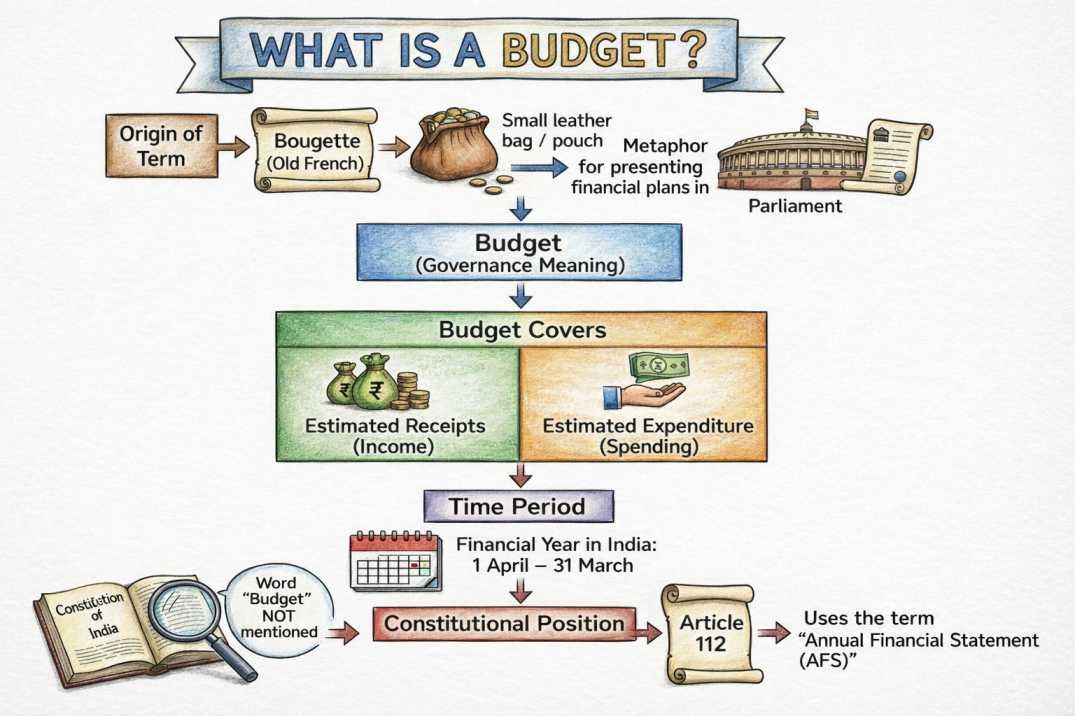
The Union Budget is:
- Prepared by: Department of Economic Affairs (DEA) within the Ministry of Finance
- Presented by: Finance Minister
- Presented in: Parliament (first in the Lok Sabha)
- Usually presented on: 1 February (every year)
Procedure after presentation:
- The Budget is laid before both Houses of Parliament (Lok Sabha and Rajya Sabha).
- Members of Parliament debate the Budget proposals in detail.
The government then seeks approval for its expenditure through Demands for Grants, followed by the passing of the Appropriation Bill and the Finance Bill.
After both Bills are passed and receive the President’s assent, the Budget comes into force. This process ensures parliamentary control over public finances and the transparent use of government funds.
Also see: Circular Economy: Meaning, Significance and Benefits [UPSC]
Key Highlights of the Union Budget 2026–27
The Union Budget 2026–27 is structured around three Kartavyas (duties) to drive growth, build capacity, and ensure inclusive development.
First Kartavya: Accelerate & Sustain Economic Growth
1. Manufacturing & Industry Push:
- Biopharma SHAKTI Mission: ₹10,000 crore outlay to make India a global biopharma hub; focus on biologics, biosimilars, new NIPERs, and CDSCO strengthening.
- India Semiconductor Mission 2.0: Focus on semiconductor equipment, materials, supply chains, and skilled workforce for technological sovereignty.
- Electronics Manufacturing: Outlay raised to ₹40,000 crore to deepen domestic value chains.
- Rare Earth Corridors & Chemical Parks: Corridors in Odisha, Kerala, Andhra Pradesh, Tamil Nadu; 3 chemical parks to reduce import dependence.
- Capital Goods & Logistics: ₹10,000 crore container manufacturing scheme, hi-tech tool rooms, and construction equipment support.
- Textile Sector: Integrated Textile Programme, Mega Textile Parks, focus on technical textiles and value addition.
- MSME Support: ₹10,000 crore SME Growth Fund; ₹2,000 crore boost to Self-Reliant India Fund to boost the MSME sector.
- Legacy Industrial Clusters: Revitalisation of 200 old clusters through infrastructure and tech upgrades.
2. Infrastructure as Growth Connectors
- High-Speed Rail: 7 corridors linking major economic cities.
- Sustainable Cargo Movement: New freight corridors, 20 national waterways, and a coastal cargo promotion scheme.
- Seaplane VGF Scheme: Boost tourism and last-mile connectivity.
- Infrastructure Risk Guarantee Fund: Partial credit guarantees for lenders.
- City Economic Regions (CERs): ₹5,000 crore per region over 5 years (challenge mode).
- Carbon Capture (CCUS): Decarbonisation of steel and cement sectors.
Second Kartavya: Fulfil Aspirations & Build Capacity
- AVGC Content Creator Labs: Set up in 15,000 schools and 500 colleges to promote the Orange Economy.
- National Institute of Hospitality: Upgrade NCHMCT to meet tourism industry needs.
- Khelo India Mission: Integrated sports development, coaching, sports science, and infrastructure.
- Medical Value Tourism: 5 regional medical hubs with AYUSH, diagnostics, and rehabilitation.
- Women in STEM: One girls’ hostel in every district via VGF/capital support.
Third Kartavya: Sabka Saath, Sabka Vikas
- Bharat-VISTAAR: AI-based multilingual platform integrating AgriStack and ICAR for farmer advisory.
- SHE Marts: Community-owned retail outlets under SHG federations.
- Mental Health: Establishment of NIMHANS-2; upgradation of institutes in Ranchi and Tezpur.
- Divyangjan Welfare: Targeted support through dedicated empowerment schemes.
Purvodaya & North-East Focus:
- Buddhist Circuits development
- East Coast Industrial Corridor
- Tourism hubs in eastern states
Must read: Economic Survey 2026: Key Highlights, Analysis & Summary PDF (UPSC)
Key Highlights of Tax Reforms – Union Budget 2026–27
The tax reforms in the Union Budget 2026–27 focus on simplification, stability, ease of compliance, and investment promotion.
Direct Tax Reforms
- New Income Tax Act, 2025: Replaces IT Act, 1961.
- Tax Slabs: No change; stability maintained.
- TCS Rationalisation: Uniform 2% on overseas tours and LRS remittances.
- TDS Rationalisation: Fixed rates for manpower services; decriminalisation of minor defaults.
- Buyback Tax: Taxed as capital gains in shareholders’ hands.
- Immunity: Non-disclosure of foreign assets below ₹20 lakh granted immunity.
Indirect Taxes & Customs
- Customs Duty: Reduced to 10% for personal imports.
- Exemptions: 17 cancer drugs; medicines for 7 rare diseases.
- Critical Minerals: Duty exemptions for lithium, cobalt processing and Li-ion cells.
- STT: Marginal increase to curb speculation.
Investment & Ease of Doing Business
- Data Centres: Tax holiday for global cloud service providers till 2047.
- IFSC (GIFT City): Tax holiday extended to 20 years.
- IT Safe Harbour: Threshold raised to ₹2,000 crore.
- Customs Modernisation: Single digital window, AI-based scanning, faster cargo clearance, export incentives.
Want the Budget 2026–27 made super simple?
Access SuperKalam Budget 2026 Summary PDF with easy explanations, smart mind maps and exam-ready notes for Prelims & Mains.
Click now and revise faster, remember longer!
Union Budget 2026-27 Summary
Final Words
The Union Budget 2026–27 reflects the government’s long-term vision for growth, capacity building, and inclusive development through its three Kartavyas. For UPSC aspirants, understanding the Budget is essential to link current affairs with GS, Essay, and Interview preparation.
Attempt Union Budget 2026-27 Test

Attempt the test either by scanning this QR code or CLICK HERE
Start your UPSC Preparation 2026/2027 with SuperKalam
SuperKalam is your personal mentor for UPSC preparation, guiding you at every step of the exam journey. Practice, revise, and evaluate– all in one place.
Download Now