Economic Survey 2026: Key Highlights, Analysis & Summary PDF (UPSC)
Download the Economic Survey 2026 PDF summary with complete video analysis. Understand India’s economy, trends, and budget linkages for UPSC 2026. Click now!
Jan, 2026
•6 min read
Every year, before the presentation of the Union Budget in the Indian Parliament, the Government of India releases the Economic Survey — a flagship policy document that reviews the economy’s performance, analyses key trends, and sets the analytical stage for the budget.
The Economic Survey 2025–26 was tabled in Parliament by the Union Finance Minister on 29 January 2026 during the Budget Session.
For UPSC aspirants, this is one of the most important current affairs documents because it provides data, context, analysis, and policy insights that are directly relevant for Prelims, GS Paper-III, Mains answers, Essay, and Interview preparation.
What is the Economic Survey?
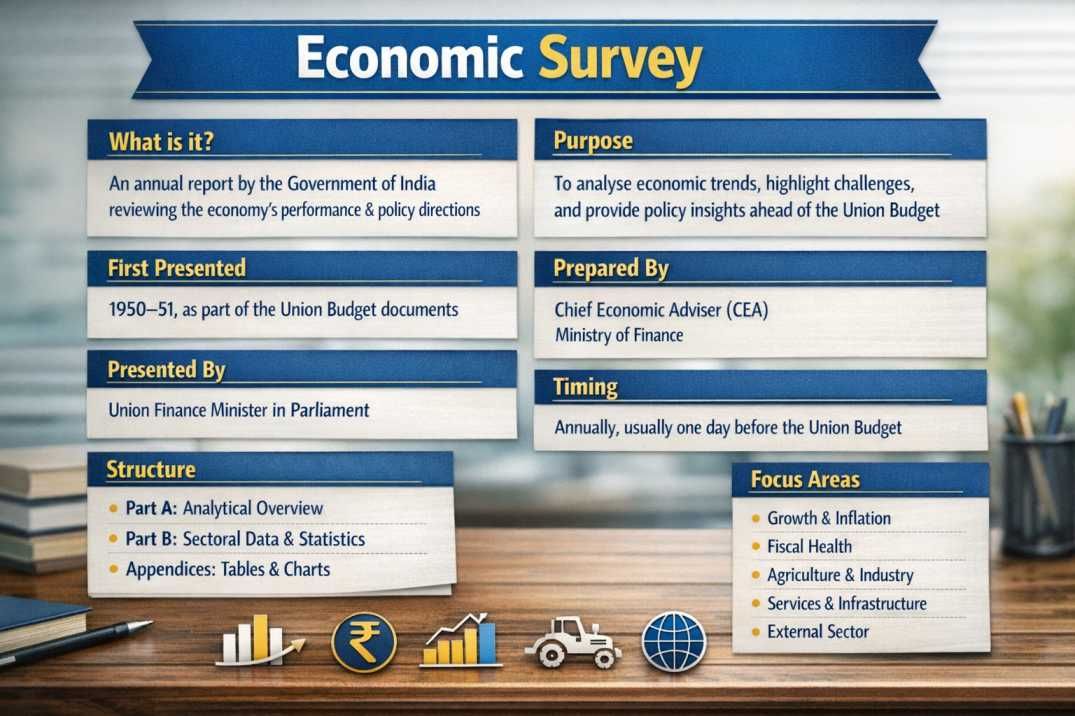
The Economic Survey is the Government of India’s annual assessment of the economy presented ahead of the Union Budget.
Key Features of the Economic Survey:
- Reviews macroeconomic performance (growth, inflation, fiscal trends)
- Analyses sectoral developments (agriculture, industry, services)
- Highlights structural challenges and reform priorities
- Sets the analytical stage for the Union Budget
- Offers insights into policy direction and future outlook
This document explains why the economy performed a certain way and what policy priorities are shaping India’s future.
History of the Economic Survey
The first Economic Survey was presented in 1950–51, coinciding with the launch of India’s First Five-Year Plan. At this stage, the Survey formed a part of the Union Budget documents and primarily aimed to provide a broad overview of India’s economic performance. The early Surveys played a crucial role in:
- Assessing the impact of planned economic development
- Reviewing trends in agriculture, industry, and public finance
- Providing policymakers with data to guide nation-building efforts
In 1964, a significant institutional reform was introduced when the Economic Survey was delinked from the Union Budget and began to be presented as an independent document. This separation was aimed at ensuring a more comprehensive, objective, and analytical review of economic developments.
When and How Is the Economic Survey Presented?
The Economic Survey is presented annually during the Budget Session of Parliament, traditionally one day before the Union Budget. It is tabled by the Union Finance Minister in both Houses of Parliament.
Who Prepares the Economic Survey?
The Economic Survey is prepared by the Economic Division of the Department of Economic Affairs, Ministry of Finance. It is authored under the guidance of the Chief Economic Adviser (CEA), with inputs from various ministries, departments, and statistical agencies.
Purpose of Presentation
- To provide an evidence-based macroeconomic overview of the Indian economy
- To highlight key trends, structural challenges, and policy priorities
- To create an analytical framework for informed discussion on the Union Budget
Must cover: Inclusive Growth UPSC Notes: Definition, Objectives and Government Schemes
Economic Survey vs Union Budget
The Economic Survey and the Union Budget are closely connected documents, but they serve different purposes. Together, they explain what the economic situation is and how the government plans to respond to it.
- The Economic Survey explains the condition of the economy and the challenges ahead.
- The Union Budget explains the government’s action plan to address those challenges.
Difference Between Economic Survey and Union Budget
Let's understand the key differences between the Economic Survey and the Union Budget:
| Economic Survey | Union Budget |
|---|---|
| Reviews and analyses the overall performance of the Indian economy | Presents the government’s financial plan for the coming year |
| “What is the state of the economy and what needs to be done?” | “How will the government act on this assessment?” |
| Analytical and diagnostic | Financial and policy-oriented |
| Chief Economic Adviser, Ministry of Finance | Ministry of Finance |
| Union Finance Minister | Union Finance Minister |
| Tabled before the Union Budget | Presented after the Economic Survey |
| Growth trends, inflation, fiscal health, sectoral performance, risks and opportunities | Tax proposals, expenditure plans, welfare schemes, fiscal targets |
| Provides economic reasoning and justification | Implements policies through allocations and taxation |
| Advisory and non-binding | Binding upon approval by Parliament |
Also see: Monetary Policy in India: Complete Notes for UPSC Indian Economy
UPSC Prelims PYQ on Union Budget of India
QUESTION 1
With reference to Union Budget, consider the following statements :
- The Union Finance Minister on behalf of the President lays the Annual Financial Statement before both the Houses of Parliament.
- At the Union level, no demand for a grant can be made except on the recommendation of the President of India.
Which of the statements given above is/are correct?
Key Highlights and Analysis of the Economic Survey 2026
Here are the key points from the Economic Survey you should focus on:
1. Strong Growth Outlook
- India is projected to remain the fastest-growing major economy in the world, with real GDP growth estimated at 7.4% in FY26.
- For FY27 (2026-27), growth is projected in the range of 6.8%-7.2%.
Exam Tip: Link this with GS3 topics like “India’s growth story”, “potential growth”, and “reforms vs demand-led growth”.
2. Inflation & Price Stability
- The Survey notes low inflation levels, helping keep purchasing power steady and maintain macroeconomic stability.
- Stable inflation supports private consumption, which accounts for a large part of GDP.
3. Fiscal and Financial Sector Health
The Survey acknowledges improved fiscal consolidation, providing policy space for public investment.
- For the Banking sector, gross NPAs have declined, and banks show healthier balance sheets.
- Recommendations include tax rationalisation on debt instruments to lower the cost of capital and deepen markets.
4. Agriculture & Rural Economy
- The Survey highlights record foodgrain production, strong harvests, and rural reforms.
- It underscores how agriculture supports income security and rural demand.
5. Industry, Manufacturing & Innovation
- Structural changes are prominent in manufacturing.
- Industry GVA grew strongly.
- PLI schemes attracted large investments and created jobs.
- Innovation rankings improved significantly (Global Innovation Index).
UPSC Tip: Use the PLI scheme’s impact as evidence when explaining government strategies to boost manufacturing in your UPSC answers.
6. External Sector & Trade Resilience
- Exports recorded notable performance, with services exports reaching historic highs.
- Forex reserves remain strong, providing import cover against shocks.
7. Infrastructure & Connectivity
- Rapid expansion of highways, rail networks, airports, and renewable energy capacity was highlighted.
- Digital infrastructure, such as 5G coverage expanded nationwide.
Also read: Circular Economy: Meaning, Significance and Benefits [UPSC]
For a more detailed analysis, access SuperKalam smart, revision-ready PDF summary with important insights, examples, and exam-relevant takeaways.
Master the Economic Survey 2026 with SuperKalam
How to Read the Economic Survey for UPSC
The Economic Survey should be read strategically, not like a textbook. Here's how to do it:
- Start with the Highlights Summary to get a broad understanding of major themes.
- Focus primarily on Volume I that explains why certain economic outcomes occurred and what policy directions are suggested.
- Volume II should be used selectively for data, tables, and charts that can support answers.
- While reading, map each chapter to the GS Paper-III syllabus.
- Avoid memorising excessive numbers. Instead, note key trends, comparisons, and explanations.
- Extract examples, case studies, and policy initiatives mentioned in the Survey.
- Pay special attention to challenges and risks highlighted in the Survey.
- Focus on retention and application rather than passive reading.
Watch the simplified breakdown of the Economic Survey 2026 by SuperKalam's expert UPSC mentors. Click the link below:
Final Words
The Economic Survey 2026 is a must-read for serious UPSC aspirants. It explains the logic behind economic policies and helps you write sharper, more analytical answers in Mains and the Interview.
Study it with purpose, revise it smartly, and learn with SuperKalam to understand the Survey in an exam-ready way.
Start your UPSC Preparation 2026/2027 with SuperKalam
SuperKalam is your personal mentor for UPSC preparation, guiding you at every step of the exam journey. Practice, revise, and evaluate– all in one place.
Download Now