Why RBI Rate Hikes Fail Against Imported Inflation and Rupee Shocks - UPSC Notes
Discover why the RBI cannot rely on benchmark rate hikes to fix imported inflation and rupee depreciation without risking stagflation.
Aug, 2026
•10 min read
Overview
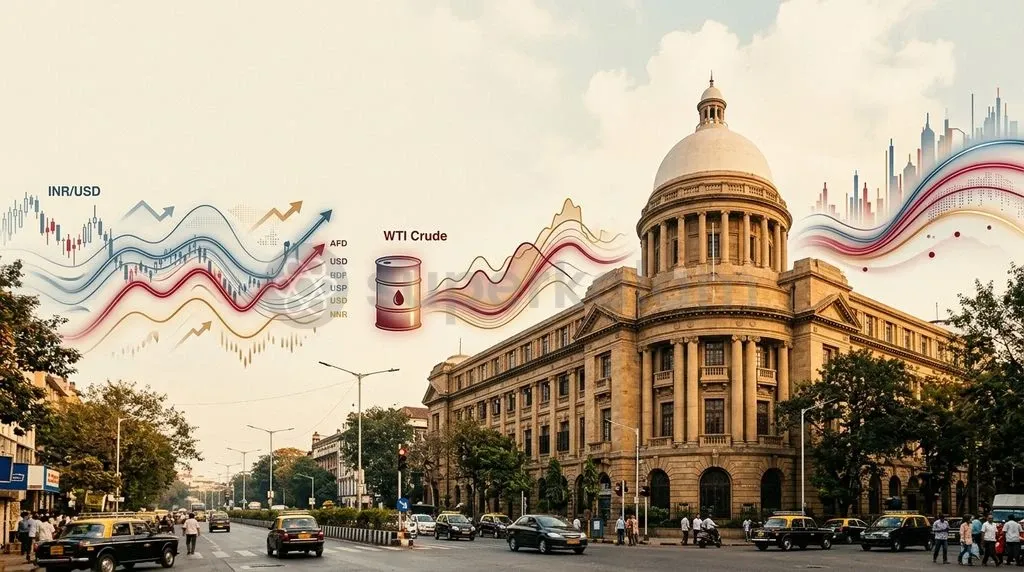
Fig: The Reserve Bank of India balances domestic liquidity policy and forex intervention against global commodity shocks.
As of August 2026, the Reserve Bank of India faces structural constraints when countering imported inflation. Interest rate adjustments designed to suppress domestic aggregate demand cannot increase global commodity production or repair disrupted international supply chains. According to the RBI Monetary Policy Statement (August 2026), headline Consumer Price Index inflation for FY 2026-27 is projected at 5.0%, driven largely by volatile food and petroleum imports rather than domestic overheating. Relying solely on benchmark rate hikes to counter currency depreciation risks inducing stagflation, making integrated foreign exchange intervention and fiscal duty rationalisation essential for long-term macroeconomic stability.
Why in the News?
As of August 2026, the Monetary Policy Committee of the Reserve Bank of India unanimously maintained the policy repo rate at 5.25% while retaining a neutral policy stance. Under Section 45ZA of the Reserve Bank of India Act, 1934, the Central Government in consultation with the central bank retained the 4% retail inflation target with a ±2% tolerance band (2% to 6%) through 2031.
Section 45ZN of the Reserve Bank of India Act, 1934 mandates that if average retail inflation breaches this tolerance band for three consecutive quarters, the central bank must submit a formal report to the Central Government detailing the underlying causes and remedial actions. With FY 2026-27 headline inflation projected at 5.0%, monetary authorities are prioritising supply-driven price stabilisation without unnecessarily dampening domestic economic momentum.
Why Imported Inflation Tests the Limits of RBI Monetary Policy
The Reserve Bank of India encounters structural limitations when using benchmark interest rates against supply-side imported price shocks. Imported inflation occurs when global cost surges in primary imports, such as crude oil, edible oils, and industrial inputs, elevate landed import prices and transmit directly into domestic wholesale and retail price indices.
Conventional monetary tightening operates by raising domestic borrowing costs to suppress aggregate consumer demand and private investment. However, increasing interest rates in India does not expand international energy production or restore global shipping channels.
Key structural constraints include:
- Production limits: Raising domestic rates cannot expand international energy extraction or repair foreign shipping channels.
- Stagflation risks: Using interest rate hikes against imported cost spikes risks inducing stagflation by depressing domestic capital expenditure without lowering foreign input costs.
How Global Commodity Shocks and Rupee Depreciation Spill Over to India
India relies on foreign energy markets for 87% to 90% of its total domestic crude oil consumption, according to the Petroleum Planning & Analysis Cell. High structural energy dependence creates acute vulnerability to international crude price fluctuations. Currency movements act as an inflation multiplier by increasing the local currency cost of dollar-denominated imports; industry estimates from ICRA indicate that every $10 per barrel increase in global crude oil expands India's net import bill (as reported in June 2025).
Foreign exchange volatility compounds domestic price pressures when external headwinds accelerate currency depreciation. In August 2026, FXStreet market data reported the USD/INR exchange rate trading near 95.06 amid West Asian geopolitical friction. When the rupee weakens against the US dollar, domestic firms pay more local currency for essential imported raw materials, driving up production costs across manufacturing sectors.
| Dimension | Demand-Pull Inflation | Imported Supply-Side Inflation |
Primary Driver | Excess domestic aggregate demand relative to economic capacity | External cost spikes in imported crude, edible oils, and inputs |
Primary RBI Lever | Policy repo rate increases to tighten credit | Spot/forward forex market intervention and swap lines |
Transmission Channel | Increases borrowing costs to slow domestic consumption | Stabilises exchange rates to curb landed import prices |
Fiscal Requirement | Moderation of public spending and demand management | Tariff rationalisation, fuel excise cuts, and stock limits |
Macroeconomic Risk | Slower growth if credit costs become overly restrictive | Risk of stagflation if treated purely with rate hikes |
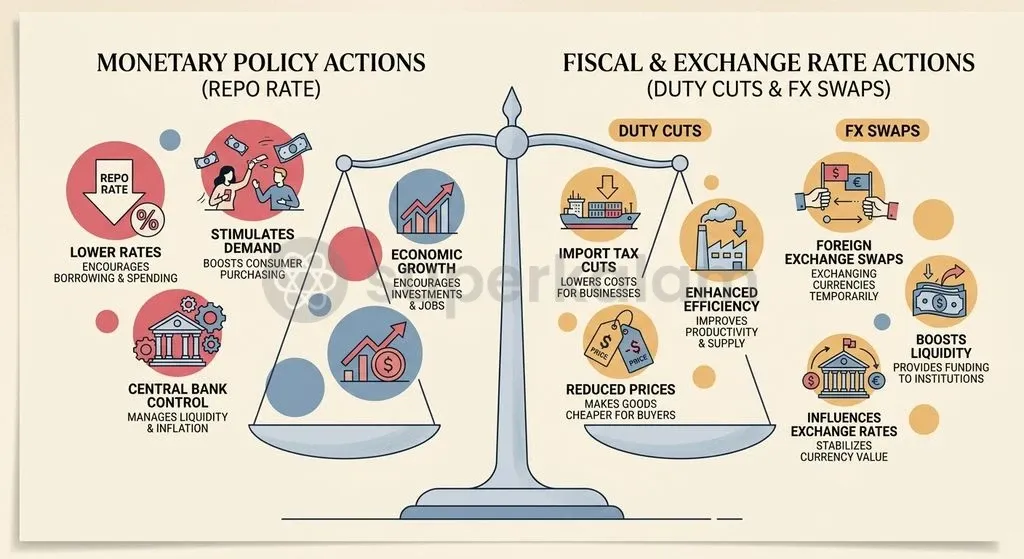
Fig: Demand-pull inflation requires monetary tightening, whereas imported inflation necessitates fiscal and foreign exchange coordination.
Discuss with Superkalam
What is the retail inflation target and tolerance band retained by the Central Government and RBI through 2031?
Ask NowThe Central Dilemma: Growth Versus Currency Defence
The Reserve Bank of India faces a direct macro-policy trade-off between defending currency stability and supporting domestic economic growth. Raising benchmark repo rates or draining market liquidity can defend exchange rate levels by attracting foreign portfolio capital. However, the Ministry of Finance highlights in the Economic Survey 2025-26 that aggressive monetary tightening elevates credit costs for Indian enterprises and curtails private consumption expenditure.
Under high policy rates, commercial borrowing costs rise, leading firms to delay capital expansion plans. When rupee weakness stems from global risk-off sentiment or interest rate hikes by foreign central banks, domestic rate increases fail to stem capital flight while placing headwinds on domestic GDP growth.
Key policy trade-offs:
- Capital attraction: Rate hikes defend exchange rates by encouraging foreign portfolio inflows.
- Growth friction: Higher credit costs compress private investment and delay corporate capital expansion.
Beyond Interest Rates: Forex Intervention and Liquidity Management
Foreign exchange intervention by the Reserve Bank of India is a primary tool to curb excessive currency volatility without altering benchmark liquidity rates. India's foreign exchange reserves stood at $692.87 billion as of August 2026, providing over 11 months of import cover. The central bank intervenes in spot and forward markets to supply US dollars and prevent disorderly market fluctuations. An IMF Working Paper evaluating India's operations under the Integrated Policy Framework (IPF) confirmed that targeted forex intervention effectively mitigates inflation-output trade-offs during risk-off shocks in temporarily shallow exchange markets.
Primary instruments under the Integrated Policy Framework include:
- Spot and forward intervention: Supplying foreign currency directly to smooth exchange rate volatility.
- Special liquidity windows: Deploying direct dollar supply windows and currency swap lines for public sector oil marketing companies.
- LAF corridor management: Anchoring money market liquidity using the Standing Deposit Facility (SDF) rate at 5.00% as the floor and the Marginal Standing Facility (MSF) rate at 5.50% as the ceiling.
- Sterilisation operations: Executing Open Market Operations (OMOs) to purchase government securities and offset rupee liquidity contraction caused by foreign reserve sales.
However, foreign exchange intervention carries distinct operational costs. Selling foreign currency reserves drains rupee liquidity from the banking system. To prevent an unintentional tightening of domestic monetary conditions, the central bank must execute sterilisation operations through OMOs. Persistent reserve sales during prolonged global shocks risk depleting foreign exchange buffers and complicating domestic liquidity management.
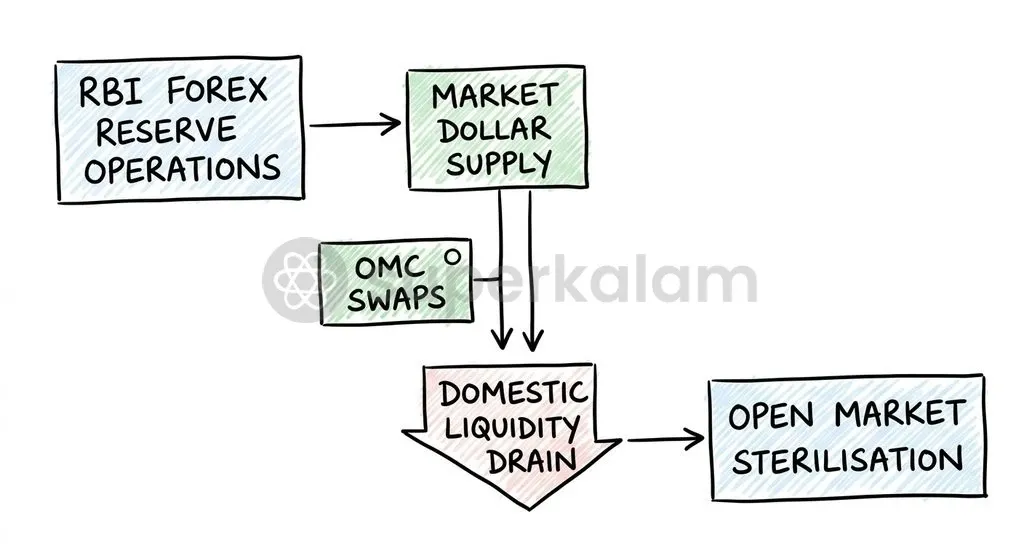
Fig: Forex intervention stabilizes the exchange rate but requires liquidity sterilisation to maintain domestic policy objectives.
The Missing Link: Why Monetary Policy Needs Fiscal Supply-Side Coordination
The Ministry of Finance and administrative departments deploy fiscal interventions to absorb external supply shocks before they pass into consumer prices. Central excise duties and state Value Added Tax (VAT) adjustments on motor fuels are utilised by the government to buffer domestic retail prices against international petroleum surges. On imported food items, the Ministry of Commerce and Industry dynamically revises basic customs duties and import tariffs on essential items like crude edible oils and pulses.
Key fiscal and administrative levers:
- Tax and duty buffers: Adjusting central excise duties and state VAT to lower retail fuel price transmission.
- Tariff rationalisation: Dynamically recalibrating basic customs duties on essential edible oils and pulses.
- Market interventions: Releasing grain through the Open Market Sale Scheme (OMSS) and enforcing stock limits under the Essential Commodities Act, 1955.
The Economic Survey 2025-26 emphasises that controlling imported inflation requires cross-policy alignment: fiscal duty cuts absorb supply shocks while monetary policy keeps long-term inflation expectations anchored.
Discuss with Superkalam
Analyze the policy dilemma central banks face between raising rates to prevent capital flight and keeping rates low to encourage private investment.
Ask NowThe Way Forward for India's Macroeconomic Resilience
Macroeconomic stability in India requires a coordinated framework spanning central bank operations, fiscal duty management, and strategic import diversification. Monetary policy under the Integrated Policy Framework should focus forex market interventions on curbing disorderly exchange volatility rather than defending specific exchange rate levels. This strategy preserves foreign exchange reserves while keeping domestic monetary conditions aligned with growth needs.
Key pillars for future resilience:
- Targeted forex intervention: Focus central bank actions on smoothing exchange rate volatility rather than defending rigid exchange levels.
- Long-term structural reforms: Expand renewable energy capacity, build strategic petroleum reserves, and diversify agricultural import supply lines to reduce structural vulnerability.
Key Takeaways
- The Reserve Bank of India maintained the policy repo rate at 5.25% in August 2026, projecting FY 2026-27 headline CPI inflation at 5.0% driven primarily by supply-side factors.
- Monetary policy tightening cannot expand global commodity production, making interest rate hikes an inefficient tool against imported supply shocks.
- India imports 87% to 90% of its crude oil requirements, making domestic price levels highly sensitive to rupee depreciation and global petroleum fluctuations.
- The central bank utilises its $692.87 billion foreign exchange reserves to perform spot interventions and provide oil marketing company swap lines under the Integrated Policy Framework.
- Forex intervention carries structural limits, as selling reserves contracts domestic liquidity and requires active sterilisation through central bank liquidity operations.
- Effective inflation management requires coordinated fiscal measures, including excise duty cuts, customs tariff adjustments, and OMSS grain releases to absorb external price spikes.
Mains Question
"Relying solely on benchmark rate hikes to counter currency depreciation risks inducing stagflation, making integrated foreign exchange intervention and fiscal duty rationalisation essential for long-term macroeconomic stability." Elucidate. (15 marks)
Evaluate NowMultiple Choice Questions
QUESTION 1
Q1. Consider the following statements regarding the statutory monetary policy framework under the Reserve Bank of India Act, 1934:
- Under Section 45ZA, the retail inflation target is determined by the Central Government in consultation with the Reserve Bank of India.
- Section 45ZN mandates that if average retail inflation breaches the tolerance band for three consecutive quarters, the central bank must submit a formal report to the Central Government.
- The retail inflation target is set at 4% with a tolerance band of ±2% through 2031.
Which of the statements given above is/are correct?
QUESTION 2
Q2. With reference to the Liquidity Adjustment Facility (LAF) corridor and monetary policy instruments mentioned in the August 2026 RBI resolution, consider the following statements:
- The Standing Deposit Facility (SDF) rate serves as the floor of the LAF corridor at 5.00%.
- The Marginal Standing Facility (MSF) rate serves as the ceiling of the LAF corridor at 5.50%.
- Sterilisation operations via Open Market Operations (OMOs) purchase government securities to offset domestic rupee liquidity contraction caused by foreign reserve sales.
Which of the statements given above is/are correct?