RBI Repo Rate October 2026: 5.5%, MPC Decision and EMI Impact
The RBI raised the repo rate to 5.50% on 7 October 2026. Read the MPC decision, SDF and MSF rates, inflation outlook and floating-rate loan impact.
Oct, 2026
•11 min read

RBI Repo Rate in October 2026: Quick Answer
The RBI repo rate is 5.50% following the MPC decision on 7 October 2026. The committee unanimously raised it by 25 basis points, from 5.25%. The SDF rate is 5.25%, while the MSF rate and Bank Rate are 5.75%.
The MPC changed its stance to calibrated tightening. The rate hike was unanimous, but two members preferred to retain a neutral stance. For borrowers with repo-linked floating-rate loans, the hike can raise interest costs when the lender resets the rate. The effect on EMI or tenure depends on the loan terms and the borrower's chosen reset option.
RBI Policy Rates After the October 2026 MPC Meeting
| Policy rate | Rate after 7 October 2026 |
|---|---|
| Repo rate | 5.50% |
| Standing Deposit Facility (SDF) | 5.25% |
| Marginal Standing Facility (MSF) | 5.75% |
| Bank Rate | 5.75% |
The RBI projects real GDP growth at 7.1% and CPI inflation at 5.2% for FY 2026-27. The reference to inflation averaging almost 5.8% applies to the next three quarters, not the full financial year.
Source: RBI MPC resolution, 7 October 2026. The next MPC meeting is scheduled for 2-4 December 2026.
October 2026 Repo Rate FAQs
What is the RBI repo rate after the October 2026 MPC meeting?
It is 5.50%. The MPC increased it by 25 basis points from 5.25% on 7 October 2026.
What did the MPC decide in October 2026?
It unanimously raised the repo rate to 5.50% and changed the stance to calibrated tightening. Two members preferred to retain a neutral stance.
Will the repo rate hike increase my home-loan EMI?
A repo-linked floating-rate loan can become costlier at the lender's reset. EMI, tenure or both may change depending on the loan terms and the borrower's reset choice. A fixed-rate loan does not automatically change with the repo rate.
The sections below explain the decision, policy transmission and its impact on borrowers and inflation.
Why in the News: The Central Bank's Tightrope Walk Between Prices and Growth
The Reserve Bank of India Monetary Policy Committee voted unanimously on October 7, 2026, to raise the policy repo rate by 25 basis points to 5.50 per cent under the Liquidity Adjustment Facility. Consequent to this rate increase, the Standing Deposit Facility rate adjusted to 5.25 per cent, while the Marginal Standing Facility rate and the Bank Rate increased to 5.75 per cent, as confirmed in the Monetary Policy Statement of October 2026.
The central bank also adopted a stance of calibrated tightening. That stance rules out near-term rate cuts, leaving future actions restricted to pauses or further hikes.
As of October 2026, this policy decision sharpens an intensifying macroeconomic trade-off between price stability and growth. The committee's projections outline this divergence across key metrics:
- Projected Real GDP Growth (2026-27): Pegged at 7.1 per cent, anticipating a sequential moderation from 7.2 per cent in the second quarter to 6.9 per cent in the third quarter and 6.8 per cent in the fourth quarter.
- Projected Headline CPI Inflation (2026-27): Stands at 5.2 per cent, expected to peak at 6.0 per cent in the third quarter before softening to 5.7 per cent in the fourth quarter.
- Projected Core Inflation: Sits at a benign 4.4 per cent, showing that ongoing price pressures stem primarily from supply-side components rather than broad-based domestic demand overheating.
Discuss with Superkalam
Which committee recommended replacing the multiple-indicator approach with Flexible Inflation Targeting anchored to headline CPI?
Ask NowThe Institutional Anchor: Urjit Patel Committee and the Section 45ZB Mandate
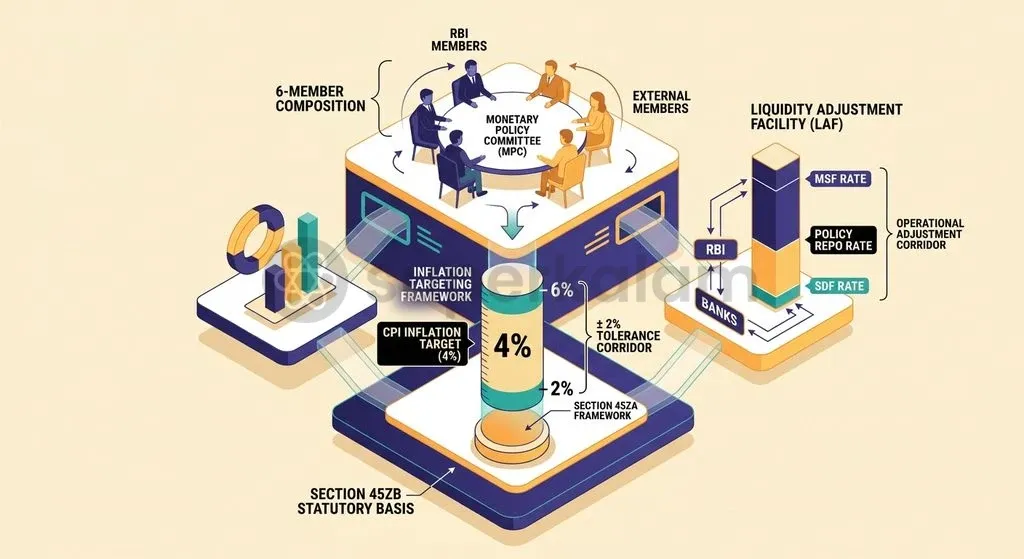
Section 45ZB of the Reserve Bank of India Act, 1934, provides the statutory foundation for the six-member Monetary Policy Committee entrusted with determining the policy rate. Inserted through the Finance Act, 2016, this provision operationalised the recommendations submitted in January 2014 by the Expert Committee to Revise and Strengthen the Monetary Policy Framework, chaired by Dr. Urjit Patel.
The Patel Committee urged the central bank to abandon its historical multiple-indicator approach in favour of a modern, rules-based Flexible Inflation Targeting regime anchored strictly to headline consumer prices. Under Section 45ZA of the Reserve Bank of India Act, 1934, the Central Government determines the inflation target in terms of the Consumer Price Index once every five years in consultation with the central bank:
- Headline CPI Target: 4.0 per cent target rate.
- Upper Tolerance Threshold: 6.0 per cent ceiling.
- Lower Tolerance Threshold: 2.0 per cent floor.
This statutory architecture establishes institutional credibility. At the same time, it binds the committee to react to headline price spikes even when the underlying drivers originate outside monetary control.
How the Policy Repo Rate Moves Through the Banking Pipeline
Monetary policy transmission is the operational process through which central bank rate decisions reach commercial borrowing terms, deposit yields, and broad aggregate demand. When the Reserve Bank of India alters the policy repo rate—the rate at which commercial banks borrow short-term liquidity against government securities—it changes the marginal cost of funds across the interbank market.
In theory, commercial banks adjust deposit and loan pricing together. That balance reshapes incentives between saving and spending. In practice, transmission flows through four distinct channels with uneven speeds across Indian financial intermediaries:
- Interest Rate Channel: Policy rate hikes raise bank funding costs, prompting lenders to increase nominal borrowing rates on business loans and retail mortgages.
- Credit Channel: Stricter borrowing costs reduce the overall volume of bank credit extended to households and private enterprises, moderating domestic credit creation.
- Asset Price Channel: Higher discounting rates compress market valuations for equities, real estate, and fixed-income securities, dampening household perceived wealth.
- Expectations Channel: Clear central bank guidance anchors forward-looking inflation expectations among businesses and wage-earners, containing second-round wage-price spirals.
Discuss with Superkalam
How does the heavy weight of food and beverages in the CPI basket limit the direct impact of repo rate changes on headline inflation?
Ask NowWhy Rate Hikes Hit Retail Borrowers Fast: The Shift to External Benchmarks
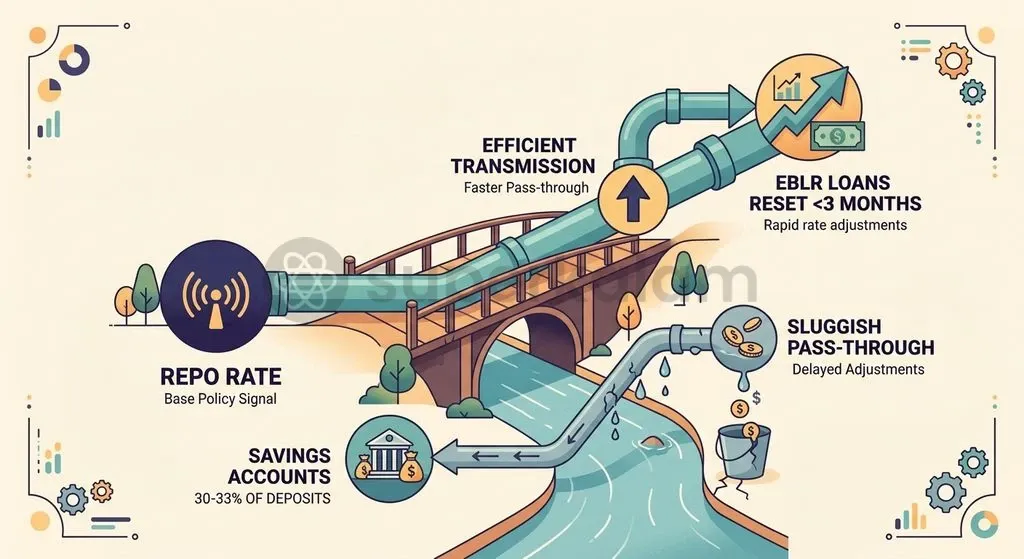
The External Benchmark Lending Rate framework, made mandatory by the central bank on October 1, 2019, transformed domestic transmission by linking floating-rate personal loans directly to market benchmarks. Under this regulatory direction, scheduled commercial banks must peg all new floating-rate retail loans—such as home loans and auto advances—as well as loans to Micro and Small Enterprises, to external benchmarks like the policy repo rate.
Central bank guidelines mandate that banks reset interest rates on these loans at least once every three months, ensuring nearly instantaneous upward transmission of policy hikes to retail borrowers. Data published in the Reserve Bank of India Bulletin highlights this structural shift:
- Broad Banking Sector Adoption: More than 50 per cent of outstanding floating-rate rupee loans across scheduled commercial banks are linked to external benchmarks.
- Private Sector Concentration: Over 75 per cent of floating-rate advances in private sector banks are currently tied to external market benchmarks.
- Liability Pricing Stickiness: Savings deposit accounts constitute approximately 30 to 33 per cent of total deposits in scheduled commercial banks and remain largely insulated from policy rate revisions.
This gap creates an asymmetric pass-through. Borrowers absorb immediate financial adjustments, whereas savers see little yield improvement on their deposits.
To manage escalating loan servicing obligations, commercial banks routinely extended loan tenures rather than raising immediate monthly instalments. According to central bank findings, this practice led to severe financial distortions, including loan amortisation schedules extending beyond the retirement age of borrowers and instances of negative amortisation, where monthly payments fail to cover monthly accrued interest.
Addressing this vulnerability, the central bank issued binding directions on August 18, 2023. Regulated entities must communicate benchmark revisions transparently and offer borrowers the explicit choice to switch between equated monthly instalment enhancement, tenure extension, or a combination of both during interest rate resets.
Discuss with Superkalam
If a bank unilaterally extends a floating-rate home loan tenure during rate increases, how does this practice lead to negative amortisation for the borrower?
Ask NowThe Limits of Monetary Tightening: Why Rate Hikes Cannot Fix Supply Shocks
Monetary policy tools are demand-management instruments. They lack the capacity to resolve physical supply bottlenecks. According to specifications from the Ministry of Statistics and Programme Implementation, food and beverages carry a weight of 45.86 per cent in India's Consumer Price Index (Combined) basket.
This high weighting exposes monetary policy to distinct constraints when managing retail price indices:
- Vulnerability to Climate and Weather: Headline prints are predominantly determined by climate-related agricultural disruptions, erratic monsoon patterns, heatwaves, and seasonal perishables swings.
- Insensitivity to Policy Rates: Central bank rate adjustments cannot produce agricultural commodities, lower international logistics costs, or restore field yields.
- Collateral Costs on Demand: Raising interest rates to curb food inflation suppresses general economic activity until broader non-food consumption contracts sufficiently to drag aggregate indices lower.
Using rate hikes against supply bottlenecks exacts a steep economic toll. It penalises productive sectors without resolving the structural drivers of volatile food prices.
Discuss with Superkalam
Between retail borrowers facing immediate EMI hikes and depositors facing sticky savings rates, assess the distributional equity of the EBLR framework.
Ask NowThe Growth Trade-Off: How Heavier EMIs Curb Consumer Spending and Investment
Persistent monetary tightening curbs economic expansion by constraining private corporate investment and dampening urban consumption. Research published in the Reserve Bank of India Bulletin highlights that sustained borrowing cost increases elevate the weighted average cost of capital for firms, raising project hurdle rates and deterring private capital expenditure.
Simultaneously, elevated interest rates suppress retail demand by increasing household debt obligations through two distinct economic mechanisms:
- Erosion of Discretionary Income: The central bank's Financial Stability Report notes that higher debt-servicing burdens erode disposable income, curtailing demand for interest-sensitive segments such as passenger vehicles, consumer durables, and residential real estate.
- Deviation from Neutral Rates: According to central bank working paper estimates from April 2024, India's neutral real policy interest rate is likely situated between 1.0 and 1.5 per cent; maintaining real policy rates substantially above this neutral corridor risks inducing avoidable economic deceleration.
Private consumption remains the bedrock of Indian gross domestic product. Squeezing household credit for prolonged periods risks dragging national output below potential.
Transmission Friction: Comparing Marginal Cost Lending (MCLR) with External Benchmarks (EBLR)
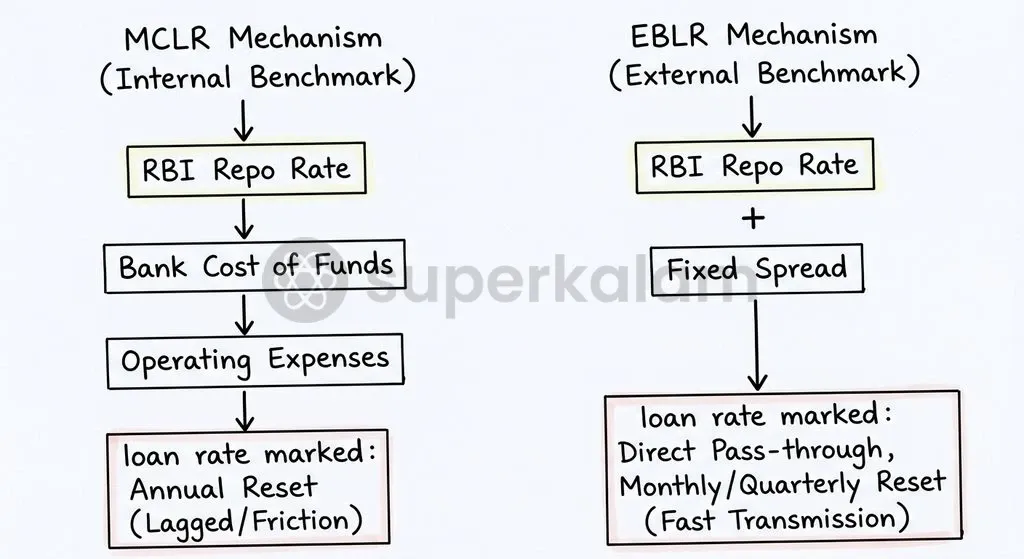
The transition from internal cost metrics to market-linked benchmarks fundamentally altered the speed and equity of India's credit pricing architecture. Prior to the External Benchmark Lending Rate regime, lending rates were governed by the Marginal Cost of Funds based Lending Rate framework, introduced on April 1, 2016. The table below delineates the structural differences between these two regulatory frameworks across operational dimensions:
| Dimension | Marginal Cost of Funds based Lending Rate (MCLR) | External Benchmark Lending Rate (EBLR) |
|---|---|---|
| Benchmark Composition | Determined by bank's internal marginal cost of funds, operating expenses, and tenor premium. | Linked to external market anchors, primarily the Reserve Bank of India policy repo rate or Treasury Bill yields. |
| Reset Frequency | Typically reset annually, or semi-annually, based on underlying loan agreements. | Mandated rate resets conducted at least once every three months. |
| Transmission Speed | Sluggish and sticky; banks delayed passing policy cuts while swiftly incorporating cost increases. | Rapid and automatic; policy rate variations reflect directly in lending rates within the reset quarter. |
| Liability Linkage | Matched to internal deposit cost movements, cushioning bank net interest margins. | Detached from bank deposit liabilities, creating an asset-liability duration and pricing mismatch. |
| Borrower Experience | Retail borrowers experienced long delays before benefiting from falling central bank policy rates. | Retail borrowers absorb immediate rate increases, facing higher monthly payments or extended tenors. |
To introduce flexibility and protect borrowers against rigid contractual terms, the central bank issued amendment directions on September 29, 2025. These regulatory modifications permit commercial banks to compress lending spreads earlier than the traditional three-year cycle, allowing institutions to pass competitive rate reductions onto retail borrowers without awaiting lengthy contractual reset milestones.
Discuss with Superkalam
Formulate a coordinated policy strategy where fiscal supply interventions complement monetary rate actions to stabilize food prices without suppressing private capex.
Ask NowWay Forward: Aligning Fiscal Supply Fixes with Balanced Monetary Policy
Managing the dual imperatives of price stability and sustained economic growth requires calibrated structural reforms across monetary and fiscal domains:
- Targeted Supply-Side Fiscal Interventions: The central government must lead the response against non-core inflation spikes using targeted administrative instruments. As highlighted in the Economic Survey 2024-25, proactive open-market sales, strategic buffer stock releases under the Price Stabilisation Fund, and calibrated import duty adjustments provide the most effective remedies against domestic food supply shocks.
- Promoting Symmetrical Liability Pricing: To address structural transmission imbalances, financial regulators should examine recommendations from the Reserve Bank of India 2017 Internal Working Group regarding external benchmark linkage for wholesale deposits and term deposits. Linking deposit rates to market benchmarks would compel banks to reward depositors equitably during tightening phases rather than passing adjustments exclusively onto retail borrowers.
- Adhering to Prudent Real Rate Thresholds: The Monetary Policy Committee must avoid maintaining excessively high real interest rates when core inflation remains anchored near target levels. Ensuring that the real policy rate stays aligned with India's estimated neutral band of 1.0 to 1.5 per cent prevents excessive dampening of private capital investments and household demand.
- Strengthening Retail Borrower Protections: Commercial banks must strictly implement the central bank's August 2023 guidelines on floating-rate personal loans, providing borrowers with clear disclosures and practical options between tenure extension and equated monthly instalment adjustments to prevent negative amortisation.
Key Takeaways
- The Reserve Bank of India Monetary Policy Committee raised the policy repo rate by 25 basis points to 5.50 per cent on October 7, 2026, shifting its stance to calibrated tightening.
- Section 45ZB of the Reserve Bank of India Act, 1934, provides the statutory foundation for the Monetary Policy Committee, operationalising the Flexible Inflation Targeting framework recommended by the Urjit Patel Committee in 2014.
- Transmission through the External Benchmark Lending Rate regime is rapid on the asset side, affecting over 50 per cent of floating-rate advances across scheduled commercial banks and over 75 per cent in private sector banks.
- Rate tightening exhibits asymmetric pass-through because savings deposit accounts, comprising 30 to 33 per cent of commercial bank deposits, remain largely insensitive to repo rate adjustments.
- Food and beverages hold a 45.86 per cent weight in the Consumer Price Index (Combined) basket, limiting the efficacy of demand-side monetary policy tools against supply-driven price spikes.
Mains Question
"Monetary policy tools are demand-management instruments that lack the capacity to resolve physical supply bottlenecks." In the context of India's Consumer Price Index composition and the mandate under Section 45ZB of the RBI Act, critically examine the efficacy of policy rate hikes in subduing headline inflation. (15 Marks)
Evaluate NowMains Question
The transition to the External Benchmark Lending Rate (EBLR) framework was designed to eliminate transmission friction, yet it has created distinct vulnerabilities for retail borrowers. Elucidate. (10 Marks)
Evaluate NowPractice MCQs
QUESTION 1
With reference to the statutory monetary policy framework in India, consider the following statements:
- Section 45ZB of the Reserve Bank of India Act, 1934, was inserted via the Finance Act, 2016, to establish a six-member Monetary Policy Committee.
- Under Section 45ZA of the Reserve Bank of India Act, 1934, the inflation target is determined by the central bank independently without government consultation.
- The statutory target is anchored to the headline Consumer Price Index with a tolerance band of 2 to 6 per cent. Which of the statements given above are correct?
QUESTION 2
Consider the following statements regarding the External Benchmark Lending Rate (EBLR) framework introduced by the Reserve Bank of India:
- Scheduled commercial banks are mandated to peg all new floating-rate retail loans and advances to Micro and Small Enterprises to external benchmarks.
- Regulated entities are mandated to reset interest rates on EBLR-linked loans at least once every three months.
- The mandatory transition to external benchmarks has eliminated the asymmetry between loan repricing and deposit rate revisions. Which of the statements given above is/are correct?
QUESTION 3
Regarding the transmission of monetary policy through the banking system, consider the following statements:
- The credit channel functions by influencing the overall volume of bank lending extended to households and private enterprises.
- The asset price channel operates by altering market discount rates, thereby impacting asset valuations and household perceived wealth.
- The expectations channel seeks to prevent second-round wage-price spirals by anchoring forward-looking inflation expectations. Which of the statements given above are correct?
QUESTION 4
Which of the following conditions led the Reserve Bank of India to issue binding directions on August 18, 2023, regarding floating-rate personal loans?
QUESTION 5
Consider the following statements regarding the limitations of monetary tightening in India:
- The Consumer Price Index (Combined) basket assigns a weight of 45.86 per cent to food and beverages.
- Policy rate increases directly resolve agricultural supply bottlenecks and lower logistics costs.
- Sustained real policy rates above the neutral corridor (estimated at 1.0 to 1.5 per cent) risk deterring private capital expenditure and curbing consumption. Which of the statements given above is/are correct?