Childhood Obesity in India: WHO Guidelines & Ultra-Processed Food Regulations
As India faces a double burden of malnutrition, regulatory battles over ultra-processed food labels test constitutional mandates under Articles 21 and 47.
Oct, 2026
•10 min read
Overview
The World Health Organization released clinical guidelines on child obesity on 7 October 2026. The guidance establishes that rising childhood adiposity demands mandatory state-level market regulations rather than voluntary lifestyle shifts.
According to the World Health Organization, global obesity prevalence among children and adolescents aged 5 to 19 quadrupled between 1990 and 2024. This trend now affects 170 million young individuals worldwide.
In India, National Family Health Survey-5 data confirms an intensifying double burden of malnutrition. Escalating obesity now coexists with persistent childhood stunting.
Addressing this crisis means shifting regulatory attention away from corporate formulations toward statutory warning labels and binding marketing curbs. This intervention grounds public health action directly in constitutional mandates under Article 21 and Article 47 of the Constitution of India.
Why in the News? The Global Shift Toward Stronger Obesity Rules
The World Health Organization issued its first comprehensive clinical guidelines on childhood and adolescent obesity on 7 October 2026 to counter accelerating rates of non-communicable diseases. The guidelines span two dedicated volumes addressing integrated clinical management for children aged under 10 years and adolescents aged 10 to 19 years.
As of October 2026, global epidemiology shows that obesity prevalence among individuals aged 5 to 19 years quadrupled from 2% in 1990 to 8% in 2024. This demographic shift cuts across developing and industrialised economies alike:
- Children aged 5 to 9 years: 70 million individuals affected worldwide.
- Adolescents aged 10 to 19 years: 100 million individuals affected globally.
Public health jurisprudence connects childhood nutrition directly to constitutional rights. The Supreme Court of India has interpreted Article 21 to encompass the right to health and the preservation of child life as fundamental rights. This doctrine provides judicial grounding for state regulation of ultra-processed food.
Concurrently, Article 47 sets out a Directive Principle of State Policy instructing the state to regard raising nutrition levels, improving standards of living, and advancing public health as among its primary duties. While Part III Fundamental Rights remain enforceable in courts of law, Part IV Directive Principles are non-justiciable directives that remain fundamental in governance. Reconciling both chapters requires statutory regulators to intervene decisively against commercial market practices that jeopardise paediatric wellbeing.
What NFHS-5 Data Tells Us About India's Rising Child Obesity Crisis
National Family Health Survey-5 data reveals that childhood obesity in India is accelerating rapidly alongside persistent childhood undernutrition, creating a severe double burden of malnutrition.
According to the National Family Health Survey-5 (2019-21) released by the Ministry of Health and Family Welfare, the proportion of overweight children under five years of age rose to 3.4% across India, climbing from 2.1% recorded during NFHS-4 in 2015-16. This upward trajectory shows that excess caloric consumption of nutrient-poor foods is spreading beyond affluent metropolitan enclaves into semi-urban and rural households.
| Nutritional Indicator (Children Under 5 Years) | NFHS-4 (2015-16) Level | NFHS-5 (2019-21) Level | Public Health Classification |
|---|---|---|---|
| Stunting (Low Height-for-Age) | 38.4% | 35.5% | Chronic Undernutrition |
| Wasting (Low Weight-for-Height) | 21.0% | 19.3% | Acute Undernutrition |
| Underweight (Low Weight-for-Age) | 35.8% | 32.1% | Composite Undernutrition |
| Overweight / Adiposity | 2.1% | 3.4% | Emerging Overnutrition |
Table notes: Data reflects national child health metrics compiled by the Ministry of Health and Family Welfare.
Administrative monitoring mirrors these demographic findings. Growth tracking data from the Ministry of Women and Child Development's Poshan Tracker recorded that approximately 6% of measured children aged 0 to 5 years—representing over 43 lakh children—were overweight or obese.
Coexisting wasting and adiposity present severe developmental risks. Undernourished infants who experience rapid, low-quality weight gain from ultra-processed snacks face immediate hazards. They develop heightened risks of paediatric hypertension, type-2 diabetes, and early metabolic dysfunction.
Discuss with Superkalam
Recall what percentage of children under five years were identified as overweight in NFHS-5 compared to NFHS-4.
Ask NowInside the WHO 2026 Guidelines: The Push for Strict Regulatory Limits
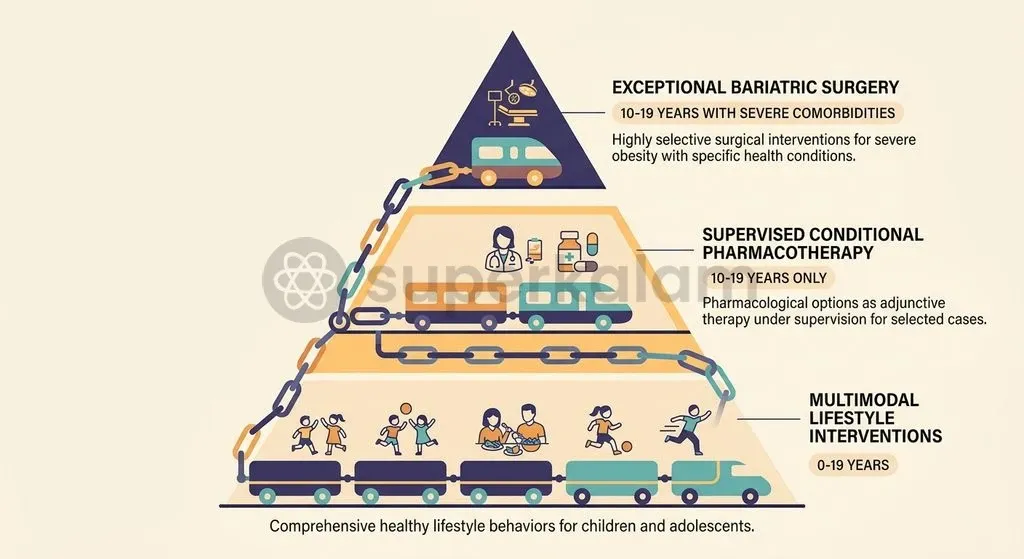
The World Health Organization prioritises structured lifestyle programmes while imposing strict clinical safeguards against premature surgical or pharmaceutical interventions in children. The 2026 clinical guidelines establish multimodal programmes as the primary foundation of paediatric care. These interventions combine structured dietary modifications, physical activity, and behaviour-changing methods delivered individually or through family units.
Digital health tools are conditionally recommended. However, they require direct caregiver supervision to prevent unsupervised screen dependency. For children under 10 years of age, the World Health Organization explicitly advises against pharmacological anti-obesity treatments, bariatric surgery, and medical weight-loss devices.
Medical therapies are strictly staged for older cohorts:
- First-Line Care (Ages 0 to 19): Comprehensive, supervised lifestyle interventions combining nutritional re-education and regular physical exertion.
- Conditional Pharmacotherapy (Ages 10 to 19): Approved anti-obesity medications are restricted to secondary interventions, deployed only when supervised multimodal programmes fail to produce required clinical outcomes.
- Exceptional Surgical Measures (Ages 10 to 19): Bariatric metabolic surgery is limited strictly to severe adolescent obesity complicated by life-threatening comorbidities.
Upstream statutory measures form the core of the global framework. The World Health Organization urges member states to mandate interpretive front-of-pack labelling, enact taxation on sugar-sweetened beverages and ultra-processed foods, mandate public school procurement standards, and enforce statutory advertising bans targeting children.
How Big Food Drives Malnutrition: Commercial Determinants of Health
The World Health Organization defines Commercial Determinants of Health as private sector activities, systems, and practices that directly shape human health and societal equity. This conceptual framework shifts analytical focus away from individual moral failure. Instead, it examines the industrial profit-seeking mechanisms that generate obesogenic environments.
By analysing the food industry through this lens, policymakers evaluate corporate political activity, supply chains, and aggressive advertising that erode consumer autonomy.
Ultra-processed food manufacturers employ deliberate market strategies across two fronts:
- Sensory Engineering: Food scientists calibrate combinations of refined sugars, industrial trans fats, saturated fats, and sodium to achieve hedonic "bliss points". These formulations override natural neurological satiety cues and establish habitual consumption patterns.
- Direct Youth Marketing: Digital algorithms deploy gamification, social media influencer sponsorships, and targeted micro-campaigns to market cheap snacks directly to minors, effectively bypassing parental gatekeeping.
Individual self-control cannot provide an adequate defence against industrial strategies designed to engineer product dependency.
Discuss with Superkalam
How does the net-scoring mechanism of the proposed Indian Nutrition Rating (INR) differ from nutrient-specific warning labels?
Ask NowWarning Labels Versus Star Ratings: The Battle Over FSSAI's Nutrition Rules
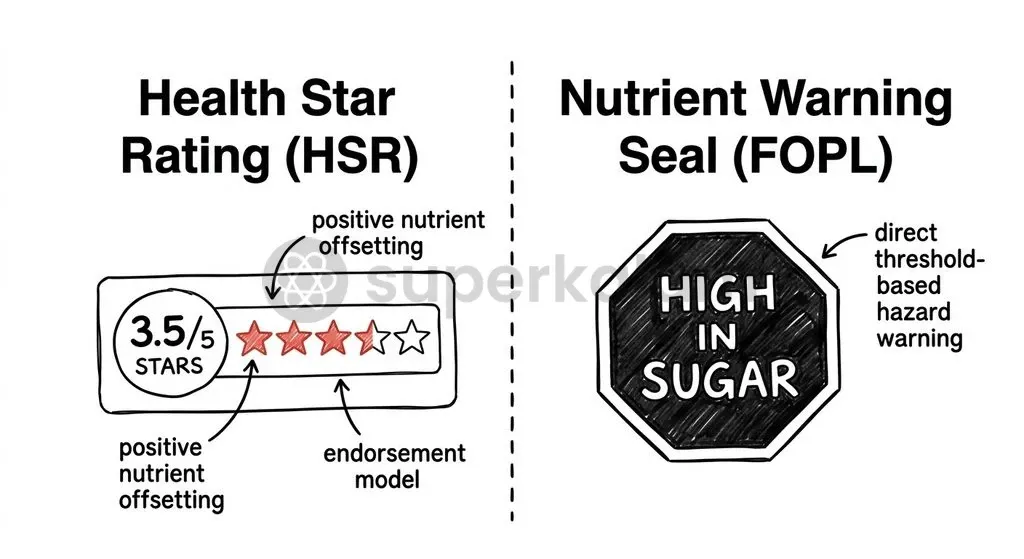
The Food Safety and Standards Authority of India faces persistent regulatory debate regarding front-of-pack design. In September 2022, the statutory authority notified draft Food Safety and Standards (Labelling and Display) Amendment Regulations proposing the Indian Nutrition Rating (INR), an interpretive model assigning products between 0.5 and 5 stars.
Medical practitioners, nutrition scientists, and consumer advocates strongly opposed the Indian Nutrition Rating framework. The underlying scoring algorithm allowed manufacturers to offset harmful levels of sugar, saturated fat, or sodium by adding positive components such as millets, nuts, or dietary fibre. Consequently, confectioneries and ultra-processed cereals could attain high star ratings, confusing consumers seeking healthy dietary choices.
| Dimension | FSSAI Proposed Indian Nutrition Rating (2022) | Mandatory Front-of-Pack Warning Labels |
|---|---|---|
| Visual Mechanism | Summary 0.5 to 5-star scoring icon | Explicit black octagonal "High In" warning stop symbol |
| Algorithmic Logic | Net-scoring: allows positive ingredients to mask high sugar/salt | Nutrient-specific thresholds: flags absolute excess nutrients |
| Industry Preference | Favoured by food processors to protect product imagery | Resisted by industrial manufacturers due to sales deterrence |
| Consumer Efficacy | Induces health halo biases on ultra-processed goods | Delivers rapid risk perception regardless of literacy level |
Table notes: Comparison grounded in regulatory filings and international evaluation standards.
Judicial scrutiny altered this regulatory trajectory. During Supreme Court proceedings in Writ Petition (Civil) No. 437/2024 (3S and Our Health Society v. Union of India), the Food Safety and Standards Authority of India submitted an affidavit on 28 September 2026 confirming its intention to discard the star-rating system in favour of an interpretive warning-label regime. Transitioning to unambiguous warning seals aligns domestic regulations with global clinical recommendations.
Discuss with Superkalam
How can the concept of Commercial Determinants of Health be applied to formulate public procurement guidelines for midday meals in schools?
Ask NowWhy Voluntary Pledges Fail to Keep Junk Food Out of Indian Schools
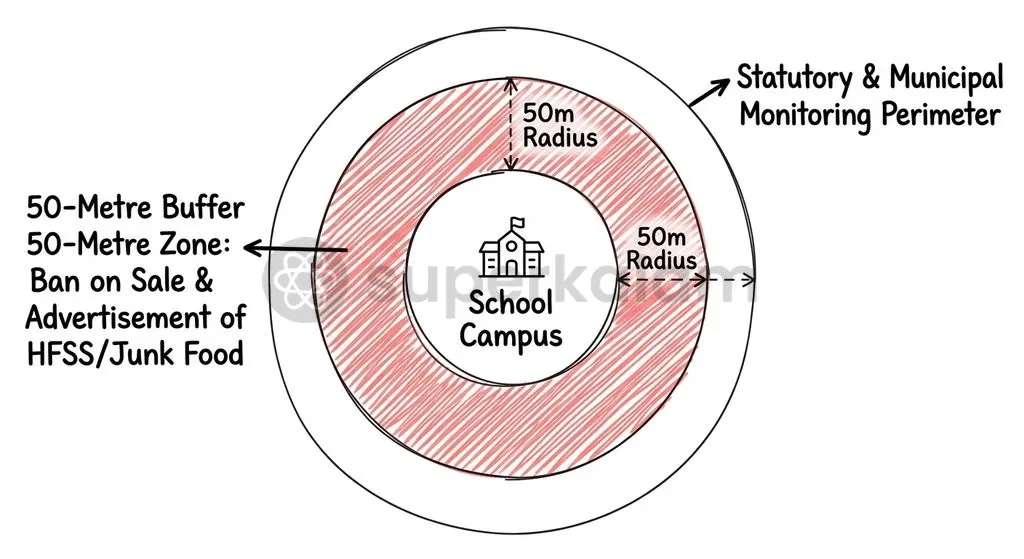
The Food Safety and Standards Authority of India established statutory school buffer zones in 2020, yet enforcement mechanisms remain largely dependent on unmonitored voluntary compliance. Under the Food Safety and Standards (Safe Food and Balanced Diets for School Children) Regulations, 2020, the sale and marketing of foods high in fat, sugar, and salt are strictly prohibited inside school premises and within 50 metres of school gates.
Ground-level execution exposes systemic implementation gaps across educational environments:
- Perimeter Surveillance Deficits: Restrictions suffer from an absence of regular municipal inspection schedules and lack formal enforcement mechanisms for informal street vendors operating immediately outside school boundaries.
- Digital Broadcast Loopholes: While the Central Consumer Protection Authority notified 2022 guidelines prohibiting junk food ads during children's programming, broader digital platforms remain unaddressed.
- Unenforceable Self-Regulation: Digital marketing relies extensively on the Advertising Standards Council of India, a voluntary industry body that lacks statutory penal sanctions to enforce comprehensive bans on digital marketing across streaming platforms and mobile applications.
Discuss with Superkalam
Compare the public health implications of managing acute undernutrition versus managing paediatric adiposity in resource-constrained primary healthcare settings.
Ask NowGlobal Precedents: How Chile, Mexico, and the UK Restricted Ultra-Processed Foods
Chile demonstrated the efficacy of black octagonal warning labels, providing an empirical benchmark for jurisdictions seeking to curtail child consumption of ultra-processed foods. Empirical evaluations confirm that black warning seals marking foods "High In" sugar, sodium, or saturated fat triggered immediate reductions in household purchases of unhealthy packaged formulations.
The Chilean statutory framework enforced multi-tiered protections:
- Barred products bearing warning labels from being sold in schools.
- Banned warning-labelled items from promotional commercial giveaways.
- Prohibited targeted advertising across child-oriented broadcast media.
.
Cross-jurisdictional evidence highlights that self-regulatory industry pledges fail to change corporate reformulation practices. Compelling manufacturers to modify hyper-palatable formulations requires clear front-of-pack warnings combined with fiscal penalties.
Discuss with Superkalam
Should India adopt mandatory front-of-pack warning labels despite resistance from the processed food industry? Justify your stance based on Articles 21 and 47.
Ask NowWay Forward: What India Must Do to Protect Children from Chronic Disease
The Government of India must transition from voluntary industry guidelines to binding statutory safeguards across food labelling, taxation, and school environment monitoring. Following commitments made before the Supreme Court, the Food Safety and Standards Authority of India must promptly notify a mandatory front-of-pack warning label system that marks excess thresholds of sugar, sodium, and saturated fats without permitting offsets.
Fiscal and administrative interventions must proceed across three concrete pillars:
- Upstream Fiscal Levers: Parliament should consider statutory excise levies on ultra-processed foods and sugar-sweetened beverages, mirroring recommendations from the World Health Organization to suppress aggregate consumer demand.
- Municipal Buffer Zone Enforcement: Urban local bodies and district administrations must integrate the 50-metre school perimeter prohibition into trade licensing and municipal health inspections.
- Statutory Digital Advertising Controls: The Central Consumer Protection Authority must expand its 2022 guidelines under the Consumer Protection Act, 2019, replacing non-statutory industry oversight with enforceable civil penalties for algorithmic ad targeting directed at minors.
Grounding national food policy in the non-justiciable directive of Article 47 enables the state to protect the justiciable fundamental right to health under Article 21. Establishing clear nutritional boundaries protects public health systems from unsustainable non-communicable disease expenditures.
Key Takeaways
- The World Health Organization released its first global clinical guidelines on child and adolescent obesity on 7 October 2026, cautioning against paediatric bariatric surgery or anti-obesity drugs for children under 10 years.
- National Family Health Survey-5 data establishes that overweight children under five increased to 3.4%, alongside high rates of stunting (35.5%) and wasting (19.3%).
- The World Health Organization conceptualises childhood adiposity through Commercial Determinants of Health, highlighting corporate formulation engineering and "bliss points."
- The Food Safety and Standards Authority of India informed the Supreme Court in September 2026 of its intent to adopt interpretive warning labels over the 2022 Indian Nutrition Rating star system.
- Statutory school food bans within 50 metres remain constrained by municipal inspection deficits, while advertising rules are limited by reliance on non-statutory self-regulatory codes.
- .
Mains Question
"The transition from undernutrition to a double burden of malnutrition requires moving regulatory focus from voluntary consumer choices to statutory market regulations." In light of NFHS-5 data and recent WHO clinical guidelines, examine the efficacy of statutory interventions in curbing childhood obesity in India. (15 Marks)
Evaluate NowMains Question
'Front-of-pack nutrition labelling models that allow positive nutrients to offset negative nutrients risk generating a health halo bias.' Critically analyse the Indian Nutrition Rating (INR) proposed by FSSAI in comparison with mandatory warning labels. (10 Marks)
Evaluate NowPractice MCQs
QUESTION 1
With reference to child malnutrition indicators in India as per the National Family Health Survey-5 (NFHS-5, 2019-21) data, consider the following statements:
- The proportion of overweight children under five years of age registered a decline compared to NFHS-4.
- While stunting and wasting levels among under-five children decreased between NFHS-4 and NFHS-5, the prevalence of overweight children increased.
- The double burden of malnutrition refers strictly to the coexistence of micronutrient deficiencies and communicable infectious diseases. Which of the statements given above is/are correct?
QUESTION 2
Regarding the World Health Organization (WHO) clinical guidelines on child and adolescent obesity released in October 2026, consider the following statements:
- Structured multimodal lifestyle programmes form the primary foundation of paediatric care across all age cohorts.
- Bariatric surgery and pharmacological anti-obesity treatments are explicitly advised against for children under 10 years of age.
- Digital health tools are recommended unconditionally without the need for caregiver supervision. Which of the statements given above is/are correct?
QUESTION 3
Consider the following statements regarding the regulatory debate over front-of-pack nutrition labelling (FoPL) in India:
- The Indian Nutrition Rating (INR) proposed by FSSAI in 2022 uses an interpretive scoring system assigning products between 0.5 and 5 stars.
- Under the proposed INR framework, high levels of sugar, saturated fat, or sodium could be mathematically offset by adding positive ingredients like millets or dietary fibre.
- Public health advocates prefer summary star-rating models over nutrient-specific front-of-pack warning labels. Which of the statements given above is/are correct?
QUESTION 4
Which of the following best describes the concept of 'Commercial Determinants of Health' as defined by the World Health Organization?
QUESTION 5
With reference to the constitutional provisions governing public health and child nutrition in India, consider the following statements:
- The Supreme Court of India has interpreted Article 21 to encompass the right to health and the preservation of child life.
- Article 47 sets out an enforceable fundamental right obligating the state to raise nutrition levels and advance public health.
- While Directive Principles in Part IV are non-justiciable in courts, they are considered fundamental in governance. Which of the statements given above is/are correct?