Veerangana Durgavati Tiger Reserve: Location and Cheetahs
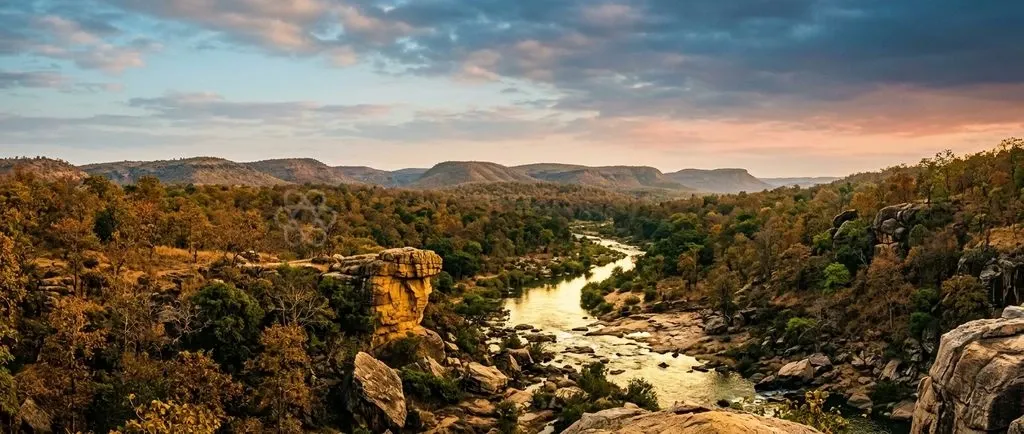
Veerangana Durgavati Tiger Reserve spans Sagar, Damoh and Narsinghpur in Madhya Pradesh. Read its location, habitats and role in Project Cheetah.
Oct, 2026
•9 min read
Overview
Veerangana Durgavati Tiger Reserve was notified under Section 38V of the Wildlife (Protection) Act, 1972, as Madhya Pradesh's seventh tiger reserve. The notification balanced river-linking submergence in Panna while supporting national cheetah reintroduction.
Covering 2,339.12 square kilometres, the reserve unifies the Nauradehi and Veerangana Durgavati Wildlife Sanctuaries. It carries an unresolved ecological challenge. State policy designated it as compensatory habitat for the Ken-Betwa Link Project, yet separate directives earmark its teak forests for grassland cheetahs. Pushing open-savanna hunters into a recovering tiger corridor risks intraguild predation and disrupts Central Indian wildlife movement.
Why in the News: Expanding Project Cheetah to MP's 7th Tiger Reserve
Veerangana Durgavati Tiger Reserve is now the 54th tiger reserve in India. According to the National Tiger Conservation Authority (NTCA) FAQ & Protected Area Registry, the sanctuary constitutes Madhya Pradesh's seventh tiger reserve.
State authorities selected the site as the third cheetah habitat in Madhya Pradesh, as reported by DD News Official Release. This step expands Project Cheetah beyond Kuno National Park and Gandhi Sagar Wildlife Sanctuary.
Dispersing cheetah populations across separate reserves offers specific conservation advantages:
- Risk Distribution: Spreading populations lowers metapopulation extinction risks from disease outbreaks, bushfires, and local carrying-capacity ceilings, as noted in the MoEFCC and Wildlife Institute of India Action Plan for Introduction of Cheetah in India.
- Landscape Expansion: Secondary release sites create space for dispersals as existing founder populations grow.
Overlaying cheetah releases onto an active tiger recovery zone creates friction. The reserve must align statutory rules for inviolate core habitats with the conflicting management needs of two large carnivores.
Discuss with Superkalam
Which two wildlife sanctuaries were unified under Section 38V of the Wildlife (Protection) Act, 1972, to constitute Veerangana Durgavati Tiger Reserve?
Ask NowBorn from a Dam: How Ken-Betwa Submergence Created the Reserve
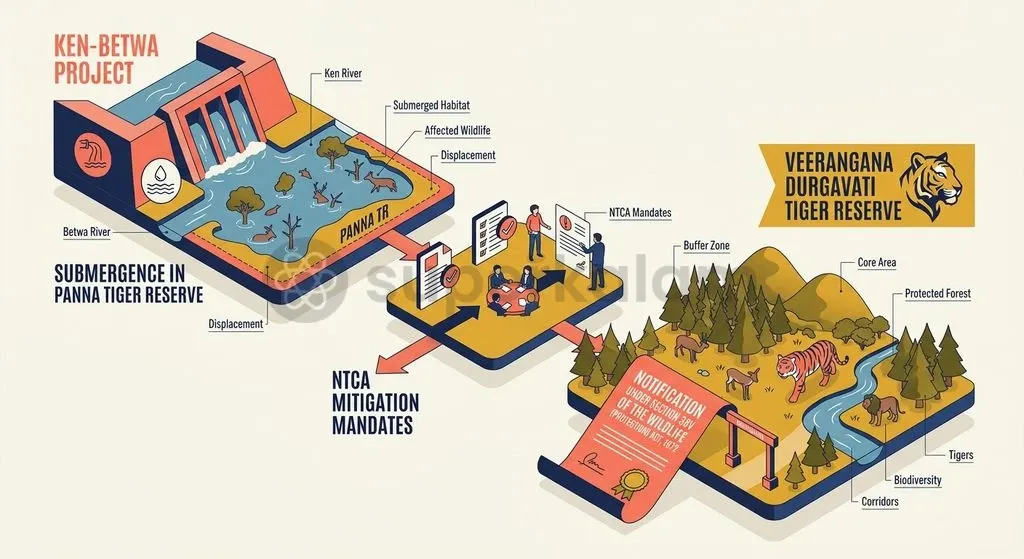
The National Tiger Conservation Authority mandated Veerangana Durgavati Tiger Reserve as an ecological offset for the Ken-Betwa River Link Project. Standing Committee of National Board for Wildlife (SC-NBWL) appraisal documents record that the river-interlinking project will submerge over 100 square kilometres of critical habitat inside Panna Tiger Reserve.
To address this loss, statutory authorities required Madhya Pradesh to consolidate adjacent forest blocks into a high-protection sanctuary:
- Notification Date: The Government of Madhya Pradesh officially notified the reserve on 20 September 2023 under Section 38V of the Wildlife (Protection) Act, 1972, as recorded in Madhya Pradesh Gazette Extraordinary Notification No. F/2/0010/2023/Sec-2-10.
- Administrative Intent: The legal declaration sought to elevate protection across central forests to offset riverine loss in the Bundelkhand region.
Substituting riverine gorge ecosystems with dry deciduous plateau forests rarely yields true ecological equivalence. The process shows how infrastructure targets reshape protected-area boundaries, forcing wildlife managers to construct replacement reserves for displaced biodiversity.
Landscape Profile: Inside Nauradehi and Durgavati Sanctuaries
Veerangana Durgavati Tiger Reserve covers 2,339.12 square kilometres across Sagar, Damoh, and Narsinghpur districts. As detailed in Madhya Pradesh Gazette Extraordinary Notification No. F/2/0010/2023/Sec-2-10, the reserve includes 1,414.006 square kilometres of core or critical tiger habitat and 925.120 square kilometres of peripheral buffer forest.
The terrain reflects the merger of two distinct protected areas:
- Erstwhile Nauradehi Wildlife Sanctuary: Forming most of the core zone, this tract features expansive rolling plateaus and dry deciduous forests.
- Erstwhile Veerangana Durgavati Wildlife Sanctuary: Anchoring the eastern segment in Damoh district, this sanctuary contains rugged hills, dense woodlands, and historic monuments.
District Damoh portal records show the reserve straddles the geographical divide separating the Narmada River basin from the Yamuna River system. The drainage network is anchored by the north-flowing Byarma and Kopra rivers, which run as major tributaries of the Sonar River in the greater Ken river basin.
Cultural heritage is woven into the forest landscape. The historic Singorgarh Fort, tied to Rani Durgavati of the Garha-Katanga Gond kingdom, stands within the boundaries of the tiger reserve in Damoh district, according to the Damoh District Administration.
Discuss with Superkalam
Explain how heavy canopy cover and reduced vigilance horizons heighten the risk of intraguild predation for cheetahs in a deciduous teak forest.
Ask NowThe Ecological Paradox: Putting Grassland Cheetahs in a Tiger Forest
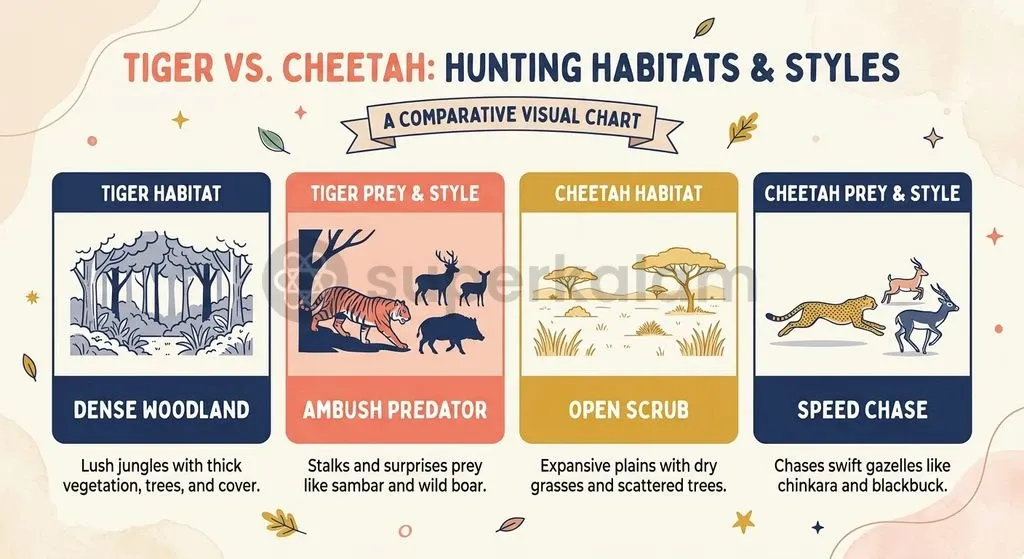
Veerangana Durgavati presents a fundamental habitat mismatch. Its primary vegetation consists of tropical dry deciduous teak forest rather than open savanna. The Action Plan for Introduction of Cheetah in India highlights that cheetahs evolved morphologically and behaviourally for high-speed hunting across open plains and arid grasslands.
Dense canopy cover prevents cursorial hunting, which demands open sightlines and flat, firm ground. The Wildlife Institute of India identified that only restricted enclaves, such as the Mohli Range, contain the open grassland and scrub vegetation necessary for cheetah foraging behaviour. Artificially holding open savanna pockets within a designated tiger reserve interrupts the natural vegetational succession of deciduous forest tracts.
Management regimes across Madhya Pradesh's cheetah sites illustrate sharply divergent spatial strategies:
| Feature | Kuno National Park | Gandhi Sagar Wildlife Sanctuary | Veerangana Durgavati Tiger Reserve |
|---|---|---|---|
| Primary River Basin | Kuno River (Chambal system) | Chambal River basin | Ken and Narmada divide |
| Vegetation Profile | Open dry deciduous forest and savanna | Dry deciduous with open scrub plateaus | Tropical dry deciduous teak forest |
| Fencing Framework | Unfenced core habitat | Predator-proof fenced enclosure | Unfenced corridor with proposed soft-release bomas |
| Apex Predator Status | Leopard-dominated matrix | Controlled carnivore density | Established tiger recovery habitat |
| Primary Statutory Role | Dedicated cheetah park | Dedicated cheetah sanctuary | Compensatory tiger reserve |
Prey profiles create further operational divergence between the two big cats. The Cheetah Action Plan notes that Bengal tigers rely heavily on large, high-biomass ungulates such as sambar, adult nilgai, and wild boar. Cheetahs selectively target small-to-medium ungulates, specifically chinkara, blackbuck, and chital fawns, requiring different vegetative conditions to maintain viable densities.
The Risk of Big-Cat Conflict: Intraguild Predation and Territory Overlap
Cheetah survival in Veerangana Durgavati faces acute pressure from intraguild predation and direct conflict with sympatric carnivores. Research published by the MoEFCC and the Wildlife Institute of India confirms that cheetahs routinely suffer lethal attacks when forced into direct spatial competition with Bengal tigers and leopards.
Wooded environments exacerbate inter-predator conflict through three main mechanisms:
- Intraguild Predation: Tigers and leopards view smaller carnivores as competitors and kill cheetah adults and cubs when home ranges overlap.
- Kleptoparasitism: Dense teak cover allows ambush scavengers, particularly leopards and striped hyenas, to stalk and pirate kills before cheetahs feed.
- Reduced Vigilance Horizons: Heavy tree cover restricts panoramic visibility, eliminating the early-warning predator detection that open-plains cheetahs rely on for evasion.
Spatial connectivity introduces another landscape dilemma. The Wildlife Institute of India's report Status of Tigers, Co-predators and Prey in India documents Veerangana Durgavati as an indispensable stepping-stone corridor connecting Panna Tiger Reserve in the north-east to Satpura Tiger Reserve in the south-west.
Erecting predator-proof fences to protect introduced cheetahs threatens this regional corridor. The Cheetah Action Plan acknowledges that rigid exclusion fencing fragments contiguous migration paths, directly obstructing the movement of tigers, leopards, and large herbivores across Central India.
Discuss with Superkalam
Compare the spatial containment strategies used at Gandhi Sagar Wildlife Sanctuary and Veerangana Durgavati Tiger Reserve, and analyze their impact on landscape connectivity.
Ask NowCompensatory Habitats under Indian Law: Does Offset Conservation Work?
Section 38V of the Wildlife (Protection) Act, 1972 governs the statutory declaration and spatial administration of tiger reserves across India. Under Section 38V(1), state governments notify tiger reserves following the objective ecological criteria and formal recommendations of the National Tiger Conservation Authority.
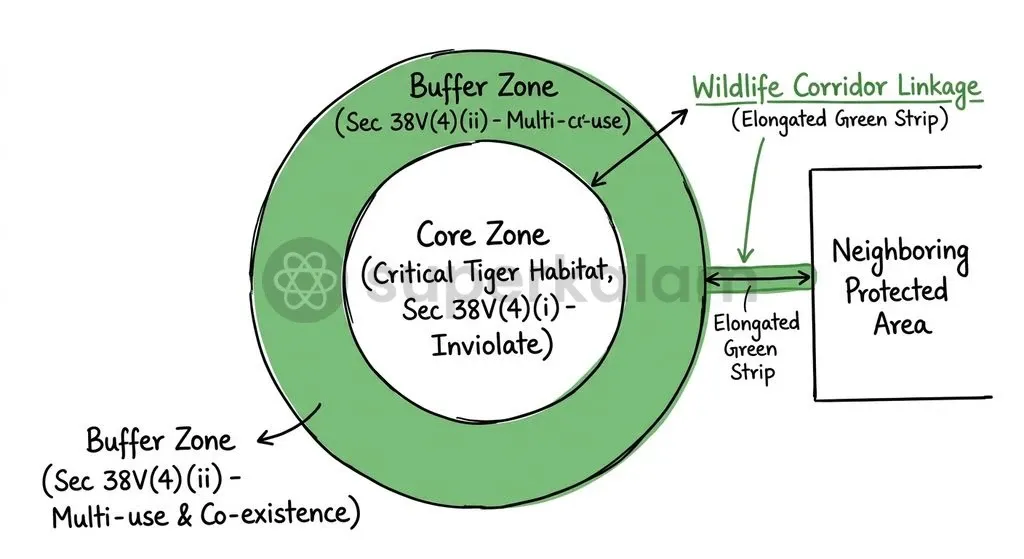
The statutory framework mandates a strict spatial zoning model:
- Core or Critical Tiger Habitat: Section 38V(4)(i) requires state governments to maintain these designated areas as strictly inviolate zones, managed exclusively for tiger conservation through scientific evidence.
- Buffer or Peripheral Areas: Section 38V(4)(ii) defines these multiple-use zones to provide landscape integrity while supporting sustainable coexistence between local communities and wildlife.
- Boundary Integrity Safeguards: Section 38V(5) prohibits altering tiger reserve boundaries without explicit NTCA recommendations and formal approval from the National Board for Wildlife.
Despite these legal barriers, compensatory reserves face ongoing development claims. In February 2026, the Standing Committee of the National Board for Wildlife recommended forest clearance to divert 272 hectares of core forest within Veerangana Durgavati for the Kopra Medium Irrigation Project, according to official SC-NBWL approval records.
Submerging core habitat inside a reserve that was itself established to compensate for Ken-Betwa submergence highlights systemic weaknesses in offset-based conservation models. Legal notifications alter administrative classifications, but they do not automatically safeguard forest land from subsequent infrastructural diversions.
Way Forward: Managing Multi-Carnivore Landscapes and Corridor Health
Harmonising tiger recovery with cheetah reintroduction requires moving away from single-species publicity targets toward unified landscape ecology. Forestry departments must evaluate whether open savanna enclaves can be maintained inside Veerangana Durgavati without undermining the overarching tiger corridor connecting Panna and Satpura.
Conservation policy should focus on four actionable management interventions:
- Zoned Coexistence Without Permanent Fences: Soft-release holding enclosures should serve strictly temporary acclimatisation needs rather than permanent barriers. Retaining permeable buffer zones allows native wildlife dispersal while limiting catastrophic habitat fragmentation.
- Differential Prey Management: Roving herbivore populations must be managed to sustain separate prey guilds. Forest managers must restore chinkara and blackbuck in the Mohli grasslands without disrupting dense browse species required by sambar and nilgai.
- Strict Enforcement of Section 38V: The Ministry of Environment, Forest and Climate Change must halt recurrent land diversions, including irrigation schemes, inside compensatory core areas. Statutory declarations must confer genuine spatial permanence.
- Integrated Carnivore Monitoring: Joint monitoring teams equipped with satellite telemetry must track real-time spatial overlap between tigers, leopards, and reintroduced cheetahs, implementing rapid-intervention protocols whenever fatal encounters become imminent.
Discuss with Superkalam
Assess whether compensatory ecological offsets can truly replace submerged riverine ecosystems, considering subsequent clearances like the Kopra Irrigation Project.
Ask NowKey Takeaways
- Veerangana Durgavati Tiger Reserve was formally notified on 20 September 2023 under Section 38V of the Wildlife (Protection) Act, 1972, becoming Madhya Pradesh's 7th tiger reserve and India's 54th.
- The reserve was established as a statutory compensatory habitat to offset over 100 square kilometres of Panna Tiger Reserve submerged by the Ken-Betwa River Link Project.
- Covering 2,339.12 square kilometres across Sagar, Damoh, and Narsinghpur districts, the sanctuary unifies the erstwhile Nauradehi and Veerangana Durgavati Wildlife Sanctuaries.
- Reintroducing grassland-dependent cheetahs into dense tropical dry deciduous teak forests creates an ecological mismatch, heightening risks of lethal intraguild predation and kleptoparasitism from tigers and leopards.
- The reserve serves as a vital ecological corridor linking Panna to Satpura, meaning large-scale predator fencing for cheetahs risks fragmenting broad-scale tiger dispersal across Central India.
- In February 2026, the National Board for Wildlife recommended diverting 272 hectares of the reserve's core forest for the Kopra Medium Irrigation Project, underlining persistent infrastructural pressures on compensatory habitats.
Mains Question
"Substituting riverine ecosystems with dry deciduous plateau forests under the rubric of compensatory conservation often compromises ecological equivalence." In light of the notification of Veerangana Durgavati Tiger Reserve under Section 38V of the Wildlife (Protection) Act, 1972, critically examine the efficacy of habitat offset mechanisms in India. (15 Marks)
Evaluate NowMains Question
Overlaying the reintroduction of open-savanna carnivores onto an established tiger recovery corridor presents severe ecological trade-offs. Discuss with reference to Project Cheetah's expansion into Veerangana Durgavati Tiger Reserve. (10 Marks)
Evaluate NowPractice MCQs
QUESTION 1
Regarding the statutory framework and notifications governing Veerangana Durgavati Tiger Reserve, consider the following statements:
- It was notified as Madhya Pradesh's seventh tiger reserve under Section 38V of the Wildlife (Protection) Act, 1972.
- The alteration of tiger reserve boundaries is prohibited without recommendations from the National Tiger Conservation Authority and approval from the National Board for Wildlife.
- The reserve was constituted through the amalgamation of the erstwhile Nauradehi and Gandhi Sagar Wildlife Sanctuaries. Which of the statements given above are correct?
QUESTION 2
With reference to the ecological dynamics and geographical profile of Veerangana Durgavati Tiger Reserve, consider the following statements:
- The reserve's drainage network straddles the divide between the Narmada and Yamuna river basins.
- The primary forest vegetation consists of tropical dry deciduous teak forest rather than open savanna.
- The Byarma and Kopra rivers flow through the reserve as tributaries of the Sonar River in the greater Ken basin. Which of the statements given above are correct?
QUESTION 3
Consider the following statements regarding the introduction of cheetahs into Veerangana Durgavati Tiger Reserve:
- Research indicates cheetahs are vulnerable to intraguild predation and kleptoparasitism in dense teak forests.
- Open savanna pockets required for cheetah hunting are naturally uniform across the entire core zone of the reserve.
- Installing predator-proof fences to isolate cheetahs risks severing a critical corridor connecting Panna Tiger Reserve with Satpura Tiger Reserve. Which of the statements given above is/are correct?
QUESTION 4
Consider the following statements regarding the establishment of Veerangana Durgavati Tiger Reserve:
- It was mandated by statutory authorities as an ecological offset for habitat submergence caused by the Ken-Betwa River Link Project.
- The Ken-Betwa River Link Project is projected to submerge over 100 square kilometres of critical habitat within Panna Tiger Reserve. Which of the statements given above is/are correct?
QUESTION 5
The historic Singorgarh Fort, associated with Rani Durgavati of the Garha-Katanga Gond kingdom, is situated within which district of the Veerangana Durgavati Tiger Reserve?