Mecca Defense Pact: The Test for India's West Asia Policy - UPSC Notes
How the trilateral Mecca Joint Defence Agreement tests New Delhi's delicate diplomatic balance between Israel, Iran, and the Gulf.
Aug, 2026
•10 min read
Context
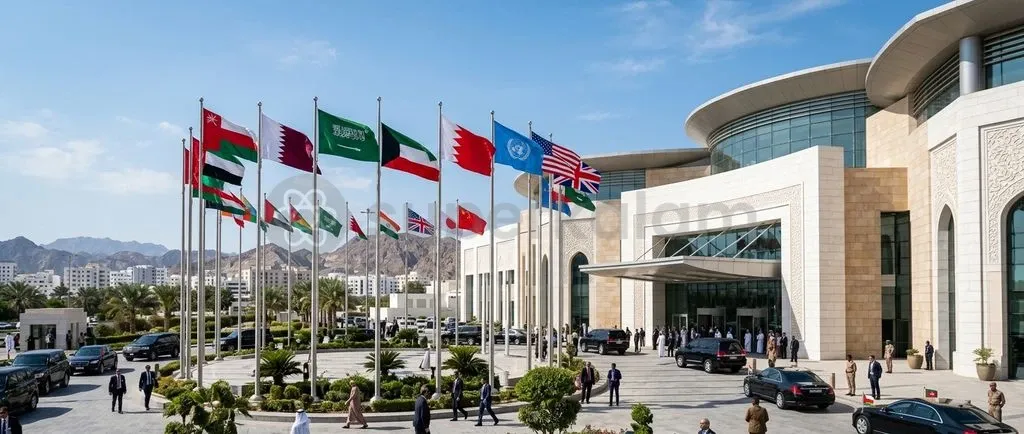
Fig: Shifting security architecture in West Asia tests India's traditional de-hyphenated foreign policy stance.
The formalisation of the Mecca Joint Defence Agreement among Saudi Arabia, Turkey, and Pakistan on 7 August 2026 creates a trilateral collective security bloc in West Asia. This pact presents a major structural test to India's foreign policy of strategic de-hyphenation across rival Middle Eastern capitals.
According to the Ministry of External Affairs, India is closely monitoring this trilateral pact while maintaining its autonomous bilateral relationships with Israel, Iran, and the Gulf Cooperation Council. The agreement binds key regional powers into a mutual defence architecture under an attack-on-one-is-an-attack-on-all principle.
New Delhi balances over $8 billion in defence procurement from Israel alongside vital energy corridors and a 1-crore Indian diaspora in the Gulf. Maintaining strict neutrality without sacrificing core national security interests requires calibrated diplomacy.
Why India's West Asia Policy is Reaching a Turning Point
West Asia's shift toward rigid security alliances challenges New Delhi's flexible diplomacy.
The Ministry of External Affairs officially acknowledged on 7 August 2026 that New Delhi is closely tracking the trilateral Mecca Joint Defence Agreement. As of August 2026, West Asia's geopolitical equilibrium is shifting from fluid bilateral alignments to rigid collective security pacts.
Key diplomatic developments leading to this turning point include:
- 17 September 2025: Saudi Arabia and Pakistan sign a bilateral Strategic Mutual Defence Agreement in Riyadh.
- 19 September 2025: India expects Riyadh to remain mindful of mutual security interests and sensitivities.
- 7 August 2026: The alliance expands to include Turkey through the trilateral Mecca pact, compounding India's foreign policy calculations.
- 7 August 2026: MEA Fact Check Unit dismisses reports of India seeking a reciprocal Israeli pact as AI-generated fake news.
What is the Mecca Defense Pact and Its Regional Impact?
The Mecca Joint Defence Agreement was signed on 7 August 2026 in Mecca by Saudi Arabia, Turkey, and Pakistan. The treaty establishes a collective defence framework where an armed attack against any single member state is treated as an attack against all three members.
Pakistani Foreign Minister Ishaq Dar stated on 9 August 2026 that the agreement is purely defensive in nature, remains open to other regional nations, and aligns with Article 51 of the UN Charter. However, the inclusion of nuclear-armed Pakistan and NATO-member Turkey alongside Saudi Arabia alters regional power dynamics significantly.
| Feature / Dimension | Saudi-Pakistan Defence Agreement (2025) | Mecca Joint Defence Agreement (2026) |
Signing Date & Venue | 17 September 2025 (Riyadh) | 7 August 2026 (Mecca) |
Member States | Saudi Arabia, Pakistan | Saudi Arabia, Turkey, Pakistan |
Legal Framework | Bilateral mutual defence pledge | Trilateral collective security (attack on one is attack on all) |
UN Charter Link | Bilateral security arrangement | Explicitly tied to Article 51 collective self-defence |
Regional Scope | Gulf-South Asia bilateral axis | Broadened West Asian-Anatolian-South Asian defence framework |
Reactions from other regional heavyweights were swift. The Iranian Foreign Ministry stated on 10 August 2026 that the pact highlights declining regional reliance on the United States, while urging neighbouring states not to allow their territories to be used for hostile strikes against Tehran.
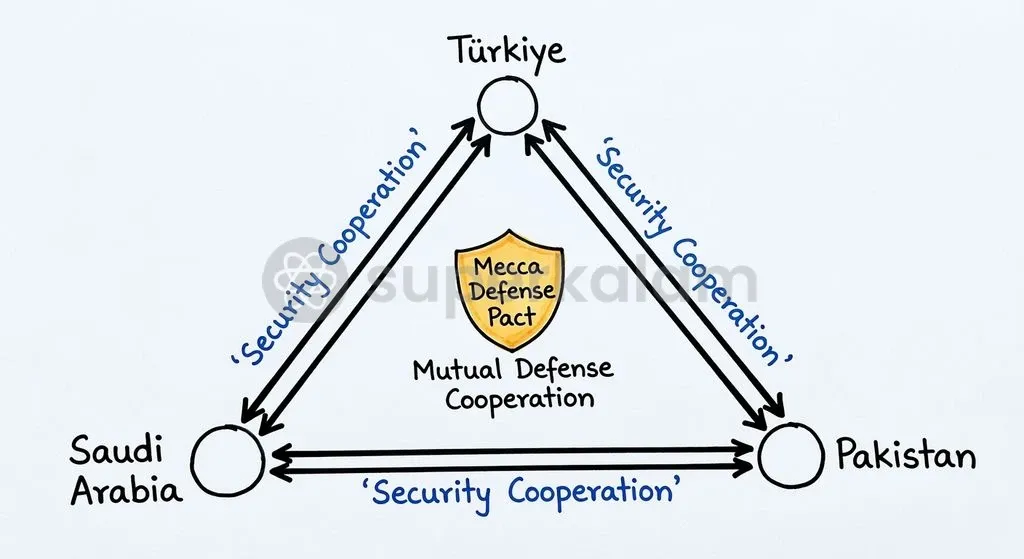
Fig: The trilateral arrangement connects Saudi capital, Turkish defence technology, and Pakistani military manpower.
Discuss with Superkalam
Which three nations signed the Mecca Joint Defence Agreement on 7 August 2026?
Ask NowHow the Mecca Defense Pact Challenges India's De-Hyphenation Strategy
Formal security blocs force New Delhi to recalibrate its strategy of maintaining equal distance between regional rivals.
India's foreign policy doctrine in West Asia relies on strategic de-hyphenation to maintain independent bilateral ties with regional rivals. As documented in Ministry of External Affairs Annual Reports, de-hyphenation enables New Delhi to build strong relations with Israel, Iran, and the Gulf monarchies without allowing one relationship to undermine another.
The Mecca Pact challenges this framework across several operational levels:
- Diplomatic Alignment: Formalising a security alliance links Saudi Arabia—India's vital economic partner—directly with Pakistan, New Delhi's primary security adversary.
- Separation of Interests: Keeping economic ties distinct from national security concerns becomes increasingly complex when key partners sign mutual defence agreements.
- Regional Friction: If regional conflicts escalate, maintaining neutral ties across all capitals will require managing direct overlaps between Gulf defence commitments and South Asian security dynamics.
Balancing Ties: India's Strategic Balancing Act Between Israel, Iran, and Arab Nations
Prime Minister Narendra Modi undertook a landmark state visit to Israel in February 2026 to deepen bilateral strategic cooperation. During the visit on 25–26 February 2026, India and Israel elevated their relationship to a Special Strategic Partnership for Peace, Innovation & Prosperity, expanding cooperation in defence, artificial intelligence, and emerging technologies.
Bilateral defence mechanisms between New Delhi and Tel Aviv remain highly active. The two nations convened the 17th Joint Working Group on Defence Cooperation in Tel Aviv on 4 November 2025, co-chaired by India's Defence Secretary, signing a new Memorandum of Understanding on Defence Cooperation during the session.
| Event / Mechanism | Key Outcome / Detail |
17th Joint Working Group (Nov 2025) | Signed MoU on Defence Cooperation |
High-Level Engagement (Feb 2026) | Elevated ties to Special Strategic Partnership |
Industrial Collaboration (June 2026) | Led by Israeli MoD DG Maj. Gen. Amir Baram |
Bilateral Trade Volume | Cumulative defence procurement exceeding $8 billion |
Defence trade forms a core pillar of this partnership. Israeli Ministry of Defence Director General Maj. Gen. Amir Baram led a high-level delegation to India in June 2026 to expand defence industrial cooperation, with cumulative bilateral defence procurement exceeding $8 billion.
High-level diplomatic contact remains continuous. On 6 August 2026, Prime Minister Narendra Modi and Israeli Prime Minister Benjamin Netanyahu reviewed the Special Strategic Partnership and discussed regional security during a telephone call.
At the same time, India maintains diplomatic balance by engaging Iran and calling for regional stability. On 8 June 2026, India urged all parties in West Asia to immediately de-escalate tensions, protect civilians, and conclude diplomatic negotiations for lasting peace.
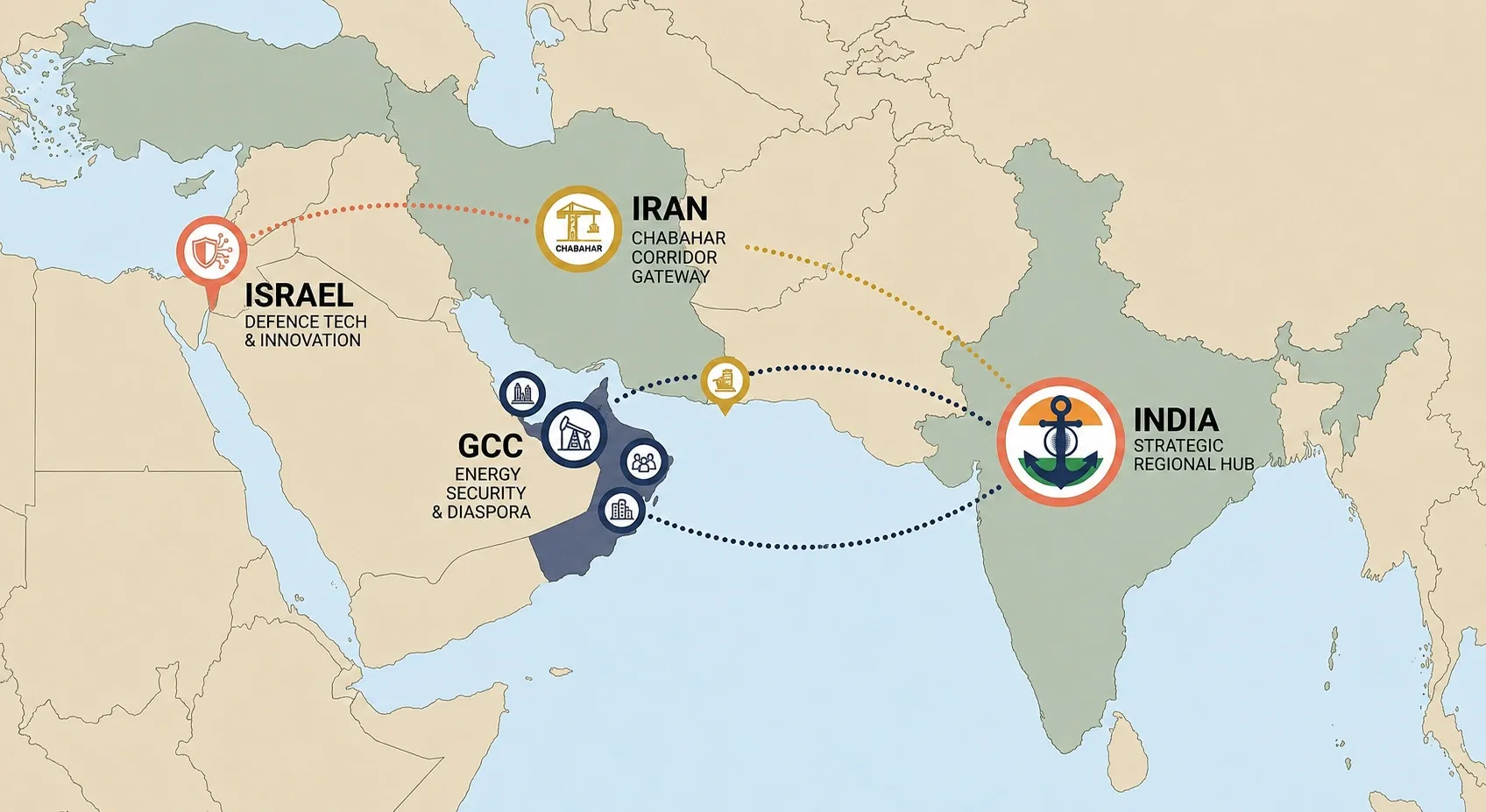
Fig: India's de-hyphenation policy balances strategic partnerships across conflicting regional poles.
Economic Stakes: Energy Security, Trade Corridors, and Diaspora
The Ministry of External Affairs reaffirmed on 3 March 2026 that safeguarding nearly 1 crore Indian citizens in the Gulf remains New Delhi's top priority. The welfare of this 10-million-strong diaspora is central to India's economic resilience and remittance inflows.
Maritime security in West Asian shipping lanes is equally vital for national energy security. On 8 July 2026, India expressed deep concern over the targeting of commercial shipping in international waterways and called for the uninterrupted flow of energy supplies and maritime commerce.
India's primary strategic stakes in the region span three core domains:
- Human Capital: Protecting ~1 crore (10 million) Indian citizens residing across Gulf countries.
- Energy Security: Ensuring uninterrupted oil and gas flows through key maritime choke points.
- Trade Infrastructure: Building the India-Middle East-Europe Economic Corridor (IMEC).
Strategic infrastructure projects also depend on regional stability. The India-Middle East-Europe Economic Corridor (IMEC) MoU was signed on 9 September 2023 at the G20 New Delhi Summit by India, the UAE, Saudi Arabia, the European Union, France, Germany, Italy, and the United States. It connects Indian ports to European markets through Gulf transit nodes.
Discuss with Superkalam
How should India balance Israel defence ties with Gulf strategic interests?
Ask NowThe Way Forward for India's Diplomatic Calculus
India must reinforce its strategic autonomy through proactive bilateral diplomatic dialogues with key West Asian governments. Maintaining stability across maritime choke points and securing national interests requires a focused diplomatic approach.
- Sustain High-Level Diplomatic Dialogue: Engagement with Saudi Arabia must continuously emphasise mutual security sensitivities regarding defence arrangements in South Asia.
- Protect Maritime Trade Arteries: Strengthen naval monitoring and diplomatic coordination to guarantee uninterrupted energy supplies across West Asian sea lanes.
- Accelerate Strategic Infrastructure: Advance implementation steps for the India-Middle East-Europe Economic Corridor alongside Gulf and European signatories.
- Insulate Diaspora Security: Maintain robust emergency management protocols with Gulf host nations to protect the nearly 1-crore Indian workforce during crises.
Key Takeaways
- Saudi Arabia, Turkey, and Pakistan signed the Mecca Joint Defence Agreement on 7 August 2026, establishing a trilateral collective defence framework based on Article 51 of the UN Charter.
- India's Ministry of External Affairs is closely tracking the trilateral pact, having previously advised Saudi Arabia in September 2025 to remain mindful of mutual sensitivities regarding its defence ties with Pakistan.
- New Delhi rejected claims of seeking a reciprocal security agreement with Israel in August 2026, labeling such reports as AI-generated fake news.
- India and Israel elevated ties to a Special Strategic Partnership in February 2026, backed by cumulative bilateral defence procurement exceeding $8 billion.
- Core Indian economic stakes in West Asia include safeguarding 1 crore citizens, securing maritime energy shipping, and implementing the IMEC corridor signed at the 2023 G20 Summit.
Mains Question
"The formalisation of collective security architectures in West Asia presents a major structural test to India's foreign policy of strategic de-hyphenation across rival regional capitals." In light of the Mecca Joint Defence Agreement, critically analyse the challenges posed to India's strategic autonomy and outline the key priorities for Indian diplomacy. (15 marks)
Evaluate NowMultiple Choice Questions
QUESTION 1
Q1. Consider the following statements regarding the Mecca Joint Defence Agreement signed in August 2026:
- It is a trilateral agreement involving Saudi Arabia, Turkey, and Iran.
- It establishes a collective defence framework where an attack against any single member state is treated as an attack against all members.
- Pakistani Foreign Minister stated that the pact aligns with Article 51 of the UN Charter regarding collective self-defence.
Which of the statements given above are correct?
QUESTION 2
Q2. With reference to India's diplomatic engagements in West Asia as noted in recent official statements, consider the following statements:
- India and Israel elevated their relationship to a Special Strategic Partnership during a state visit in February 2026.
- The 17th Joint Working Group on Defence Cooperation between India and Israel was held in Tel Aviv in November 2025.
- The Ministry of External Affairs Fact Check Unit confirmed in August 2026 that India has officially entered into a reciprocal defence treaty with Israel.
Which of the statements given above is/are correct?
QUESTION 3
Q3. Consider the following statements regarding the India-Middle East-Europe Economic Corridor (IMEC):
- The Memorandum of Understanding for IMEC was signed at the G20 New Delhi Summit in September 2023.
- Its primary objective is to connect Indian ports to European markets through Gulf transit nodes.
- Signatories to the IMEC MoU include India, the UAE, Saudi Arabia, the European Union, France, Germany, Italy, and the United States.
Which of the statements given above are correct?