Inflation: Definition, Types, Causes, & Measures (UPSC Notes)
Inflation is a sustained increase in the general price level, reducing purchasing power. Learn its types, causes and control measures for UPSC Prelims and Mains.
Jan, 2026
•8 min read
Imagine that you are going to the market and notice that the vegetables, milk, or bus ticket now cost more than before. Over time, the prices of common goods and services continue to increase. When this happens, your money can buy less than it used to. This situation is known as inflation.
Inflation is a crucial topic for both the UPSC Prelims (CPI, WPI, and control measures) and the Mains (monetary policy, fiscal measures, and government interventions).
Let’s understand this topic in detail!
What is Inflation?
Inflation is the continuous increase in the prices of goods and services in an economy over time. It is the general rise in the cost of living, where your money buys fewer things than it used to.
For example, if inflation is 5% this year, items that cost ₹100 last year will now cost ₹105.
- It reduces the purchasing power of money, meaning each rupee buys fewer goods and services over time.
- Inflation is measured as a percentage change in price levels, typically calculated annually.
- A moderate level of inflation (around 2-4%) is considered healthy for economic growth.
- For India, RBI targets 4% inflation with ±2% tolerance band (2-6% range).
- It affects everyone, but impacts lower-income groups more severely as they spend a higher proportion of their income on necessities.
Also read: Circular Economy: Meaning, Significance and Benefits [UPSC]
Types of Inflation
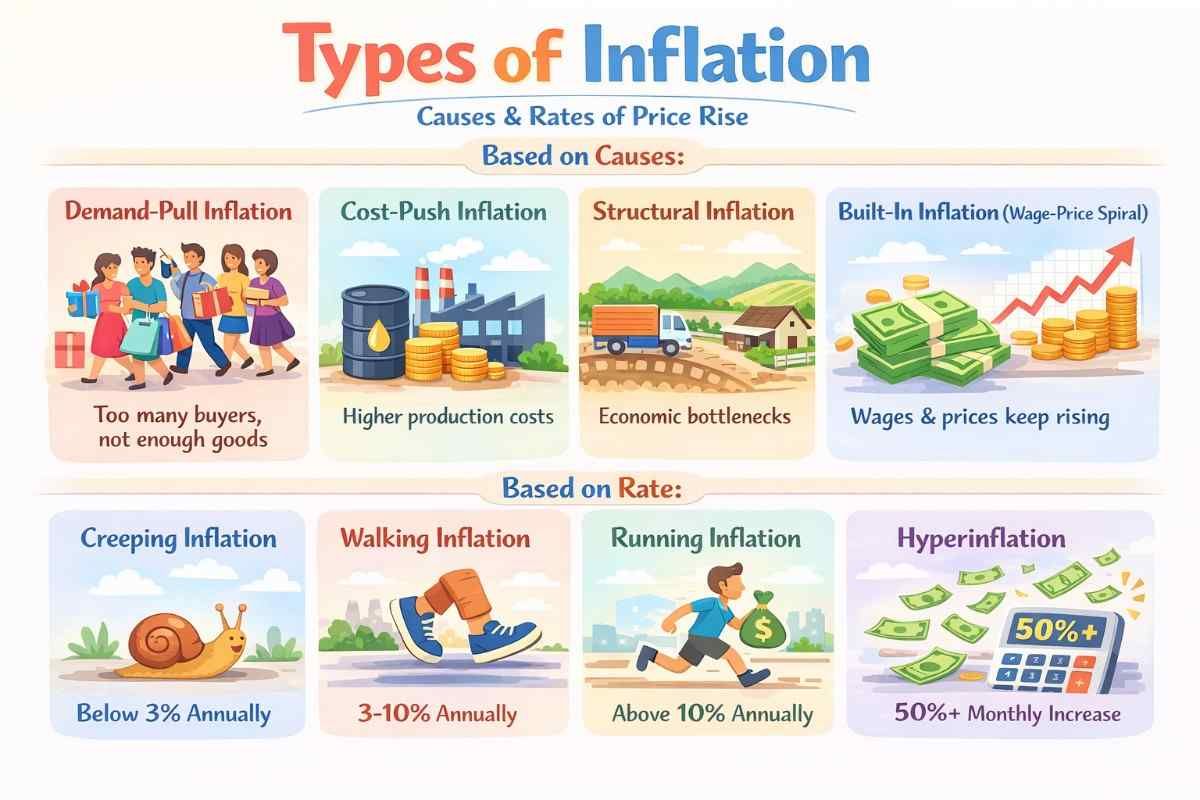
Inflation can be categorised based on its causes and the rate at which prices rise.
Based on Causes
1. Demand-Pull Inflation:
- Demand-pull inflation happens when more people want to buy goods and services than what is available. Because demand is higher than supply, prices go up.
- Example: During a festival season, many people buy new clothes and gifts. Shops may not have enough stock for everyone, so prices increase due to high demand.
In short, demand-pull inflation means "too many buyers chasing too few goods," causing prices to rise.
2. Cost-Push Inflation:
- Cost-push inflation happens when the prices of goods and services rise because it costs more to make them.
- Example: If the price of oil goes up, businesses pay more for fuel and materials, so they increase their prices to cover these costs.
In short, cost-push inflation means higher production costs push prices up.
3. Structural Inflation:
- Structural inflation arises from long-term structural bottlenecks and rigidities in the economy, particularly in developing countries like India.
- Sources:
- Inadequate infrastructure (roads, storage, logistics)
- Fragmented and inefficient agricultural markets
- Low productivity and capacity constraints in key sectors
- Regulatory and institutional rigidities
- Example (India): Farmers may produce enough vegetables at low farm-gate prices, but due to poor cold-storage, transport, and market linkages, a large part is wasted. Limited effective supply in cities leads to high consumer prices, even when production is adequate.
4. Built-in Inflation (Wage-Price Spiral)
- Also known as expectation-driven inflation, this occurs when people expect prices to rise and adjust their behaviour accordingly, creating a self-fulfilling prophecy.
Based on the Rate
- Creeping Inflation: Below 3% annually, considered healthy for economic growth
- Walking/Trotting Inflation: Between 3-10% annually
- Running/Galloping Inflation: Above 10% annually
- Hyperinflation: Extremely rapid price increases, often above 50% monthly
Also read: Indian Diaspora: Complete UPSC Notes
Measurement of Inflation
India uses sophisticated methods to track inflation, ensuring accurate policy decisions.
Consumer Price Index (CPI)
- Measures retail-level price changes affecting consumers directly.
- It includes food, housing, education, medical care, and services.
- The RBI adopted CPI as its primary inflation measure in April 2014.
Wholesale Price Index (WPI)
- Tracks price changes at the wholesale level, focusing on goods traded in bulk between businesses.
- It doesn't include services but covers manufactured goods, primary articles, and fuel.
GDP Deflator
- Provides an economy-wide measure of inflation by comparing current and constant price GDP.
- Key Differences:
- CPI captures consumer experience while WPI reflects producer costs.
- CPI includes services; WPI focuses mainly on goods.
- CPI gives higher weightage to food items; WPI emphasises manufactured goods.
Also read: Inclusive Growth UPSC Notes: Definition, Objectives and Government Schemes
Headline Inflation Headline inflation is the total inflation rate measured by the Consumer Price Index (CPI), including all items like food and fuel.
Core Inflation Core inflation measures inflation after removing food and fuel prices, as they change frequently.
|
Causes of Inflation
Understanding inflation's root causes helps in formulating effective policies.
Monetary Factors:
- Excessive Money Supply: When central banks print too much money, it increases liquidity in the system, leading to higher demand and prices.
- Low Interest Rates: Cheap credit encourages borrowing and spending, boosting demand.
Fiscal Factors:
- High Government Spending: Increased public expenditure, especially on consumption, raises aggregate demand.
- Budget Deficits: When governments spend more than they earn, it often leads to money printing and inflation.
Supply-Side Factors:
- Production Costs: Rising wages, raw material prices, and energy costs push up production expenses.
- Supply Disruptions: Natural disasters, strikes, or global supply chain issues reduce the availability of goods.
Structural Factors:
- Food Price Volatility: In India, food has a high weightage in the inflation basket, making agricultural price swings significant.
- Infrastructure Bottlenecks: Poor storage, transportation, and distribution networks contribute to price rises.
Also read: MSMEs in India UPSC Notes: Classification, Sectors and Government Schemes & Challenges
Impacts of Inflation
Inflation affects different sections of society and the economy in various ways.
Economic Impacts
- Reduced Purchasing Power: Fixed-income earners suffer most as their real income declines.
- Uncertainty in Investment: High inflation creates unpredictability, discouraging long-term investments.
- Redistribution of Wealth: Borrowers benefit as they repay loans with cheaper money, while savers lose.
Social Impacts
- Disproportionate Effect on Poor: Lower-income groups spend more on food and necessities, making them vulnerable to price rises.
- Erosion of Savings: Real value of bank deposits and fixed-income securities declines.
- Social Unrest: Persistent high inflation can lead to public dissatisfaction and political instability.
Positive Effects
- Debt Reduction: Makes it easier for borrowers to repay loans.
- Encourages Spending: Mild inflation motivates people to spend rather than hoard money.
- Economic Growth: Moderate inflation often accompanies healthy economic expansion.
UPSC Prelims PYQ on Inflation
QUESTION 1
In India, which one of the following is responsible for maintaining price stability by controlling inflation?
Measures to Control Inflation
Both the government and RBI employ various tools to manage inflation effectively.
Monetary Policy Measures (by RBI)
- Repo Rate Adjustment: Increasing the repo rate makes borrowing expensive, reducing the money supply, and cooling demand.
- Cash Reserve Ratio (CRR): A Higher CRR reduces bank lending capacity.
- Statutory Liquidity Ratio (SLR): Forces banks to hold more government securities, reducing lendable funds.
- Open Market Operations: Selling government securities absorbs excess liquidity from the market.
Fiscal Policy Measures (by Government)
- Reduced Government Spending: Controlling public expenditure to reduce aggregate demand.
- Tax Policy: Adjusting taxes to influence consumer spending patterns.
- Subsidy Management: Strategic use of subsidies to control prices of essential items.
Administrative Measures
- Buffer Stock Management: Maintaining strategic reserves of essential commodities to stabilise prices.
- Export-Import Policy: Restricting exports or reducing import duties on essential items.
- Price Controls: Setting maximum retail prices for essential commodities.
- Anti-Hoarding Measures: Preventing artificial scarcity through strict monitoring.
Must read: Monetary Policy in India: Complete Notes for UPSC Indian Economy
Important Inflation Concepts1. Stagflation: Stagflation is a situation where an economy experiences high inflation, high unemployment, and stagnant or low growth simultaneously. Traditionally, inflation and unemployment move in opposite directions. Stagflation breaks this pattern.
2. Deflation: A sustained fall in the general price level (negative inflation).
3. Disinflation: Disinflation means a slowdown in the rate of inflation (prices still rise, but more slowly).
|
UPSC Mains Previous year Practice Question
What are the causes of persistent high food inflation in India? Comment on the effectiveness of the monetary policy of the RBI to control this type of inflation. (2024)
Evaluate Your Answers nowWay Forward
India's approach to inflation management continues to evolve with changing economic dynamics.
- Strengthen Supply Chains: Improve storage, processing, and distribution infrastructure for perishables like vegetables.
- Diversify Production: Reduce import dependence for edible oils by increasing domestic oilseed production.
- Structural Reforms: Address bottlenecks in agriculture, logistics, and food processing sectors.
- Financial Inclusion: Expand access to formal financial services to reduce informal sector price volatility.
- Review CPI Basket: Update weights and items based on current consumption patterns.
Boost your UPSC preparation with SuperKalam
Your smart mentor for instant doubt-solving, personalised study plans, PYQs, and rapid Mains evaluation. Start today and stay ahead!
Unlock SuperKalam’s tools and fast-track your UPSC success!
Crack UPSC with your Personal AI Mentor
An AI-powered ecosystem to learn, practice, and evaluate with discipline
Download the SuperKalam App Now