MSMEs in India UPSC Notes: Classification, Sectors and Government Schemes & Challenges
MSMEs in India UPSC Notes: Understand MSME definition, classification, key sectors, major government schemes, challenges and reforms, crisp notes for Prelims & Mains. Click now!
Dec, 2025
•4 min read
India’s Micro, Small and Medium Enterprises (MSME) sector is often referred to as the backbone of the Indian economy. It drives jobs, exports, and inclusive growth and supports large industries as suppliers and service providers.
MSME is an important topic for both Prelims (definitions, classifications, schemes, data) and Mains (role in growth, challenges, reforms). Let’s study this topic in detail!
What are MSMEs?
MSMEs (Micro, Small, and Medium Enterprises) are small businesses in manufacturing, services, trade, and related activities, which are officially recognised based on their investment in plant & machinery/equipment and annual turnover. They can be micro, small or medium depending on their size.
- MSMEs in India come under the Ministry of Micro, Small and Medium Enterprises (MoMSME), Government of India.
- Registration is done on the Udyam Portal (online, paperless, Aadhaar-based).
- MSMEs contribute approximately 30.1% to India's Gross Domestic Product (GDP).
- These enterprises employ over 28 crore people, making them the second-largest employment generator after agriculture.
- MSMEs form the largest single-country MSME system globally, with 6.5 crore registered units in India as of 2025.
- Micro, Small, and Medium Enterprises are defined under the Micro, Small and Medium Enterprises Development (MSMED) Act, 2006.
Also read: Prime Minister Dhan-Dhaanya Krishi Yojana
Objectives of MSMEs
The MSME sector aims to promote entrepreneurship, create employment opportunities, and foster inclusive economic growth across India. Key objectives are:
- Generate large-scale employment at low capital cost, especially in rural and semi-urban areas.
- Promote inclusive growth by supporting small entrepreneurs, artisans, self-employed and first-generation entrepreneurs.
- Encourage entrepreneurship and innovation, especially among youth, women, SC/ST, OBC and minorities.
- Support balanced regional development by spreading industries beyond big cities into backward and rural regions.
- Boost manufacturing and services in line with Atmanirbhar Bharat and Make in India.
- Facilitate formalisation through Udyam/Udyam Assist, making enterprises eligible for credit, subsidies and other benefits.
Also read: BharatNet Project | UPSC Governance Notes
Classification of MSMEs
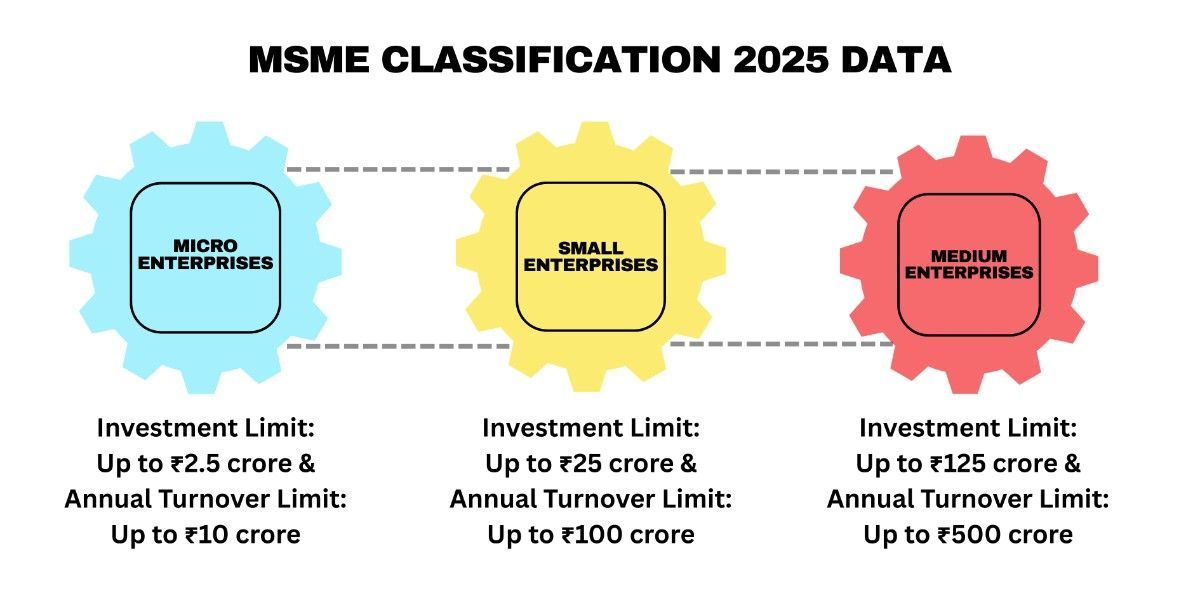
As per the Union Budget 2025, the government revised MSME classification criteria with effect from April 1, 2025.
| Enterprise Category | Investment Limit (Plant & Machinery/Equipment) | Annual Turnover Limit | Previous Investment Limit | Previous Turnover Limit |
|---|---|---|---|---|
| Micro Enterprise | Up to ₹2.5 crore | Up to ₹10 crore | Up to ₹1 crore | Up to ₹5 crore |
| Small Enterprise | Up to ₹25 crore | Up to ₹100 crore | Up to ₹10 crore | Up to ₹50 crore |
| Medium Enterprise | Up to ₹125 crore | Up to ₹500 crore | Up to ₹50 crore | Up to ₹250 crore |
These revised criteria apply to both manufacturing and service sector enterprises.
Also read: Make in India UPSC Notes: Pillars, Objectives, and Key Infrastructure Schemes
MSME Act 2006
The Micro, Small and Medium Enterprises Development (MSMED) Act, 2006, is the law that defines, regulates, and promotes MSMEs in India by providing classification, development measures, and policy support.
- Enacted in 2006 to strengthen and formalise the MSME sector.
- Legally defines Micro, Small, and Medium Enterprises (initially by investment; revised to turnover + investment in 2020).
- Provides a single framework for MSME promotion and development.
- Ensures delayed payment protection for MSMEs from buyers (payment within 45 days).
- Mandates the establishment of Micro & Small Enterprises Facilitation Councils (MSEFCs) for dispute resolution.
- Empowers the government to launch schemes, incentives, subsidies, and credit support for MSMEs.
- Encourages technology upgradation, infrastructure development, and skill enhancement.
- Forms the legal basis for systems like Udyog Aadhaar and Udyam Registration.
Also read: Monetary Policy in India: Complete Notes for UPSC Indian Economy
Sectors Under MSMEs
The MSME sector covers both manufacturing and service industries. This includes:
1. Manufacturing Sector
The manufacturing MSME sector encompasses businesses engaged in producing finished goods from raw materials. Some examples are:
- Textile and Garments: From traditional handlooms to modern garment factories, this is a dominant MSME segment with deep cultural and economic roots.
- Food Processing: Fruit and vegetable preservation, baking, dairy products, and spice processing, ensuring food security and export competitiveness.
- Leather Products: Manufacturing of bags, wallets, shoes, belts, and other leather goods catering to domestic and international markets.
- Metal and Engineering Products: Manufacturing of components, machinery parts, and specialised engineering equipment.
- Automobile Components: Production of parts and accessories for the automotive industry.
- Pharmaceuticals and Ayurveda: Manufacturing of active pharmaceutical components, ayurvedic products, and formulations.
2. Service Sector
The service sector constitutes a larger portion of registered MSMEs and demonstrates the breadth of non-manufacturing economic activities. Some examples are:
- IT and Business Services: Software development, back-office operations, data processing, and technical consultancy.
- Healthcare and Diagnostic Services: Nursing homes, diagnostic centres, and medical consultation clinics.
- Education and Training: Coaching centres, skill development institutes, and specialised training facilities.
- Hospitality and Tourism: Hotels, restaurants, lodges, and tourism-related services.
- Transportation and Logistics: Vehicle rentals, local freight services, and delivery networks.
- Financial Services: Non-banking financial institutions, insurance intermediaries, and investment advisory services.
Also read: Unemployment in India UPSC Notes: Types, Causes & Government Measures
Government Schemes for MSMEs
The Government of India runs a suite of schemes to support and develop MSMEs. These schemes offer subsidies, credit, training, technology and marketing support. Major programmes include:
1. Udyam Portal
Udyam is a simplified, online, self-declaration-based registration system that replaced the earlier Udyog Aadhaar Memorandum.
- Fully Digital and Paperless: The entire registration process is online with zero physical documentation required.
- Cost-Free: No registration fees or hidden charges.
- Quick Processing: Instant registration with a 12-digit Udyam Registration Number (URN).
- Loan Approval Expeditation: Banks use Udyam registration to quickly verify business legitimacy and approve loans.
- Government Tender Access: Easy participation in government procurement and tenders with exemptions during the application.
- Automatic Integration: Registered data automatically integrates with government databases, including PAN, GST, and IT records.
2. Pradhan Mantri Mudra Yojana (PMMY)
PMMY provides collateral-free loans to MSMEs, enabling them to expand operations and improve cash flow.
Loan Categories:
- Shishu Loans: Up to ₹50,000 for initial business setup and expansion.
- Kishor Loans: Up to ₹5 lakhs for businesses with some operating history.
- Tarun Loans: Up to ₹10 lakhs for established enterprises seeking expansion.
- Tarun Plus Loans: Covering loans above ₹10 lakh and up to ₹20 lakh.
Benefits:
- No collateral or security required.
- Flexible repayment terms based on business cash flows.
- Quick loan disbursal through participating banks and financial institutions.
3. Credit Guarantee Fund Trust for Micro and Small Enterprises (CGTMSE)
CGTMSE facilitates credit flow to MSEs without requiring collateral security or third-party guarantees, addressing the primary financing barrier for small enterprises.
- Guarantee Coverage Increased: With effect from April 1, 2025, the scheme facilitates credit guarantees up to ₹10 crore (increased from ₹5 crore), enabling larger borrowings.
- Guarantee Fee Reduction: Annual guarantee fees for guarantees above ₹1 crore have been reduced to attract more MSEs.
- Special Benefits: Extended special benefits to MSEs promoted by transgender entrepreneurs.
- Portfolio-Based Guarantee: Banks extend credit and receive guarantee cover on a portfolio basis, reducing risk.
4. PMEGP (Prime Minister's Employment Generation Programme)
PMEGP is a major credit-linked subsidy scheme generating self-employment opportunities through the establishment of micro-enterprises in the non-farm sector.
Subsidy Structure:
- General Category: 15% subsidy in rural areas, 25% in urban areas
- Special Category (SC/ST/OBC/Women/Ex-servicemen/Minorities): 25% subsidy in rural areas, 35% in urban areas.
Maximum Project Cost:
- Manufacturing Sector: Up to ₹50 lakhs
- Service Sector: Up to ₹20 lakhs
Target Beneficiaries: Unemployed youth, traditional artisans, and rural entrepreneurs
Eligibility:
- Age: 18 years and above
- Education: VIII standard pass for projects above ₹10 lakhs (manufacturing) or ₹5 lakhs (services).
- No income ceiling
Implementation: The scheme is administered by the Khadi and Village Industries Commission (KVIC) at the national level and implemented through State KVIC Directorates, State KVIBs, and District Industries Centres.
5. PM Vishwakarma Scheme
A comprehensive support scheme for traditional artisans and craftspeople engaged in 18 recognised trades who work primarily with their hands and tools.
- Recognition: PM Vishwakarma Certificate and ID Card, providing formal recognition and social status.
- Collateral-Free Credit: Access to credit without collateral requirements.
- Skill Upgradation: Specialised training and capacity building programs.
- Toolkit Incentive: Financial assistance for purchasing or upgrading tools of trade
- Market Linkages: Connection with markets and e-commerce platforms for product sales.
6. Scheme of Funds for Regeneration of Traditional Industries (SFURTI Scheme)
SFURTI promotes cluster development by organising traditional industries and artisans into clusters for long-term sustainability and economies of scale.
- Cluster Development: Support for organising traditional artisans and industries into geographical clusters.
- Timelines: Implementation timeline reduced from 3 years to 12-18 months as of March 2020.
- Project Funding: Government grant-based funding for eligible projects with project costing up to ₹5 crore under SFURTI.
- Geographic Preference: Focus on uncovered areas, new districts, NER regions, hilly areas, tribal areas, and aspirational districts.
- Nodal Agency: Khadi and Village Industries Commission (KVIC) serves as the nodal agency for Khadi cluster development.
7. Technology and Infrastructure Support
- PM Gati Shakti: Integrated multimodal logistics planning, reducing transportation costs and time.
- National Logistics Policy: Improving cost efficiency across logistics networks, benefiting export-oriented MSMEs.
- MSME Competitive (Lean) Scheme: Promoting lean manufacturing practices to reduce costs and improve operational efficiency.
UPSC Prelims PYQ on MSME
QUESTION 1
Consider the following statements with reference to India:
- According to the 'Micro Small and Medium enterprises Development (MSMED) Act, 2006, the 'medium enterprises' are those with investments in plant and machinery between Rs. 15 crore and Rs. 25 crore.
- All bank loans to the Micro, Small and Medium Enterprises qualify under the Priority sector.
Which of the statements given above is/are correct?
Factors Leading to Growth in India's MSME Sector
Despite these challenges, MSMEs in India have shown resilience and expansion, aided by reforms, digitalisation and rising domestic demand.
- Udyam Portal Surge: Registrations jumped to 6.2 crore by March 2025, from 2.5 crore a year earlier, bringing informal enterprises into the formal economy.
- Digital Access to Benefits: Formalisation enables easy access to government subsidies, credit schemes, and institutional support.
- Comprehensive Scheme Ecosystem: Multiple schemes (Mudra, CGTMSE, PMEGP, PM Vishwakarma) address different needs at different growth stages.
- Procurement Preference: Government's Public Procurement Policy for MSEs ensures preferential market access.
- Growing Domestic Demand: Rising incomes, urbanisation and government programmes (e.g. Atmanirbhar Bharat) have increased demand for locally manufactured goods.
- Logistics Improvement: PM Gati Shakti and National Logistics Policy reduce transportation costs and time, benefiting MSME competitiveness.
- Industrial Areas Development: MSE-CDP and SFURTI establish Common Facility Centres, improving cluster productivity.
Challenges Faced by the MSME Sector
While MSMEs form the economic backbone of India, they face significant structural and systemic challenges that limit their growth potential.
- Limited Access to Formal Credit: Many MSMEs, particularly micro-enterprises and women-led businesses, struggle to access formal banking channels.
- Working Capital Shortage: Rising input costs and interest rates aggravate liquidity issues, hampering businesses from fulfilling orders or maintaining inventory
- Collateral Requirements: Traditional banking practices requiring extensive collateral exclude many viable small businesses from formal credit markets.
- Infrastructure Bottlenecks: Unreliable electricity supply and weak internet connectivity hinder technology adoption.
- Outdated Technology: MSMEs operate with older equipment and processes, reducing productivity and competitiveness.
- Limited Training Access: Workers in smaller towns and industrial clusters have restricted access to formal training and skill development programs.
UPSC Mains Previous Year Question
Faster economic growth requires increased share of the manufacturing sector in GDP, particularly of MSMEs. Comment on the present policies of the Government in this regard. (2023)
Evaluate Your Answer Now!Way Forward
To sustain and accelerate MSME growth, a multipronged strategy is needed:
- Simplify lending further (digital loans, lower collateral), expand venture funding for start-ups, and increase credit guarantee limits.
- Ramp up adoption of Industry 4.0 (automation, IoT, cloud) through subsidised technology parks and innovation grants.
- Scale up vocational training close to industry clusters, and provide on-the-job training.
- Encourage MSMEs to adopt clean energy and waste-reduction (e.g., subsidies for solar panels, biogas).
Unlock your UPSC Success with SuperKalam
Get instant doubt clearance, customised study plans, unlimited MCQ practice, and fast Mains answer feedback.
Join thousands of aspirants learning with India’s AI-powered mentor today!