Rabi and Kharif Crops Examples, Differences and MSP | UPSC Notes
Get complete UPSC notes on Rabi, Kharif and Zaid crops, key differences, examples, and MSP coverage— key topic for Prelims and GS Paper 3 agriculture. Read now!
Feb, 2026
•7 min read
India’s agriculture follows a distinct seasonal pattern, broadly divided into the Kharif and Rabi seasons. Understanding Rabi and Kharif crops UPSC is crucial for GS Paper 1 (Indian Geography – Agriculture) and GS Paper 3 (Agriculture, Cropping Patterns, Food Security).
Questions in Prelims and Mains focus on the Rabi and Kharif crops differences, climate conditions, sowing and harvesting periods, and important regions. Let's study this topic in detail!
Main Cropping Seasons of India
India, with its diverse climate and geographical variations, follows a well-defined agricultural calendar. The timing of crop cultivation depends on factors such as the type of crop, rainfall pattern, temperature, soil conditions, and regional climate. Based on these factors, crops in India are broadly classified into three main cropping seasons:
1. Kharif Season (Monsoon Crops)
- The Kharif season is also known as the monsoon season.
- It generally begins with the onset of the southwest monsoon in June and continues until September.
2. Rabi Season (Winter Crops)
- The Rabi season, also called the winter cropping season, starts in October and lasts until March.
- Farmers sow rabi crops after the monsoon retreats and harvest them in spring.
3. Zaid Season (Summer Crops)
- The Zaid season is a short summer cropping season that runs from March to June, between the rabi and kharif cycles.
Apart from India, countries like Pakistan and Bangladesh also use the terms Kharif and Rabi to describe their cropping patterns.
Rabi Crops: Features & Examples
The term ‘Rabi’ is derived from the Arabic word meaning “spring.” Rabi crops are known as winter crops because farmers sow them after the monsoon retreats and harvest them in spring. In India, the rabi season generally extends from October to March/April, making it an important cropping cycle for food security and agricultural output.
Rabi crops grow best in cool and dry climatic conditions and are largely dependent on residual soil moisture from the monsoon, along with irrigation support in many regions.
| Aspect | Details |
|---|---|
| Sowing Period | October to December (after the withdrawal of the southwest monsoon) |
| Harvesting Period | April to June (spring to early summer) |
| Temperature Requirement | Ideal growth temperature: 15°C to 20°C |
| Rainfall Requirement | Low to moderate rainfall; excessive rain can damage crops |
| Water Needs | Require less water compared to Kharif crops; irrigation often used |
| Suitable Soils | Well-drained soils such as loamy, sandy loam, and alluvial soils |
| Major Producing Regions | Northern plains (Punjab, Haryana, Uttar Pradesh), parts of Madhya Pradesh, Rajasthan, and Bihar |
Examples of Rabi Crops
- Cereals: Wheat, Barley, Oats
- Pulses (Legumes): Gram (Chickpea), Lentil (Masoor), Peas, Kulthi (Horse Gram), Lobia (Cowpea)
- Oilseeds: Mustard, Linseed, Sesame, Sunflower
- Vegetables: Potato, Onion, Garlic, Carrot, Cauliflower, Cabbage, Radish, Spinach, Tomato, Broccoli
- Fruits: Strawberry
- Spices & Seeds: Cumin, Coriander, Fenugreek, Isabgol (Psyllium)
- Fodder Crops: Alfalfa (Lucerne)
Kharif Crops: Features & Examples
The term ‘Kharif’ is derived from the Arabic word meaning “autumn.” Kharif crops are known as monsoon crops because farmers sow them with the onset of the southwest monsoon. In India, the kharif season generally runs from June to October, making rainfall the most critical factor for cultivation.
These crops require warm temperatures and high humidity, and they depend largely on monsoon rains for growth.
| Aspect | Details |
|---|---|
| Sowing Period | June to July (with the onset of the southwest monsoon) |
| Harvesting Period | September to October (end of monsoon season) |
| Temperature Requirement | Ideal growth temperature: 25°C to 35°C |
| Rainfall Requirement | High rainfall; generally 100–150 cm or more |
| Water Needs | High water requirement; rainfall-dependent crops |
| Suitable Soils | Loamy and alluvial soils that retain moisture well |
| Major Producing Regions | Eastern India, coastal regions, Western Ghats, parts of Central and Southern India |
Examples of Kharif Crops
- Cereals: Rice, Maize, Jowar (Sorghum), Bajra (Pearl Millet)
- Pulses (Legumes): Moong (Green Gram), Urad (Black Gram), Tur (Pigeon Pea
- Oilseeds: Soybean, Groundnut
- Fibre Crops: Cotton, Jute
- Cash Crops: Sugarcane
- Fruits: Banana, Mango, Watermelon
- Vegetables: Okra (Ladyfinger), Brinjal (Eggplant)
Must over: Millets: Types, Production, Benefits & Initiatives (UPSC Notes)
What are Zaid Crops?
Zaid crops are short-duration summer crops grown between the Rabi and Kharif seasons. The Zaid season generally extends from March to June, making it a transitional cropping period. Farmers often call them “filler crops” because they utilise the gap between the two major agricultural seasons.
Zaid crops are mainly cultivated in regions with adequate irrigation facilities, as rainfall is minimal during this period. They grow well in hot and dry conditions with longer daylight hours.
| Aspect | Details |
|---|---|
| Sowing Period | March to April (after Rabi harvest) |
| Harvesting Period | May to June (before onset of monsoon) |
| Crop Duration | Short duration: 60–90 days |
| Temperature Requirement | High temperature; hot and dry summer conditions |
| Water Requirement | Low to moderate; mainly dependent on irrigation |
| Daylight Requirement | Require longer daylight hours for flowering |
| Pest Incidence | Lower pest and disease pressure due to dry climate |
| Soil Impact | Leguminous crops improve soil fertility through nitrogen fixation |
Examples of Zaid Crops
- Fruits: Watermelon, Muskmelon, Cucumber, Bitter Gourd, Pumpkin, Strawberry
- Vegetables: Okra (Ladyfinger), Brinjal (Eggplant), Tomato
- Pulses: Moong (Green Gram), Urad (Black Gram), Pigeon Pea (Arhar), Lentil
- Fodder & Other Crops: Guar (Cluster Beans), Sugarcane
Difference between Kharif, Rabi and Zaid Crops
Kharif, Rabi, and Zaid crops differ in season, climate requirements, water dependency, growth cycle, and agricultural significance.
| Feature | Kharif Crops | Rabi Crops | Zaid Crops |
|---|---|---|---|
| Meaning | Monsoon crops (Arabic origin: “autumn”) | Winter crops (Arabic origin: “spring”) | Summer crops grown between Rabi and Kharif |
| Season | June–October (Monsoon) | October–March/April (Winter) | March–June (Short summer season) |
| Sowing Period | June–July (onset of Southwest Monsoon) | October–November (after monsoon withdrawal) | March–April (after Rabi harvest) |
| Harvesting Period | September–October | April–June | May–June (before monsoon onset) |
| Climate Requirement | Hot and humid climate | Cool and dry climate | Hot and dry summer climate |
| Ideal Temperature | 25°C–35°C | 15°C–20°C | 30°C and above |
| Rainfall Requirement | High rainfall (100–150 cm or more) | Low to moderate rainfall | Very low rainfall; mainly irrigation dependent |
| Water Dependency | Highly dependent on monsoon | Depends on irrigation and residual soil moisture | Primarily irrigation-based |
| Soil Preference | Moisture-retentive soils (alluvial, black soil for cotton) | Well-drained loamy and alluvial soils | Fertile, well-drained soils with irrigation support |
| Growth Duration | 90–150 days | 120–180 days | Short duration (60–90 days) |
| Major Crops | Rice, Maize, Cotton, Bajra, Soybean | Wheat, Barley, Mustard, Gram | Watermelon, Muskmelon, Cucumber, Moong |
| Nutrient Requirement | High nitrogen requirement | Balanced nutrients (Phosphorus & Potassium important) | Moderate nutrients; legumes improve soil nitrogen |
| Pest & Disease Pressure | High due to humid conditions | Moderate; risk of frost and winter diseases | Lower pest incidence due to dry climate |
| Dependency on Monsoon | Directly linked to monsoon performance | Indirectly linked | Not dependent on monsoon |
| Agricultural Role | Major food and cash crop season | Key contributor to food grain production | Enhances cropping intensity and farm income |
Also read: Soils of India: Classification, Significance & Recent Crisis
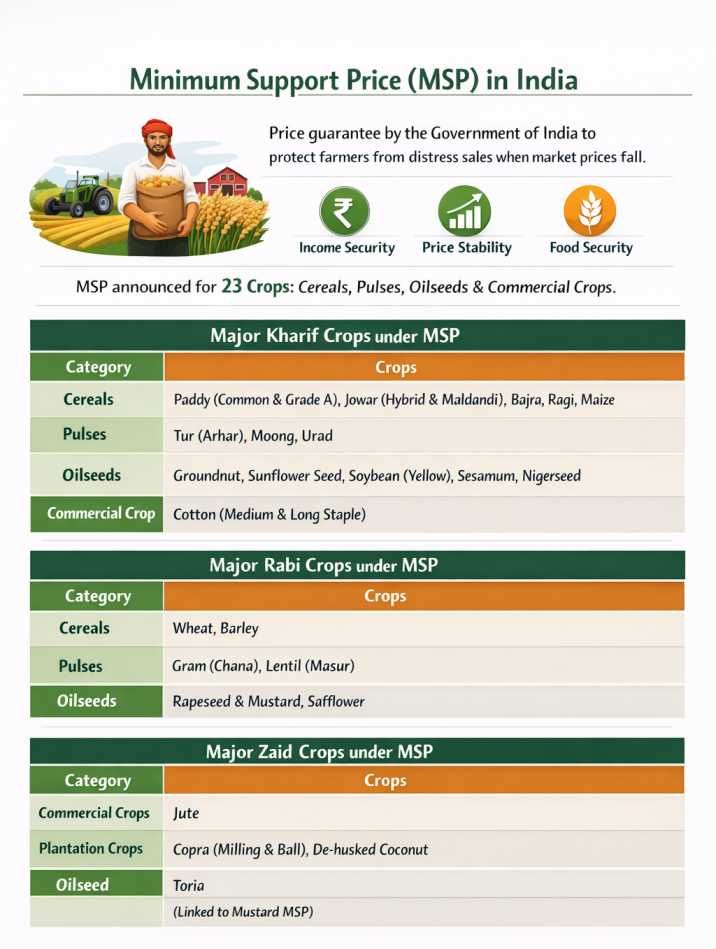
Minimum Support Price (MSP) for Kharif, Rabi and Zaid Crops
The Minimum Support Price (MSP) is a price guarantee announced by the Government of India to protect farmers from distress sales when market prices fall. It ensures income security, price stability, and food security.
The government announces MSP for 23 crops (including cereals, pulses, oilseeds, and commercial crops). Procurement is carried out by central and state agencies, depending on the crop and season.
Must read: Aravali Range in News [UPSC 2025]
UPSC Prelims PYQs on Rabi & Kharif Crops
QUESTION 1
With reference to pulse production in India, consider the following statements:
- Black gram can be cultivated as both kharif and rabi crop.
- Green-gram alone accounts for nearly half of pulse production.
- In the last three decades, while the production of kharif pulses has increased, the production of rabi pulses has decreased.
Which of the statements given above is/are correct?
QUESTION 2
Consider the following crops
- Cotton
- Groundnut
- Rice
- Wheat
Which of these are Kharif crops?
QUESTION 3
Consider the following statements:
- The Government of India provides Minimum Support Price for niger (Guizotia abyssinica) seeds.
- Niger is cultivated as a Kharif crop.
- Some tribal people in India use niger seed oil for cooking.
How many of the above statements are correct?
Conclusion
Understanding Rabi and Kharif crops UPSC, their differences, examples, and MSP coverage, is essential for mastering Indian agriculture. These concepts are highly relevant for GS Paper 1 (Geography) and GS Paper 3 (Agriculture, Food Security, MSP). Strong clarity on cropping seasons helps you tackle both Prelims and Mains questions confidently.
Start your UPSC Preparation 2026/2027 with SuperKalam
SuperKalam is your personal mentor for UPSC preparation, guiding you at every step of the exam journey. Practice, revise, and evaluate– all in one place.
Download Now