UPSC Prelims 2018 Analysis
This analysis of the UPSC Prelims question paper provides insights into subject-wise weightage, question patterns, and difficulty levels. With a focus on analytical abilities, elimination techniques, and NCERT-based themes, the paper tested a mix of multi-statement and assertion-reasoning questions. Understanding these trends will help aspirants refine their strategy and improve accuracy.
Subject wise MCQ distribution
- Economy (20 Questions): The highest weightage in the paper, covering macroeconomic indicators, policies, and economic development themes. Analytical abilities were essential to interpret trends.
- Environment & Ecology (15 Questions): A significant presence, likely reflecting UPSC’s increasing focus on climate change, biodiversity, and sustainable development. Maps were useful in location-based questions.
- Indian Polity (15 Questions): A core subject, testing governance, constitutional provisions, and landmark judgments. Many questions followed an assertion-reasoning pattern.
- Modern History (13 Questions): A relatively high emphasis on the freedom struggle, key personalities, and movements.
- Science & Technology (12 Questions): Covered advancements in AI, biotechnology, and space technology, requiring both static and current knowledge.
- Art & Culture (7 Questions): More weightage than in some later years, indicating an expectation for deeper knowledge of cultural heritage.
- International Relations (7 Questions): Focused on global organizations, treaties, and India's foreign policy.
- Medieval History (1 Question): Minimal representation, following the usual trend of fewer medieval history questions.
- Geography (Indian Geography: 4, Physical Geography: 2, World Geography: 0): The focus was on Indian geography, with limited physical geography and no direct world geography questions.

Difficulty analysis
- Medium Difficulty (50 Questions): The largest segment, requiring a balance of factual knowledge and application skills.
- Hard Questions (29 Questions): A significant portion of the paper, making elimination techniques and conceptual clarity essential.
- Easy Questions (21 Questions): Fewer than in later years, indicating a relatively tougher paper.
The 2018 Prelims had tougher questions than before, which made them hard to solve. This is reflected in the final cut-off, which was only 98 marks.

Variations in Question framing
Multi-Statement Questions (58%):
- The most common type, requiring elimination techniques and conceptual clarity.
- Particularly prevalent in Polity, Economy, and Environment sections.
- Many followed match the following and assertion-reasoning formats.
Direct Questions (42%):
- Straightforward factual questions, especially in History and Geography.
- Easier to score but required precise knowledge.

Current Affairs vs. Static Questions
- Current Affairs-Based (44 Questions): UPSC maintained a strong current affairs focus, particularly in Economy, Science & Technology, and International Relations.
- Static (56 Questions): A balanced approach, with a considerable portion testing foundational knowledge, often derived from NCERT books.
Key learning for Future Preparation
- Strengthen Economy and Polity: These subjects consistently hold high weightage and require an in-depth understanding of fundamental concepts.
- Master Multi-Statement Questions: Since a majority of questions require elimination skills, practice structured reasoning techniques.
- Balance Static and Current Affairs: While static knowledge remains crucial, integrating dynamic current developments is essential for scoring well.
- Prepare for Moderate to Hard Questions: The paper had a higher proportion of challenging questions, so aspirants should refine their approach to conceptual application and strategic guessing.
- History and Culture Awareness: Despite variations in different years, Art & Culture and Modern History continue to hold importance, making them key focus areas.
Subject-Wise Answer Key
QUESTION 1
Very recently, in which of the following countries have lakhs of people either suffered from severe famine/acute malnutrition or died due to starvation caused by war/ethnic conflicts?
A. Angola and Zambia
B. Morocco and Tunisia
C. Venezuela and Colombia
D. Yemen and South Sudan
QUESTION 2
Consider the following pairs:
| Regions sometimes mentioned in news | Country |
|---|---|
| 1. Catalonia | Spain |
| 2. Crimea | Hungary |
| 3. Mindanao | Philippines |
| 4. Oromia | Nigeria |
Which of the pairs given above are correctly matched?
A. 1, 2 and 3
B. 3 and 4 only
C. 1 and 3 only
D. 2 and 4 only
QUESTION 3
In the Indian context, what is the implication of ratifying the 'Additional Protocol' with the 'International Atomic Energy Agency (IAEA)'?
A. The civilian nuclear reactors come under IAEA safeguards.
B. The military nuclear installations come under the inspection of IAEA.
C. The country will have the privilege to buy uranium from the Nuclear Suppliers Group NSG.
D. The country automatically becomes a member of the NSG.
QUESTION 4
Consider the following pairs:
| Town | Sometime mentioned in news Country |
|---|---|
| 1. Aleppo | Syria |
| 2. Kirkuk | Yemen |
| 3. Mosul | Palestine |
| 4. Mazar-i-Sharif | Afghanistan |
Which of the pairs given above are correctly matched?
A. 1 and 2
B. 1 and 4
C. 2 and 3
D. 3 and 4
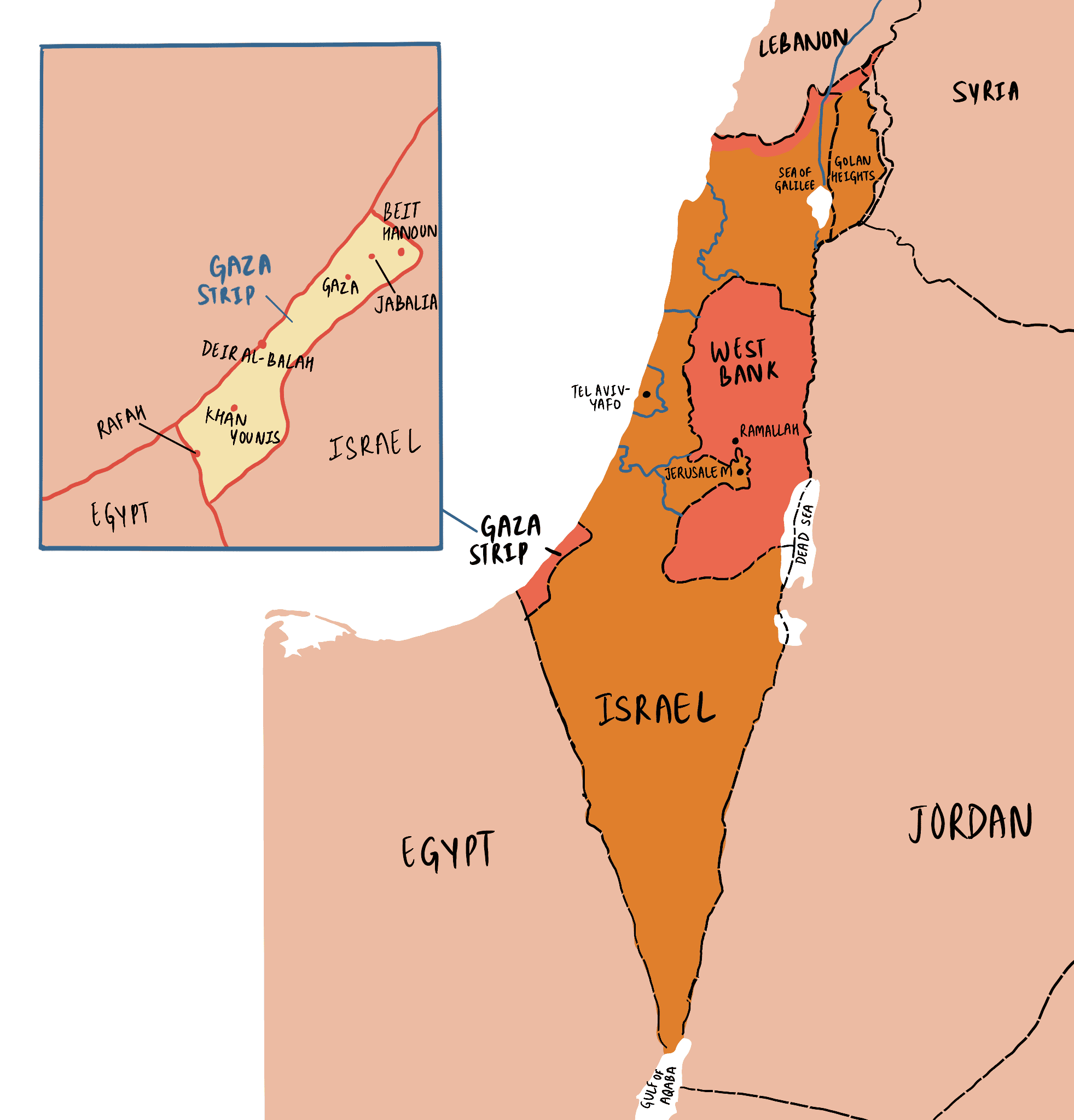
QUESTION 5
The term "two-state solution" is sometimes mentioned in the news in the context of the affairs of -
A. China
B. Israel
C. Iraq
D. Yemen
QUESTION 6
Consider the following countries :
- Australia
- Canada
- China
- India
- Japan
- USA
Which of the above are among the 'free-trade partners' of ASEAN?
A. 1, 2, 4 and 5
B. 3, 4, 5 and 6
C. 1, 3, 4 and 5
D. 2, 3, 4 and 6
QUESTION 7
What is/are the consequence/consequences of a country becoming a member of the 'Nuclear Suppliers Group'?
- It will have access to the latest and most efficient nuclear technologies.
- It automatically becomes a member of "The Treaty on the Non-Proliferation of Nuclear Weapons (NPT)".
Which of the statements given above is/are correct?
A. 1 only
B. 2 only
C. Both 1 and 2
D. Neither 1 nor 2


