The model of planned economy was adopted in India to address the regional imbalances left behind by colonial rule. Comment.
The model of planned economy was adopted in India to address the regional imbalances left behind by colonial rule. Comment.
Post-1947, India inherited a structural distortion characterized by spatial inequalities and extreme poverty due to the extractive colonial economy. To achieve distributive justice, India adopted a centrally planned model through the Planning Commission (1950).
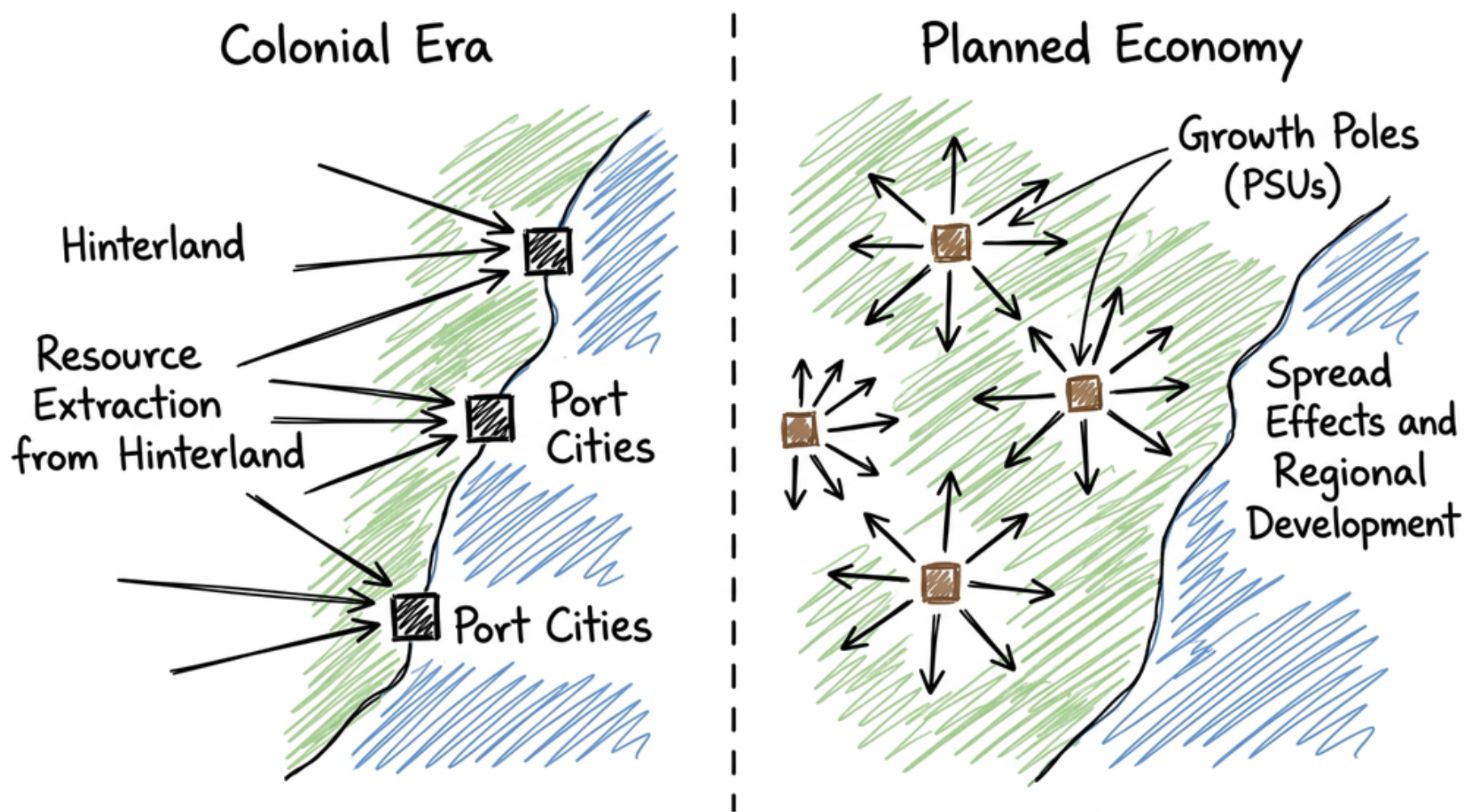
Spatial Shift from Colonial Resource Extraction to Planned Regional Development through Growth Poles
Rationale for Adopting the Planned Economy Model
-
Commanding Heights: Prioritizing public sector investment in core sectors to overcome private capital deficiency.
-
Resource Mobilization: Directing scarce national resources toward socially optimal sectors rather than pure profit.
-
Mahalanobis Strategy: Building a capital goods base to reduce dependence on foreign imports.
-
Article 38 Compliance: Fulfilling the Directive Principles to minimize inequalities in income and status.
-
Market Regulation: Preventing the concentration of wealth in specific urban pockets like Bombay or Calcutta.
Measures to Redress Regional Imbalances
-
Industrial Decoupling: Establishing Public Sector Undertakings (PSUs) in backward regions.
- Eg: Steel plants in Bhilai (Chhattisgarh) and Rourkela (Odisha).
-
Freight Equalization Policy: Subsidizing mineral transport to encourage pan-India industrial growth.
-
Multi-purpose Projects: Developing river valleys for irrigation and power.
- Eg: Damodar Valley Corporation modeled on the US TVA.
-
Backward Area Subsidies: Providing fiscal incentives for private units in "No Industry Districts."
-
Targeted Area Planning: Specific programs for ecologically disadvantaged zones.
- Eg: Drought Prone Area Programme (DPAP) and Hill Area Development Programme.
-
Tribal Sub-Plans (TSP): Channelling dedicated funds for the socio-economic upliftment of Scheduled Areas.
-
Minimum Needs Programme: Ensuring basic infrastructure like rural roads and health centers in neglected hinterlands.
Challenges and Limitations
-
Top-Down Rigidity: A "one-size-fits-all" approach often ignores local ecological and cultural specificities.
-
Enclave Development: Large industries often remained isolated "enclaves" without creating local ancillary linkages.
-
Bureaucratic Red Tape: The License-Permit Raj stifled regional entrepreneurial spirit outside traditional hubs.
-
Implementation Gaps: Weak administrative capacity in backward states led to poor fund utilization.
Transitioning from the Planning Commission to NITI Aayog has shifted focus toward Competitive and Cooperative Federalism. Programs like the Aspirational Districts Programme now utilize data-driven governance to bridge gaps, aligning with SDG 10 (Reduced Inequalities) for inclusive national growth.
Answer Length
Model answers may exceed the word limit for better clarity and depth. Use them as a guide, but always frame your final answer within the exam’s prescribed limit.
Evaluate this PYQ now
Write your answer & evaluate in just 60 seconds




500+ students evaluated
Model Answers by Subject


Crack UPSC with your
Personal AI Mentor
An AI-powered ecosystem to learn, practice, and evaluate with discipline



