Is caste disappearing in urban India? Illustrate your answer with examples.
Is caste disappearing in urban India? Illustrate your answer with examples.
Caste in urban India is undergoing a structural transformation rather than a total disappearance. While urbanisation promotes secularisation and ritual flexibility, caste identities are being reinvented through modern political and social networks, moving from a "ritual status" to a "secular identity."
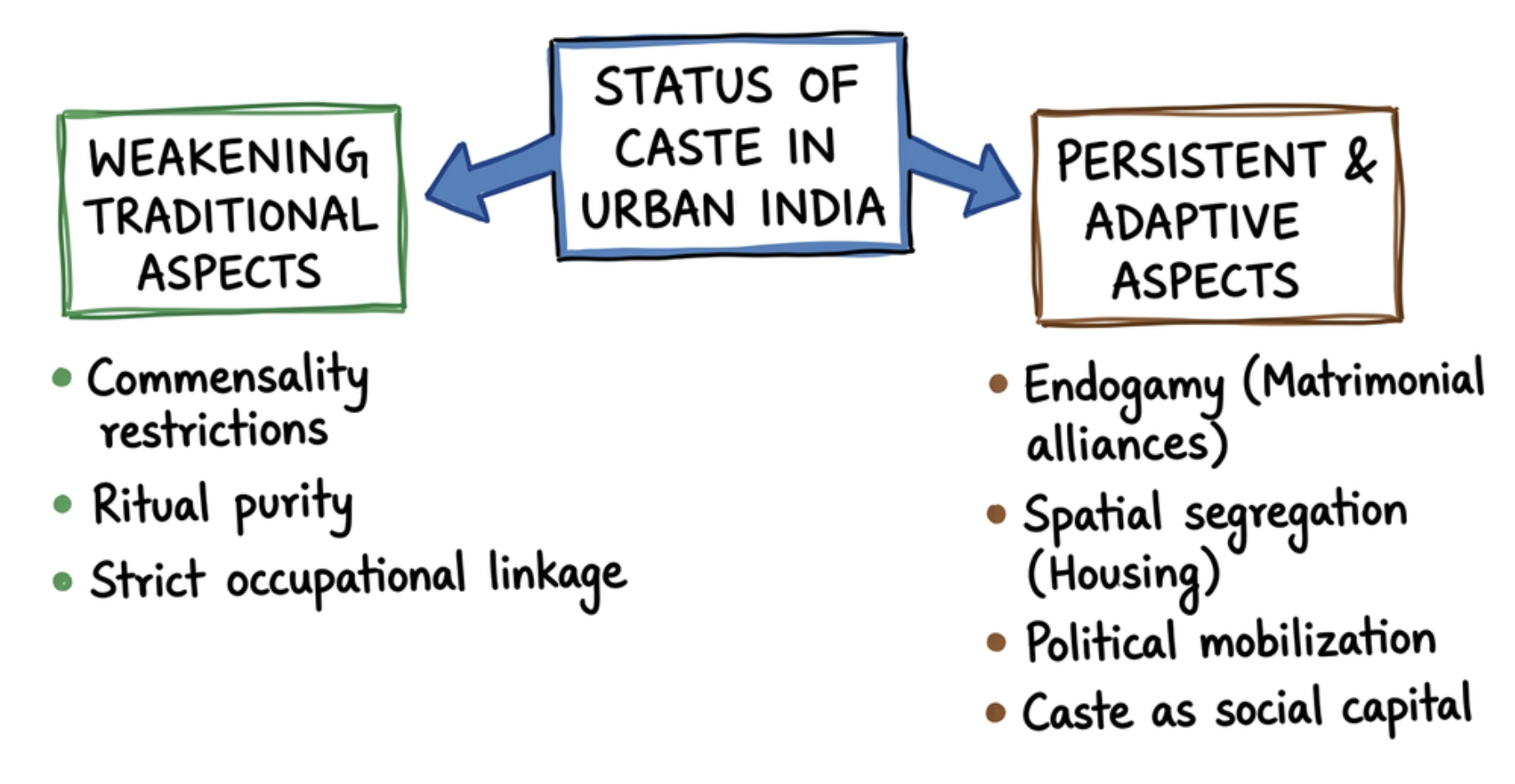
Changing and Persistent Dimensions of Caste in Urban India
Evidences of Caste Disappearing or Weakening
-
Occupational Mobility: Urban markets prioritise skills over hereditary roles, breaking the link between jati and profession.
- Eg: Growth of the Dalit Indian Chamber of Commerce and Industry (DICCI).
-
Decline in Commensality: Strict food taboos and purity-pollution norms have faded in public spaces.
- Eg: Caste-neutral dining in office canteens and restaurants.
-
Physical Anonymity: High-density urban living allows individuals to shed ritual identities.
- Eg: Caste-blind seating in public transport like the Delhi Metro.
-
Legal Empowerment: Strict enforcement of Article 17 (Abolition of Untouchability) and the SC/ST Act deters overt discrimination.
-
Secular Education: Access to modern schooling promotes rationalism and social egalitarianism.
-
Class-Caste Overlap: Economic status often supersedes ritual rank in high-end urban social circles.
-
Public Space Democratisation: Malls and multiplexes act as "caste-neutral" zones of consumption.
Evidences of Caste Persistence and Reinvention
-
Marital Endogamy: Caste remains the primary filter in urban marriage markets despite professional success.
- Eg: Continued use of "caste filters" on platforms like Shaadi.com.
-
Residential Segregation: Housing choices in cities often reflect caste-based clustering or exclusion.
- Eg: Denial of rental housing to Dalits in elite urban colonies (documented by Thorat and Attewell).
-
Caste-based Associations: Urban migrants form caste lobbies to navigate urban competition and politics.
- Eg: Urban wings of Kamma or Patidar associations providing hostel facilities.
-
Labor Market Bias: Informal recruitment through social networks often favors upper-caste candidates.
- Eg: "Social capital" disparities in MNC entry-level hiring.
-
Digital Casteism: Social media platforms are used to consolidate caste pride and mobilise for reservations.
-
Subaltern Assertion: Growing urban consciousness through cultural symbols and festivals.
- Eg: Grand celebrations of Ambedkar Jayanti in urban metropolitan centres.
-
Manual Scavenging: Persistence of caste-linked hazardous labor in urban sanitation departments.
-
Political Identity: Caste remains a decisive factor in Urban Local Body elections and ticket distribution.
Way Forward
-
Sensitization Programs: Implementing diversity and inclusion (D&I) modules in corporate and educational sectors.
-
Economic Empowerment: Strengthening the Stand-Up India scheme to bridge the wealth gap between different social groups.
-
Urban Governance: Ensuring inclusive urban planning to prevent the "ghettoization" of marginalised communities.
Transitioning from caste-based identities to Constitutional Morality is essential to achieve SDG 10 (Reduced Inequalities) and foster true social integration in India's growing urban landscape.
Answer Length
Model answers may exceed the word limit for better clarity and depth. Use them as a guide, but always frame your final answer within the exam’s prescribed limit.
Evaluate this PYQ now
Write your answer & evaluate in just 60 seconds




500+ students evaluated
Model Answers from
- 2026Indian Society15 MarksView Answer
Evaluate the impact of globalization on Indian youths with reference to social, political, economic and cultural spheres.
- 2026Indian Society15 MarksView Answer
Critically examine the challenges of demographic transition in contemporary India.
- 2026Indian Society10 MarksView Answer
Do you think digital technology promotes social empowerment? Explain with examples.
- 2026Indian Society10 MarksView Answer
How do you understand disability? Substantiate the need for inclusive policy framework in India in this regard.
- 2026Indian Society10 MarksView Answer
Unity in diversity remains the defining feature of Indian society despite the challenges from communalism and regionalism. Comment.
Model Answers by Subject


Crack UPSC with your
Personal AI Mentor
An AI-powered ecosystem to learn, practice, and evaluate with discipline



