Critically examine the challenges of demographic transition in contemporary India.
Critically examine the challenges of demographic transition in contemporary India.
India is currently navigating the third stage of demographic transition, characterized by a declining Total Fertility Rate (TFR 2.0) and a burgeoning working-age population. While this offers a demographic dividend, it presents significant multi-dimensional challenges.
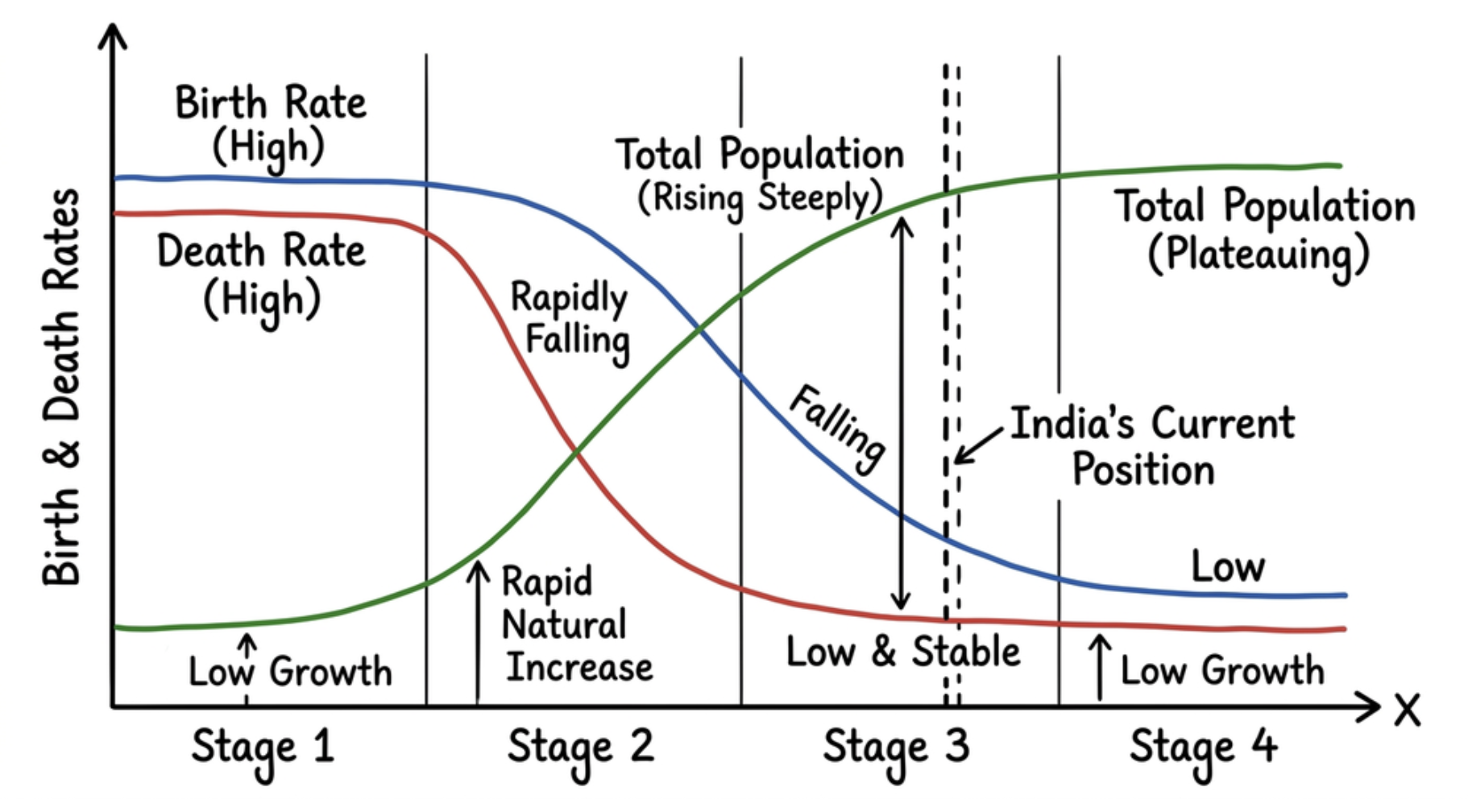
India’s Position in the Demographic Transition Model
Socio-Economic and Labor Challenges
-
Jobless Growth: economic expansion failing to create proportional employment for the 12 million youth entering the workforce annually.
-
Skill Mismatch: poor employability where only 5% of the workforce has formal vocational training.
- E.g: India Skills Report highlighting gaps in emerging sectors like AI.
-
Low FLFPR: declining or stagnant Female Labour Force Participation Rate due to patriarchal norms.
- E.g: PLFS data showing gender gaps in remunerative work.
-
Informalization: over 90% of workers remain in the informal sector without social security.
- Eg: Lack of benefits for Gig workers in the platform economy.
-
Premature Deindustrialization: shifting directly from agriculture to services, bypassing labor-intensive manufacturing.
- Eg: Slow progress of the Make in India initiative in generating mass employment.
Health and Infrastructural Challenges
-
Geriatric Transition: rising elderly population (projected 20% by 2050) straining social safety nets.
- Eg: Inadequacy of the Indira Gandhi National Old Age Pension Scheme.
-
Epidemiological Shift: rising burden of Non-Communicable Diseases (NCDs) alongside infectious diseases.
-
Nutritional Poverty: high rates of stunting and wasting limiting human capital potential.
- Eg: NFHS-5 data on childhood malnutrition.
-
Urban Primacy: distress migration leading to the growth of slums and "census towns."
- Eg: Infrastructural collapse in Tier-1 cities like Bengaluru.
-
Digital Divide: unequal access to digital infrastructure hindering rural youth productivity.
- e.g., Disparities in BharatNet implementation across states.
Structural and Regional Asymmetries
-
Regional Divergence: demographic divide between high-TFR Northern states and aging Southern states.
-
Skewed Sex Ratio: persistent Son Meta-Preference leading to "missing women."
- Eg: Gender imbalances in states like Haryana despite Beti Bachao Beti Padhao.
-
Education Quality: poor learning outcomes despite high enrollment rates.
- Eg: ASER Report highlighting basic literacy gaps in rural schools.
-
Missing Middle: lack of mid-sized firms that typically absorb transition-phase labor.
-
Climate Migration: demographic pressure on resource-stressed ecological zones.
- Eg: Migration from the Sundarbans due to sea-level rise.
Way Forward
India must adopt a life-cycle approach by integrating the National Skill Development Mission with Ayushman Bharat to ensure a healthy, skilled workforce. Aligning national policies with SDG 8 (Decent Work) and SDG 10 (Reduced Inequalities) is essential to prevent the demographic dividend from turning into a demographic disaster.
Answer Length
Model answers may exceed the word limit for better clarity and depth. Use them as a guide, but always frame your final answer within the exam’s prescribed limit.
Evaluate this PYQ now
Write your answer & evaluate in just 60 seconds



500+ students evaluated
Model Answers from
- 2026Indian Society15 MarksView Answer
Evaluate the impact of globalization on Indian youths with reference to social, political, economic and cultural spheres.
- 2026Indian Society15 MarksView Answer
Is caste disappearing in urban India? Illustrate your answer with examples.
- 2026Indian Society10 MarksView Answer
Do you think digital technology promotes social empowerment? Explain with examples.
- 2026Indian Society10 MarksView Answer
How do you understand disability? Substantiate the need for inclusive policy framework in India in this regard.
- 2026Indian Society10 MarksView Answer
Unity in diversity remains the defining feature of Indian society despite the challenges from communalism and regionalism. Comment.
Model Answers by Subject


Crack UPSC with your
Personal AI Mentor
An AI-powered ecosystem to learn, practice, and evaluate with discipline



