How do you understand disability? Substantiate the need for inclusive policy framework in India in this regard.
How do you understand disability? Substantiate the need for inclusive policy framework in India in this regard.
Disability is an evolving concept resulting from the interaction between persons with impairments and attitudinal/environmental barriers. The RPwD Act, 2016 marks a paradigm shift from a medical model to a rights-based model, recognizing 21 types of disabilities.
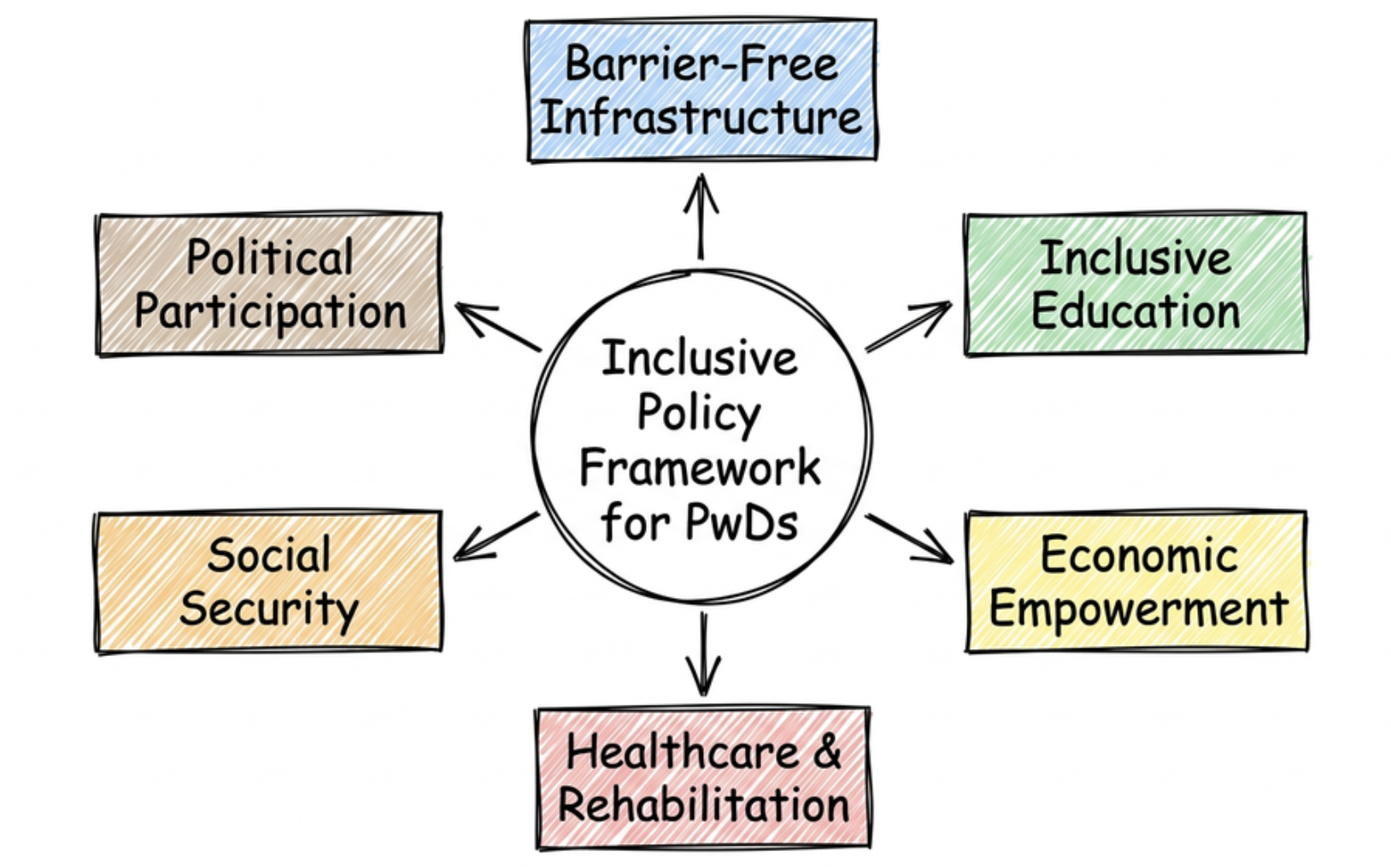
Inclusive Policy Framework for Empowerment of Persons with Disabilities
Understanding Disability
-
Bio-Psycho-Social Interaction: It is not merely a medical condition but a lack of fit between the person and society.
-
Legal Dimension: Defined under Section 2(s) of RPwD Act 2016 as long-term physical, mental, or sensory impairments.
-
Rights-Based Approach: Aligned with UNCRPD, treating PwDs as active citizens rather than objects of charity.
Need for Inclusive Policy Framework in India
-
Economic Integration: Improving labor force participation; only 36% of PwDs are currently employed (PLFS 2022-23).
-
Universal Accessibility: Building barrier-free environments under the Sugamya Bharat Abhiyan.
-
Educational Equity: Ensuring Reasonable Accommodation in schools to curb high dropout rates among PwD children.
-
Digital Divide: Mandating screen-reader-friendly government portals for inclusive e-Governance.
-
Healthcare Access: Providing specialized services and affordable assistive devices through the ADIP Scheme.
-
Social Protection: Implementing uniform disability pensions and insurance like the Swavlamban Health Insurance.
-
Empirical Planning: Bridging data gaps through the UDID (Unique Disability ID) project for targeted intervention.
-
Political Participation: Making polling booths accessible to ensure "No Voter is Left Behind."
-
Stigma Reduction: Sensitizing society to replace "pity" with "empowerment" through community-based rehabilitation.
-
Human Dignity: Upholding Article 21 by ensuring a life of dignity for 2.68 crore Divyangjan (Census 2011).
Fulfilling the mandate of SDG 10 (Reduced Inequalities) requires a holistic shift towards Universal Design, ensuring that the vision of Sabka Saath, Sabka Vikas is truly inclusive of all abilities.
Answer Length
Model answers may exceed the word limit for better clarity and depth. Use them as a guide, but always frame your final answer within the exam’s prescribed limit.
Evaluate this PYQ now
Write your answer & evaluate in just 60 seconds




500+ students evaluated
Model Answers from
- 2026Indian Society15 MarksView Answer
Evaluate the impact of globalization on Indian youths with reference to social, political, economic and cultural spheres.
- 2026Indian Society15 MarksView Answer
Critically examine the challenges of demographic transition in contemporary India.
- 2026Indian Society15 MarksView Answer
Is caste disappearing in urban India? Illustrate your answer with examples.
- 2026Indian Society10 MarksView Answer
Do you think digital technology promotes social empowerment? Explain with examples.
- 2026Indian Society10 MarksView Answer
Unity in diversity remains the defining feature of Indian society despite the challenges from communalism and regionalism. Comment.
Model Answers by Subject


Crack UPSC with your
Personal AI Mentor
An AI-powered ecosystem to learn, practice, and evaluate with discipline



