Analyze the major drivers of human-induced land-use changes in India and their geographical consequences.
Analyze the major drivers of human-induced land-use changes in India and their geographical consequences.
Human-induced Land-Use and Land-Cover Change (LULCC) in India reflects the transition from natural ecosystems to managed landscapes, driven by the needs of a 1.4 billion population and a rapidly growing economy.
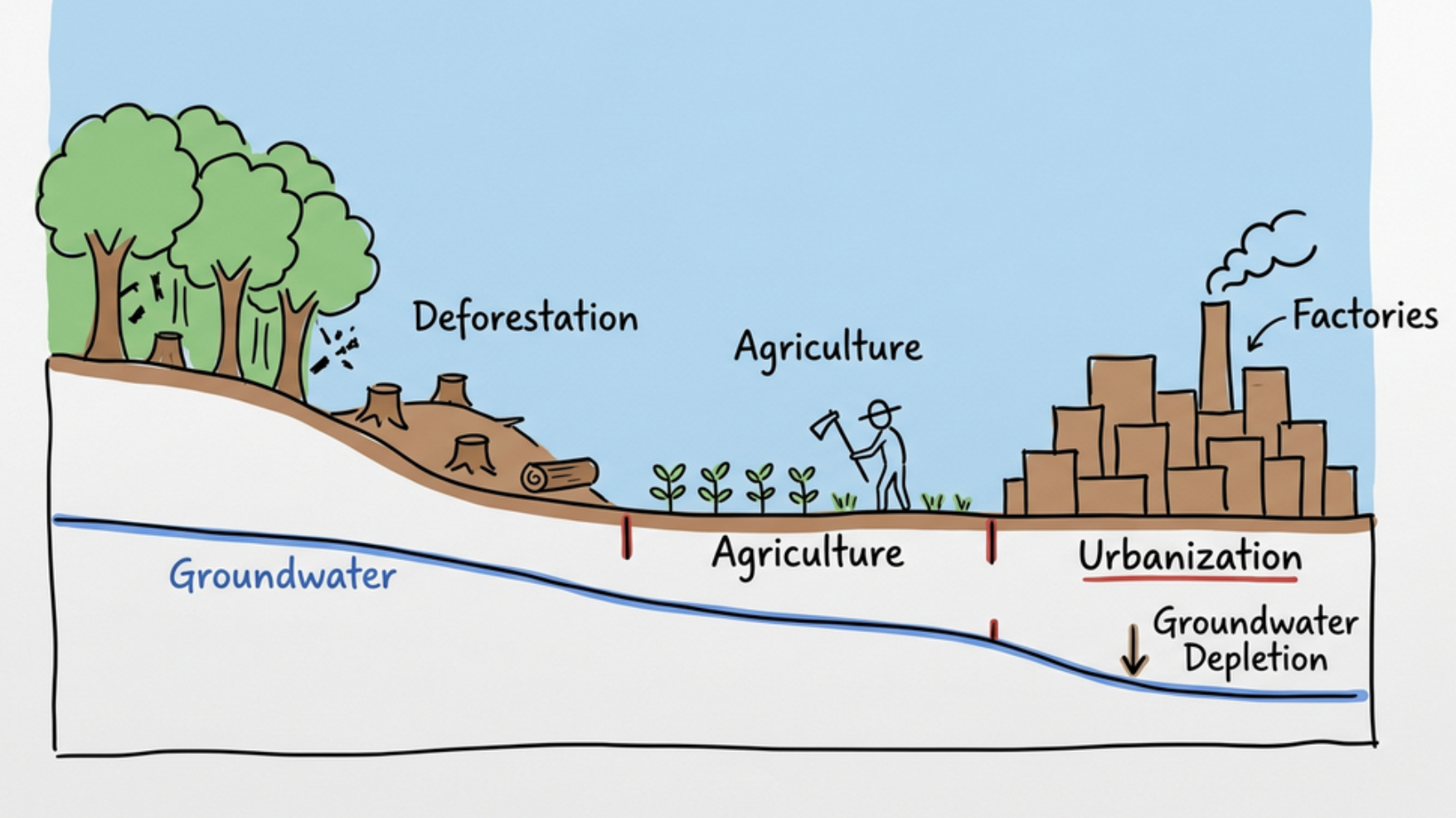
Land-Use Transition from Deforestation to Urbanization and Groundwater Depletion
Major Drivers of Human-Induced Land-Use Changes
-
Population Pressure: Increasing demand for food, housing, and livelihoods necessitates land conversion.
-
Rapid Urban sprawl: Conversion of fertile peri-urban agricultural land into residential and commercial built-up areas.
- Eg: Expansion of the National Capital Region (NCR) into rural Haryana and UP.
-
Agricultural Intensification: Shift from traditional multi-cropping to intensive monoculture and commercial farming.
- Eg: Expansion of paddy-wheat cycles in the Indo-Gangetic Plains.
-
Infrastructure Projects: Large-scale diversion of land for linear projects like highways and railways.
- Eg: Land clearing for the Bharatmala Pariyojana and Dedicated Freight Corridors.
-
Industrialization: Development of Special Economic Zones (SEZs) and industrial clusters on erstwhile grazing or agricultural lands.
-
Open-Cast Mining: Removal of topsoil and vegetation for mineral extraction, leading to landscape scarring.
- Eg: Extensive mining activities in the Chhota Nagpur Plateau.
-
Hydropower and Dams: Massive forest submergence and displacement of riverine ecosystems.
- Eg: Submergence caused by the Sardar Sarovar Project on the Narmada.
-
Deforestation for Fuelwood: Dependence of rural populations on forest biomass for energy needs in the absence of LPG penetration.
Geographical Consequences of Land-Use Changes
-
Soil Degradation: Excessive chemical use and over-irrigation leading to salinization and loss of fertility.
- Eg: Soil alkalinity issues in Punjab and Haryana.
-
Biodiversity Fragmentation: Loss of contiguous habitats leading to "island" ecosystems and species decline.
- Eg: Threat to endemic species in the Western Ghats due to plantation expansion.
-
Urban Heat Islands (UHI): Paved surfaces and concrete replacing vegetation, increasing local temperatures.
- Eg: Rising surface temperatures in Delhi and Bengaluru.
-
Hydrological Disruption: Encroachment of floodplains and wetlands reducing natural water storage and drainage.
- Eg: Recurring floods in Chennai and Srinagar due to lake bed encroachment.
-
Human-Wildlife Conflict: Disruption of migratory paths leading to increased animal intrusions into human settlements.
- Eg: Conflict in elephant corridors of Odisha and Chhattisgarh.
-
Desertification: Accelerated land degradation in arid and semi-arid regions due to overgrazing and unscientific farming.
- Eg: Nearly 29% of India's land is undergoing degradation according to ISRO's Desertification Atlas.
-
Slope Instability: Construction in fragile terrains leading to increased frequency of landslides.
- Eg: Disasters in the Himalayan belt linked to the Char Dham Road project.
Way Forward
-
Integrated Land Use Planning: Adopting GIS-based mapping (e.g., Bhuvan portal) for scientific zoning and land allocation.
-
Restoration and Afforestation: Scaling up the Green India Mission and Nagar Van Scheme to restore ecological balance.
Achieving Land Degradation Neutrality (LDN) by 2030, as per UNCCD commitments, is essential for India’s climate resilience and to meet SDG 15 (Life on Land).
Answer Length
Model answers may exceed the word limit for better clarity and depth. Use them as a guide, but always frame your final answer within the exam’s prescribed limit.
Evaluate this PYQ now
Write your answer & evaluate in just 60 seconds




500+ students evaluated
Model Answers from
- 2026Indian Geography15 MarksView Answer
Analyze the role of satellite-based technologies in achieving climate-smart agriculture and food security in India.
- 2026Indian Geography10 MarksView Answer
"Water resources are both an asset and a source of conflict in South Asia." Examine this statement giving examples.
Model Answers by Subject


Crack UPSC with your
Personal AI Mentor
An AI-powered ecosystem to learn, practice, and evaluate with discipline