Mention the significance of straits and isthmus in international trade.
Mention the significance of straits and isthmus in international trade.
Straits and isthmuses are key geographical features that influence maritime trade, shipping routes, and global connectivity. Understanding them helps explain the strategic and economic importance of certain global chokepoints.
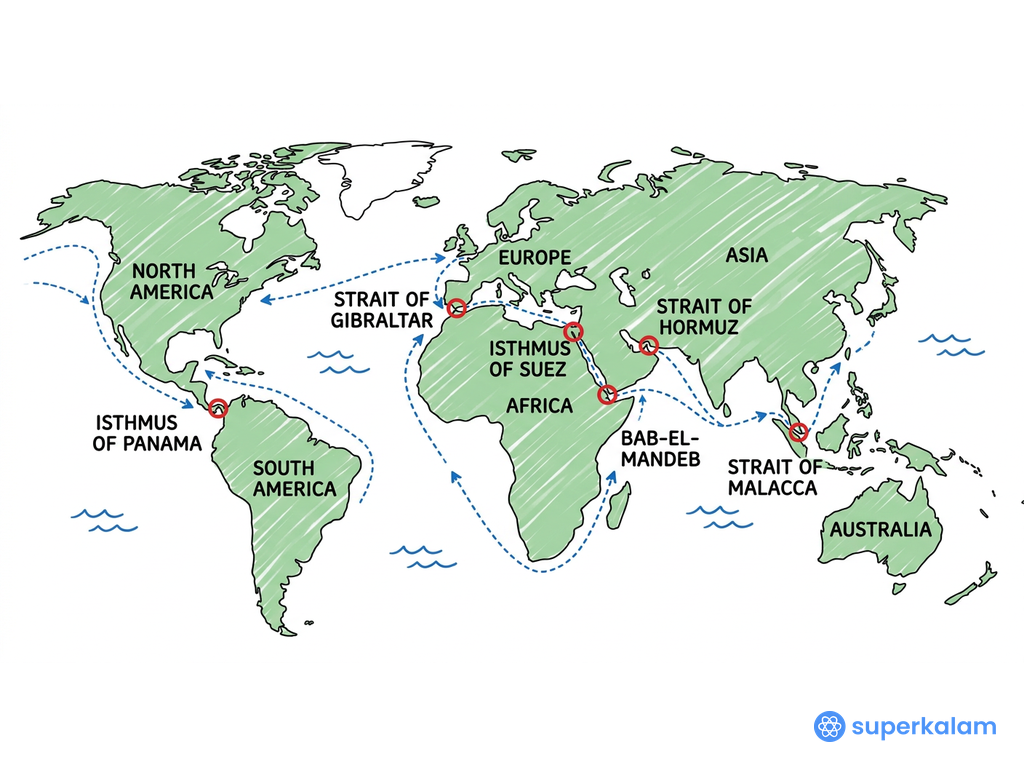
Strait and Isthmus Schematic Diagram
Straits and Isthmuses: Meaning and Examples 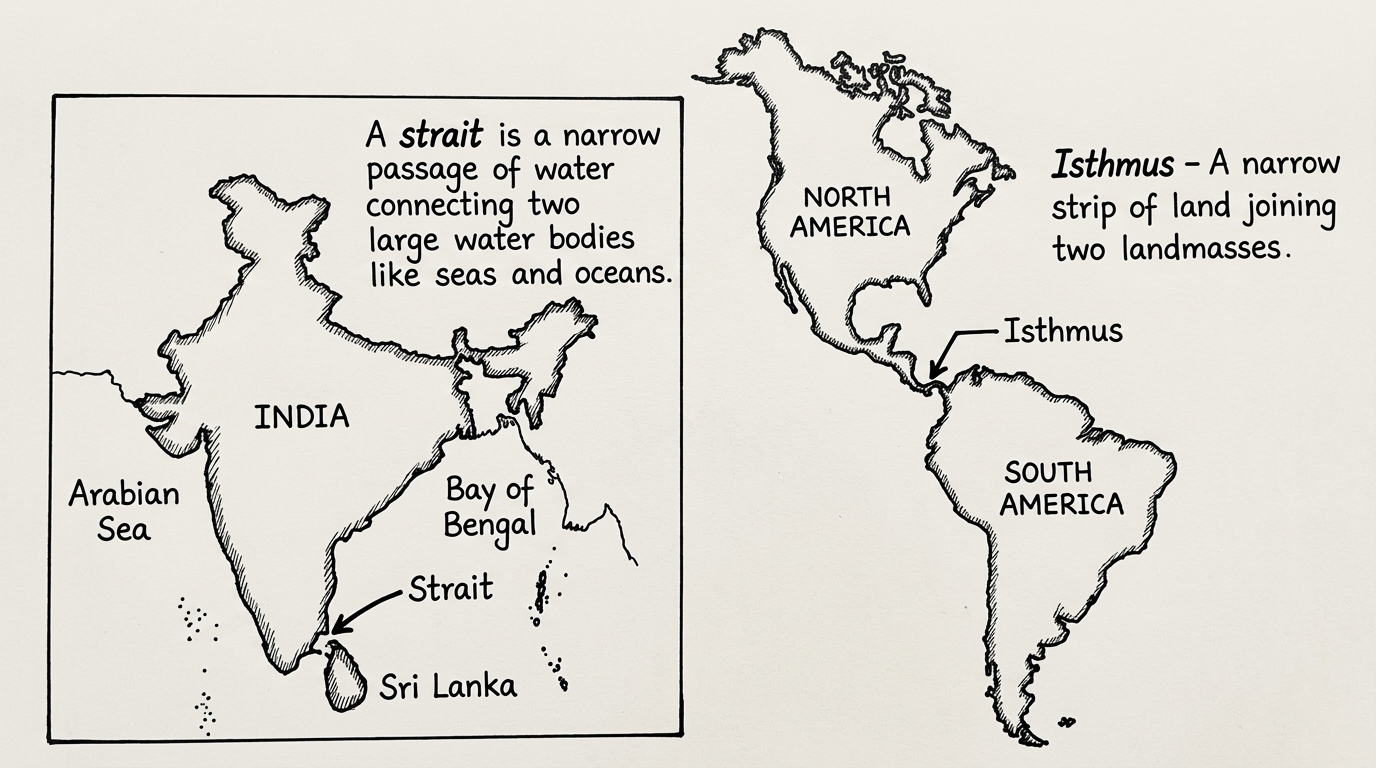
Schematic Diagram showing strait and Isthamus
Schematic Diagram showing strait and Isthamus
a) Straits: A strait is a narrow waterway that connects two larger bodies of water, often seas or oceans.
- Examples:
- Strait of Malacca: Connects the Indian Ocean with the South China Sea; crucial for trade between East Asia and Europe.
- Strait of Hormuz: Connects the Persian Gulf with the Gulf of Oman; key for global oil shipments.
- Strait of Gibraltar: Connects the Atlantic Ocean with the Mediterranean Sea.
b) Isthmuses: An isthmus is a narrow strip of land connecting two larger landmasses, often used for artificial canals to link seas or oceans.
- Examples:
- Isthmus of Panama: Hosts the Panama Canal, connecting the Atlantic and Pacific Oceans.
- Isthmus of Suez: Hosts the Suez Canal, connecting the Mediterranean Sea and the Red Sea.
- Isthmus of Kra (Thailand): Proposed site for Kra Canal, potential shortcut between Pacific and Indian Oceans.
Significance of Straits and Isthmuses in International Trade
-
Facilitating Global Shipping
- Straits provide natural maritime shortcuts, reducing travel distances between major oceans.
- Example: Strait of Malacca enables faster trade between East Asia and Europe.
-
Artificial Canals through Isthmuses
- Canals across isthmuses reduce the need for long maritime detours.
- Example: Panama Canal saves ships about 8,000 nautical miles compared to circumnavigating South America.
-
Reducing Transport Costs and Time
- Shorter routes cut fuel consumption, voyage duration, and shipping costs, making trade more efficient.
- Example: Suez Canal avoids the long trip around Africa’s Cape of Good Hope.
-
Strategic and Geopolitical Importance
- Control over straits or canals gives countries leverage over global trade.
- Example: Strait of Hormuz – potential blockades can affect 20% of global oil supply.
-
Supporting Port Development and Regional Trade
- Proximity to major straits and canals encourages port growth, logistics hubs, and maritime industries.
- Example: Singapore (Strait of Malacca) and Port Said (Suez Canal) are major trade centers.
-
Promoting Engineering Innovation: Canals across isthmuses demonstrate human ingenuity in overcoming geographic constraints, improving trade efficiency.
-
Encouraging Tourism and Economic Activity
- Straits and canal regions attract cruise shipping, tourism, and commercial activities, boosting local economies.
- Example: Cruise tourism in the Suez Canal region and Bosporus Strait contributes significantly to the service sector.
-
Enhancing Energy and Commodity Trade
- Many straits serve as chokepoints for energy shipments and critical commodities, ensuring global supply chains.
- Example: Strait of Malacca is vital for LNG and oil exports from the Middle East to Asia.
-
Facilitating Regional Integration
- Straits and isthmus canals connect regional economies, enabling trade agreements and economic corridors.
- Example: Suez Canal promotes trade between Europe, Africa, and Asia, enhancing regional economic integration.
-
Reducing Risk of Maritime Hazards
- Shorter routes through straits and canals reduce exposure to piracy, storms, and navigational hazards, ensuring safer trade.
- Example: Panama Canal route is safer than the long and rough waters around Cape Horn.
Straits and isthmuses are critical chokepoints that facilitate efficient international trade, reduce costs, and shape geopolitical and economic power. Countries controlling these features often gain strategic and economic advantages, making them central to global commerce and maritime security.
Answer Length
Model answers may exceed the word limit for better clarity and depth. Use them as a guide, but always frame your final answer within the exam’s prescribed limit.
Evaluate this PYQ now
Write your answer & evaluate in just 60 seconds




500+ students evaluated
Model Answers from
- 2022Physical Geography15 MarksView Answer
Troposphere is a very significant atmospheric layer that determines weather processes. How?
- 2022Physical Geography15 MarksView Answer
What are the forces that influence ocean currents? Describe their role in the fishing industry of the world.
- 2022Physical Geography10 MarksView Answer
Discuss the natural resource potentials of ‘Deccan trap’.
- 2022Physical Geography10 MarksView Answer
Describe the characteristics and types of primary rocks.
Model Answers by Subject


Crack UPSC with your
Personal AI Mentor
An AI-powered ecosystem to learn, practice, and evaluate with discipline



