Describing the distribution of rubber producing countries, indicate the major environmental issues faced by them.
Describing the distribution of rubber producing countries, indicate the major environmental issues faced by them.
Natural rubber is obtained mainly from the latex of Hevea brasiliensis, a tropical tree requiring hot, humid conditions. Its production is concentrated in the humid tropics between 5°N and 10°S latitude, especially in Southeast Asia.
Distribution of Rubber-Producing Countries
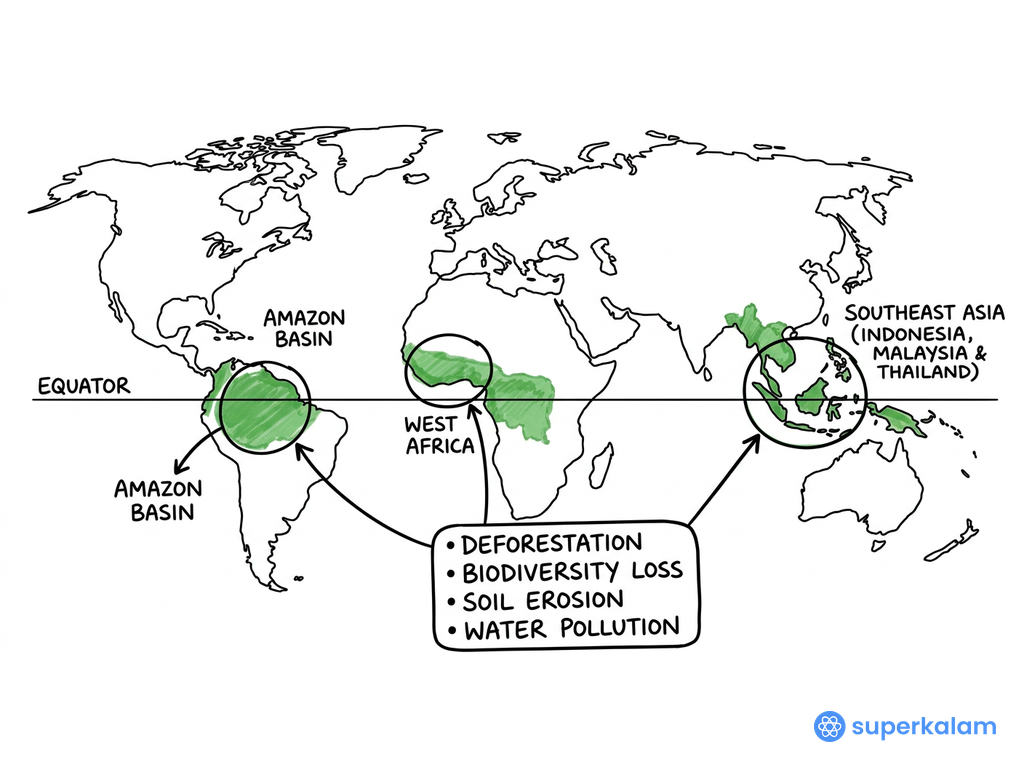
Major Rubber Producing Countries World Map
-
Asia (dominates global production, ~90%)
- Thailand – Largest producer (~35% of world’s output), concentrated in the southern peninsula.
- Indonesia – Major plantations in Sumatra and Kalimantan.
- Vietnam – Expanding production in central highlands.
- Malaysia – Historical leader, now overtaken by Thailand and Indonesia.
- India – Kerala, Tamil Nadu, and Karnataka contribute ~90% of national output.
-
Africa
- Nigeria, Liberia, Côte d’Ivoire, Cameroon – Rubber estates often linked to multinational companies.
-
Latin America (origin region of rubber tree)
- Brazil – Amazon basin production; affected historically by “South American Leaf Blight.”
- Guatemala & Mexico – Small-scale but significant exports.
Major Environmental Issues Faced by Rubber-Producing Countries
-
Deforestation & Loss of Biodiversity
-
Large-scale conversion of tropical rainforests into monoculture rubber estates is one of the most visible environmental impacts.
-
Example: In Cambodia and Laos, forest cover loss has been closely linked to foreign investment–driven rubber plantations.
-
This reduces biodiversity, fragments habitats of species such as the Asian elephant and Malayan tiger, and disrupts ecosystem services like carbon sequestration.
-
-
Monoculture-Induced Soil Degradation & Erosion
-
Rubber plantations are typically monocultures, leading to nutrient depletion and reduced organic matter in the soil.
-
Example: In Kerala’s Western Ghats, plantations on steep slopes have increased run-off and soil erosion during monsoon seasons.
-
Over time, this necessitates heavier fertilizer use, creating a vicious cycle of soil exhaustion.
-
-
Water Stress & Pollution from Processing Units
-
While the rubber tree itself is moderately drought-resistant, large plantations demand water for nursery maintenance and processing.
-
Latex processing releases ammonia and formic acid; untreated effluents can lower dissolved oxygen in rivers, killing fish.
-
Example: Perak River in Malaysia faced significant water quality decline in the 2010s due to rubber factory discharges.
-
-
Chemical Dependency – Pesticides & Fertilizers
-
Intensive chemical inputs, including herbicides for weed control and synthetic fertilizers, harm beneficial soil microbes and contaminate groundwater.
-
Example: In southern Thailand, nitrate levels in groundwater have exceeded WHO limits in plantation belts, impacting drinking water safety.
-
-
Climate Change Sensitivity
-
Rubber trees require stable temperature (25–35°C) and rainfall (>2,000 mm annually). Variability in monsoons or prolonged droughts directly reduces latex yield.
-
Example: In Indonesia, the El Niño events of 2015 and 2019 caused severe drought stress, forcing tapping suspension and lowering incomes for thousands of smallholders.
-
-
Plant Diseases & Pest Outbreaks
-
Monocultures are highly susceptible to epidemics.
-
South American Leaf Blight devastated Brazil’s Amazon plantations, forcing large-scale shift to Southeast Asia.
-
In recent years, Pestalotiopsis leaf disease in Thailand and Indonesia has caused up to 40% yield losses.
-
-
Displacement of Indigenous & Rural Communities
-
Land acquisition for plantations often displaces small farmers and tribal populations, leading to socio-economic and cultural disruption.
-
Example: In Liberia, large concessions to foreign companies for rubber led to community protests over loss of ancestral lands and poor compensation.
-
-
Carbon Emissions from Land Conversion
-
Forest-to-plantation conversion releases stored carbon, contributing to greenhouse gas emissions.
-
Example: Studies in Myanmar show that rubber expansion between 2000–2020 released millions of tonnes of CO₂ equivalents annually.
-
-
Human–Wildlife Conflict
-
Habitat loss forces wildlife into plantation zones, damaging crops and leading to retaliatory killings.
-
Example: Notable in Assam’s Karbi Anglong region, where elephants have entered rubber plantations in search of food.
-
While rubber cultivation supports millions of livelihoods and is vital for the global automobile and manufacturing industries, its environmental footprint—ranging from deforestation to biodiversity loss—demands sustainable agroforestry models, disease-resistant varieties, and eco-certification to balance economic benefits with ecological integrity.
Answer Length
Model answers may exceed the word limit for better clarity and depth. Use them as a guide, but always frame your final answer within the exam’s prescribed limit.
Evaluate this PYQ now
Write your answer & evaluate in just 60 seconds




500+ students evaluated
Model Answers from
- 2022Indian Geography10 MarksView Answer
Examine the potential of wind energy in India and explain the reasons for their limited spatial spread.
- 2022Indian Geography10 MarksView Answer
Discuss the meaning of colour-coded weather warnings for cyclone prone areas given by India Meteorological Department.
Model Answers by Subject


Crack UPSC with your
Personal AI Mentor
An AI-powered ecosystem to learn, practice, and evaluate with discipline



