Identify ten essential values that are needed to be an effective public servant. Describe the /ways and means to prevent non-ethical behavior in the pubic servants.
Identify ten essential values that are needed to be an effective public servant. Describe the /ways and means to prevent non-ethical behavior in the pubic servants.
Integrity, accountability, and transparency form the cornerstone of effective public service, as emphasized by Mahatma Gandhi's principle of satyagraha and Chanakya's governance philosophy.
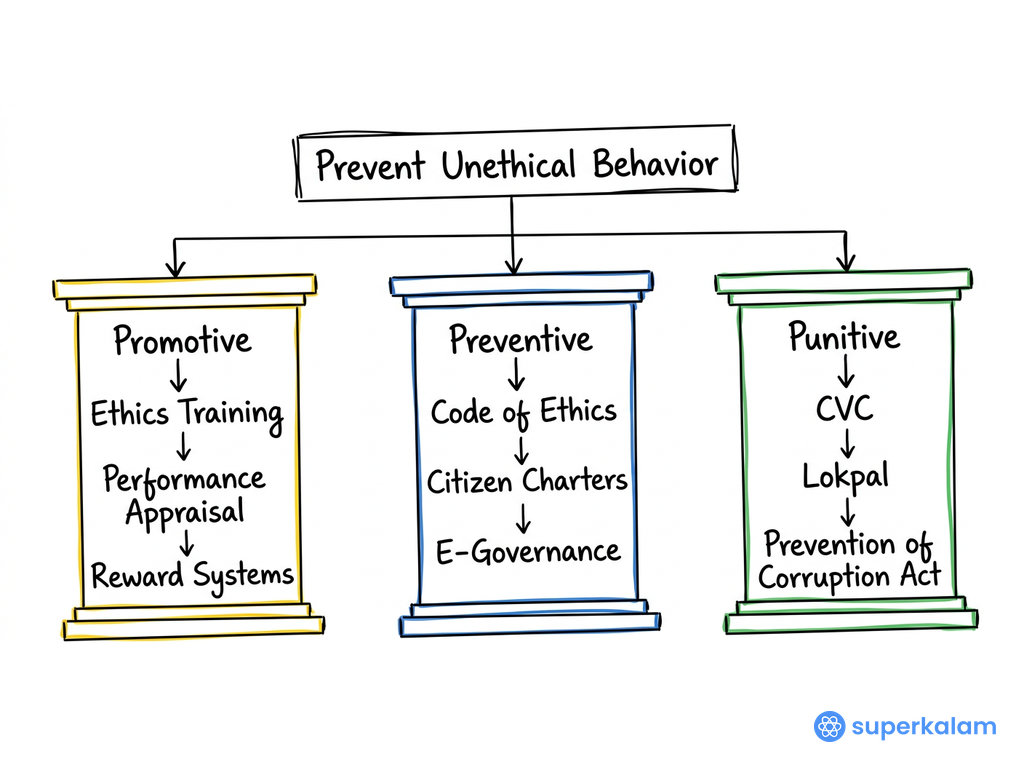
Strategy to Prevent Unethical Behavior Framework
Ten Essential Values for Effective Public Servants
• Integrity: Adherence to moral principles in all actions, exemplified by Ashok Khemka's anti-corruption stance and E. Sreedharan's project management ethics.
• Accountability: Taking responsibility for decisions and outcomes, as demonstrated through RTI Act 2005 implementation and citizen grievance redressal mechanisms.
• Transparency: Open governance practices ensuring public access to information, reflected in Digital India initiatives and online service delivery platforms.
• Impartiality: Fair treatment without bias, following Aristotle's concept of distributive justice and constitutional equality principles.
• Compassion: Empathetic service delivery, inspired by Kiran Bedi's prison reforms and Armstrong Pame's community development work.
• Professional Competence: Continuous skill development through Mission Karmayogi and capacity building programs for administrative excellence.
• Objectivity: Evidence-based decision making, incorporating Rawls' veil of ignorance principle and scientific temper in policy formulation.
• Honesty: Truthfulness in communication and reporting, exemplified by whistleblowing protections under Whistleblowers Protection Act 2014.
• Dedication: Commitment to public welfare, demonstrated through Aruna Roy's transparency advocacy and grassroots governance initiatives.
• Respect for Law: Constitutional adherence and rule of law principles, ensuring due process and fundamental rights protection.
Ways and Means to Prevent Non-Ethical Behavior
• Institutional Mechanisms: Strengthening Central Vigilance Commission, Lokpal, and state vigilance departments with enhanced investigative powers and time-bound disposal.
• Technology Integration: Implementing blockchain-based transparent systems, AI-powered monitoring of public procurement, and digital audit trails for accountability.
• Training and Sensitization: Regular ethics workshops, case study discussions, and moral reasoning sessions based on Kantian categorical imperative principles.
• Performance Monitoring: 360-degree feedback systems, citizen satisfaction surveys, and outcome-based performance indicators for continuous evaluation.
• Legal Framework: Robust anti-corruption laws, asset declaration requirements, and conflict of interest guidelines with deterrent punishments.
• Cultural Transformation: Promoting value-based leadership, merit-based promotions, and recognition systems for ethical conduct in public service.
Effective public service requires integrating dharmic governance principles with modern accountability mechanisms, ensuring citizen-centric delivery through ethical leadership and institutional reforms.
Answer Length
Model answers may exceed the word limit for better clarity and depth. Use them as a guide, but always frame your final answer within the exam’s prescribed limit.
Evaluate this PYQ now
Write your answer & evaluate in just 60 seconds




500+ students evaluated
Model Answers from
- 2021Ethics: Theory10 MarksView Answer
“Integrity is a value that empowers the human being’’. Justify with suitable illustration.
- 2021Ethics: Theory10 MarksView Answer
An independent and empowered social audit mechanism is an absolute must in every sphere of public service, including the judiciary, to ensure performance, accountability and ethical conduct. Elaborate.
- 2021Ethics: Theory10 MarksView Answer
Should impartial and being non-partisan be considered indispensable qualities to make a successful civil servant? Discuss with illustrations.
- 2021Ethics: Theory10 MarksView Answer
“Refugees should not be turned back to the country where they would face prosecution or human rights violation.” Examine the statement with reference to the ethical dimension being violated by the nation claiming to be democratic with an open society.
- 2021Ethics: Theory10 MarksView Answer
In case of a crisis of conscience does emotional intelligence help to overcome the same without compromising the ethical and moral stand that you are likely to follow? Critically examine.
- 2021Ethics: Theory10 MarksView Answer
Attitude is an important component that goes as input in the development of human being. How to build a suitable attitude needed for a public servant?
Model Answers by Subject


Crack UPSC with your
Personal AI Mentor
An AI-powered ecosystem to learn, practice, and evaluate with discipline



