Besides domain knowledge, a public official needs innovativeness and creativity of a high order as well, while resolving ethical dilemmas. Discuss with suitable example.
Besides domain knowledge, a public official needs innovativeness and creativity of a high order as well, while resolving ethical dilemmas. Discuss with suitable example.
Innovativeness and creativity represent the ability to devise novel solutions beyond conventional approaches, essential for public officials facing complex ethical dilemmas where standard protocols may prove inadequate.
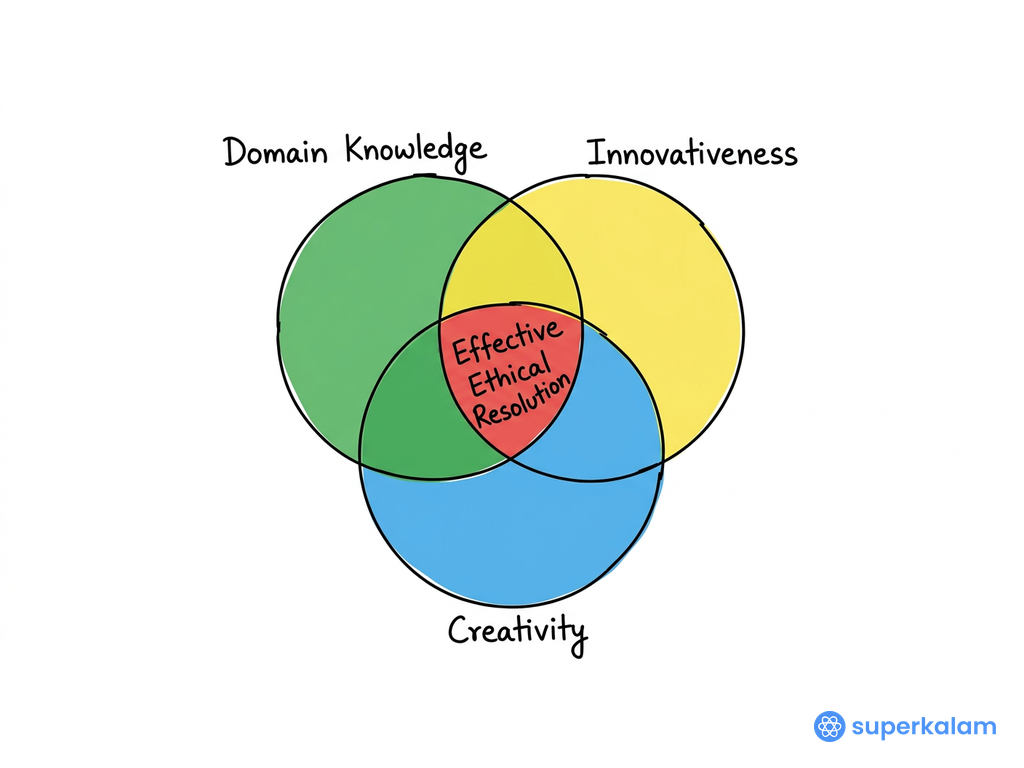
Venn Diagram of Domain Knowledge Innovation
Need for Innovation and Creativity in Ethical Decision-Making
• Complex Stakeholder Dynamics: Modern governance involves multiple competing interests requiring creative synthesis of diverse viewpoints (e.g., balancing development with environmental protection in Smart Cities Mission).
• Resource Constraints: Limited budgets demand innovative resource allocation while maintaining ethical standards (e.g., Sukanya Samriddhi Yojana's creative financing for girl child education).
• Technological Disruption: Digital governance creates new ethical challenges requiring adaptive solutions (e.g., Aadhaar implementation balancing privacy with service delivery).
• Cultural Sensitivity: Diverse Indian society demands culturally innovative approaches respecting pluralistic values while ensuring constitutional morality.
• Time-Critical Decisions: Emergency situations require rapid creative problem-solving maintaining ethical integrity (e.g., COVID-19 vaccine distribution strategies).
• Transparency vs. Security: Balancing RTI compliance with national security through innovative disclosure mechanisms.
Case Study: E. Sreedharan's Konkan Railway Project
• Ethical Dilemma: Constructing railway through ecologically sensitive Western Ghats while ensuring tribal rehabilitation and environmental protection.
• Creative Solution: Developed elevated viaducts minimizing land acquisition, implemented community participation models for tribal welfare, and established environmental monitoring systems.
• Innovation Applied: Used Japanese technology adaptation with local materials, created skill development programs for displaced communities, and established transparent grievance mechanisms.
• Outcome: Project completed within timeline and budget while maintaining environmental sustainability and social justice.
• Ethical Framework: Applied Rawlsian justice principles through difference principle benefiting least advantaged while achieving utilitarian outcomes.
Way Forward
• Design Thinking Training: Incorporating human-centered design approaches in civil services training programs.
• Cross-Sector Collaboration: Establishing innovation labs within government departments for ethical solution development.
Aristotelian golden mean suggests that creative governance requires balancing efficiency with equity, where innovative public administration becomes the cornerstone of ethical leadership in contemporary India.
Answer Length
Model answers may exceed the word limit for better clarity and depth. Use them as a guide, but always frame your final answer within the exam’s prescribed limit.
Evaluate this PYQ now
Write your answer & evaluate in just 60 seconds




500+ students evaluated
Model Answers from
- 2021Ethics: Theory10 MarksView Answer
“Integrity is a value that empowers the human being’’. Justify with suitable illustration.
- 2021Ethics: Theory10 MarksView Answer
An independent and empowered social audit mechanism is an absolute must in every sphere of public service, including the judiciary, to ensure performance, accountability and ethical conduct. Elaborate.
- 2021Ethics: Theory10 MarksView Answer
Should impartial and being non-partisan be considered indispensable qualities to make a successful civil servant? Discuss with illustrations.
- 2021Ethics: Theory10 MarksView Answer
“Refugees should not be turned back to the country where they would face prosecution or human rights violation.” Examine the statement with reference to the ethical dimension being violated by the nation claiming to be democratic with an open society.
- 2021Ethics: Theory10 MarksView Answer
In case of a crisis of conscience does emotional intelligence help to overcome the same without compromising the ethical and moral stand that you are likely to follow? Critically examine.
- 2021Ethics: Theory10 MarksView Answer
Attitude is an important component that goes as input in the development of human being. How to build a suitable attitude needed for a public servant?
Model Answers by Subject


Crack UPSC with your
Personal AI Mentor
An AI-powered ecosystem to learn, practice, and evaluate with discipline



