What is meant by 'crisis of conscience'? How does it manifest itself in the public domain?
What is meant by 'crisis of conscience'? How does it manifest itself in the public domain?
Crisis of conscience refers to the internal moral conflict experienced when one's ethical principles clash with external pressures or institutional demands. Aristotle's concept of moral distress and Gandhi's emphasis on satyagraha highlight the tension between dharma and adharma in decision-making.
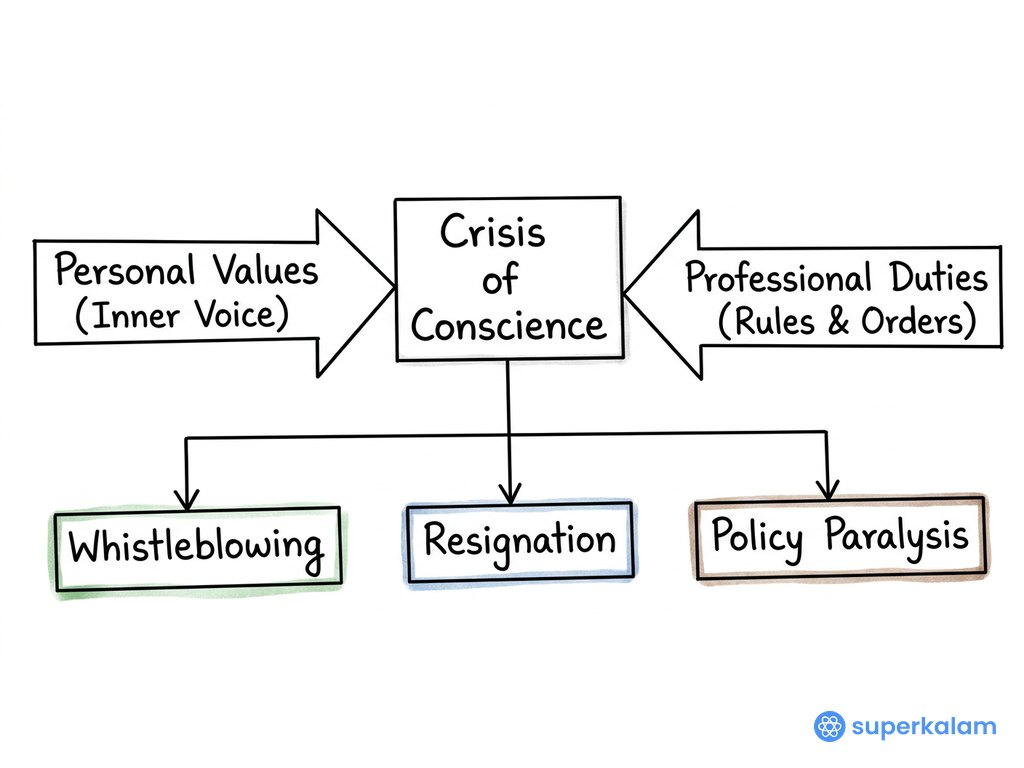
Crisis of Conscience Conceptual Framework Diagram
Understanding Crisis of Conscience
• Moral Dilemma: Conflict between personal values and professional obligations, creating psychological distress (e.g., Kant's categorical imperative versus utilitarian outcomes).
• Ethical Paralysis: Inability to act due to competing moral claims, as seen in Arjuna's dilemma in the Bhagavad Gita before the Kurukshetra war.
• Value Contradiction: Clash between individual conscience and organizational culture, exemplified by whistleblowing cases in corporate and government sectors.
• Institutional Pressure: External forces compelling actions against moral convictions, creating what Rawls termed moral injury in professional settings.
• Decision Paralysis: Inability to choose between equally valid ethical frameworks, leading to moral distress and professional burnout.
• Identity Crisis: Questioning of professional identity when institutional demands conflict with personal integrity and ethical foundations.
Manifestations in Public Domain
• Whistleblowing Cases: Civil servants like Ashok Khemka exposing corruption despite career risks, demonstrating moral courage over professional security.
• Policy Dissent: Officials resigning over ethical disagreements with government policies (e.g., U.S. State Department resignations over foreign policy decisions).
• Judicial Independence: Judges facing pressure in politically sensitive cases, balancing constitutional duty with external influences and public opinion.
• Administrative Disobedience: IAS officers refusing to implement unconstitutional orders, invoking Article 311 protections and constitutional morality.
• Media Ethics: Journalists choosing between editorial independence and commercial pressures, affecting press freedom and public discourse.
• Corporate Responsibility: Business leaders balancing profit maximization with social responsibility, especially during environmental crises and labor disputes.
Addressing crisis of conscience requires robust institutional frameworks supporting ethical decision-making, whistleblower protection, and moral education in civil services training. Constitutional values and Gandhian principles provide guidance for navigating these complex moral landscapes.
Answer Length
Model answers may exceed the word limit for better clarity and depth. Use them as a guide, but always frame your final answer within the exam’s prescribed limit.
Evaluate this PYQ now
Write your answer & evaluate in just 60 seconds



500+ students evaluated
Model Answers from
- 2019Ethics: Theory10 MarksView Answer
What does this quotation mean to you
“Where there is righteousness in the heart, there is beauty in the character. When there is beauty in the character, there is harmony in the home. When there is harmony in the home, there is order in the nation. When there is order in the nation, there is peace in the world.” – A.P.J. Abdul Kalam - 2019Ethics: Theory10 MarksView Answer
What does this quotation mean to you
“A man is but the product of his thoughts. What he thinks, he becomes.” – M.K.Gandhi - 2019Ethics: Theory10 MarksView Answer
What does this quotation mean to you
“An unexamined life is not worth living.” – Socrates - 2019Ethics: Theory10 MarksView Answer
“Emotional Intelligence is the ability to make your emotions work for you instead of against you.” Do you agree with this view? Discuss. (150 words)
- 2019Ethics: Theory10 MarksView Answer
What do you understand by probity in governance? Based on your understanding of the term, suggest measures for ensuring probity in government. (150 words)
- 2019Ethics: Theory10 MarksView Answer
There is a view that the Official Secrets Act is an obstacle to the implementation of the Rights to Information Act. Do you agree with the view? Discuss (150 words)
Model Answers by Subject


Crack UPSC with your
Personal AI Mentor
An AI-powered ecosystem to learn, practice, and evaluate with discipline