What are the methods used by the Farmer's
organizations to influence the policy-makers in India
and how effective are these methods?
What are the methods used by the Farmer's
organizations to influence the policy-makers in India
and how effective are these methods?
Recent farmer movements, particularly the 2020-21 protests, have demonstrated the significant influence of agrarian organizations in India's policy-making process. These organizations employ diverse strategies ranging from traditional protests to modern advocacy techniques.
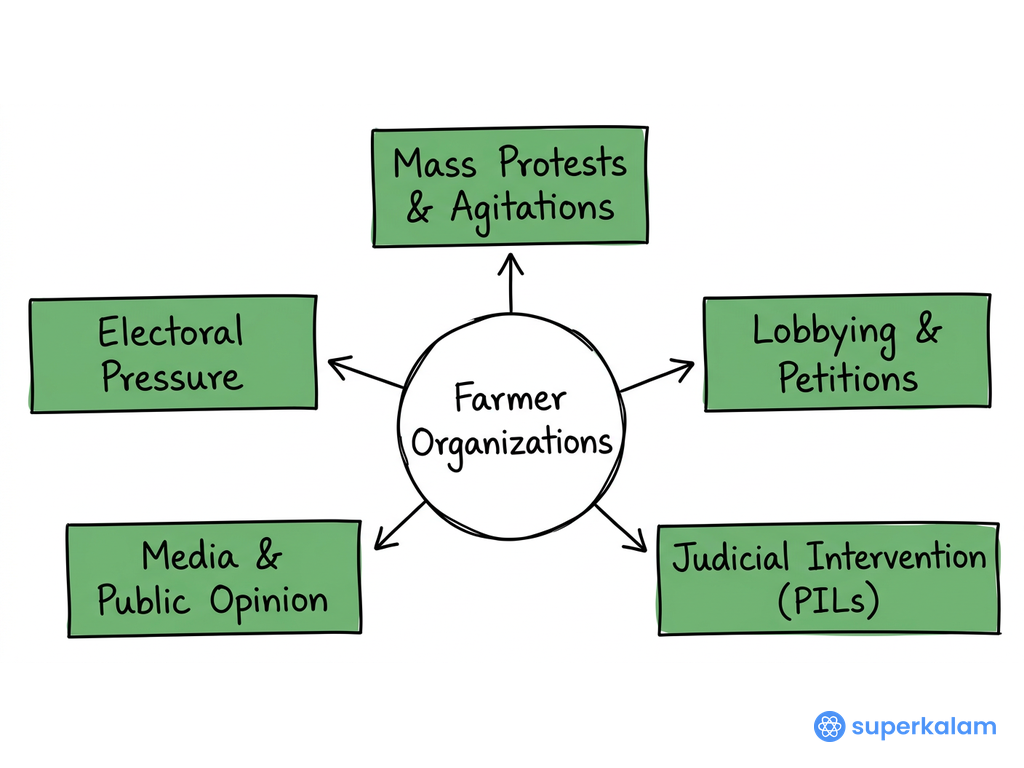
Farmer Organizations Radial Diagram With Arrows
Methods of Policy Influence
Direct Action and Mass Mobilization
- Large-scale Protests: Coordinated demonstrations like the 2020-21 Farmers' Protest involving over 250,000 farmers at Delhi borders
- Highway Blockades: Strategic occupation of major routes including Singhu, Tikri, and Ghazipur borders to create economic pressure
- Bharat Bandh: Nationwide strikes organized by All India Kisan Sabha (AIKS) and Samyukta Kisan Morcha
- Symbolic Actions: Tractor rallies and burning of farm laws copies to capture media attention
- Hunger Strikes: Individual and collective fasting by leaders like Rakesh Tikait to generate public sympathy
Institutional Engagement and Legal Advocacy
- Parliamentary Lobbying: Direct engagement with MPs through organizations like Bhartiya Kisan Union (BKU-Tikait faction)
- Policy Consultations: Participation in Commission for Agricultural Costs & Prices (CACP) deliberations
- Supreme Court Petitions: Filing PILs challenging policies, as seen in MSP guarantee cases
- State Assembly Representations: Engaging with state governments for region-specific issues
- Expert Committee Participation: Contributing to panels like the Swaminathan Commission recommendations
Effectiveness Assessment
| Method | Success Rate | Recent Examples |
|---|---|---|
| Mass Protests | High | Three Farm Laws repealed (2021) |
| Legal Advocacy | Moderate | MSP cases pending in SC |
| Parliamentary Engagement | Low | Limited legislative success |
Major Successes
- Complete Policy Reversal: Repeal of three farm laws in November 2021 after year-long protests
- MSP Increases: Regular hikes in Minimum Support Prices following sustained pressure
- Debt Relief Programs: State-level loan waivers in Uttar Pradesh, Maharashtra, and Punjab
- Infrastructure Investments: ₹1 lakh crore Agriculture Infrastructure Fund announced in 2020
Limitations and Challenges
- Fragmented Leadership: Over 40 farmer unions with conflicting ideologies reduce bargaining power
- Geographic Disparities: Punjab-Haryana dominance overshadows concerns of eastern and southern states
- Implementation Gaps: Despite PM-KISAN scheme, ground-level delivery remains inconsistent
The evolving relationship between farmer organizations and policymakers reflects India's democratic responsiveness, with the recent establishment of Natural Farming Mission and FPO promotion schemes indicating continued policy adaptation to agrarian demands.
Answer Length
Model answers may exceed the word limit for better clarity and depth. Use them as a guide, but always frame your final answer within the exam’s prescribed limit.
Evaluate this PYQ now
Write your answer & evaluate in just 60 seconds




500+ students evaluated
Model Answers from
- 2019Indian Polity15 MarksView Answer
Individual Parliamentarian’s role as the national
the lawmaker is on a decline, which in turn, has
adversely impacted the quality of debates
and their outcome. - 2019Indian Polity15 MarksView Answer
The Attorney-General is the chief legal adviser
and lawyer of the Government of India. Discuss - 2019Indian Polity15 MarksView Answer
The reservation of seats for women in the
institutions of local self-government have had a
limited impact on the patriarchal character of the
Indian Political Process. - 2019Indian Polity15 MarksView Answer
Parliament’s power to amend the Constitution is
limited and it cannot be enlarged into absolute
power.” In light of this statement explain whether
Parliament under Article 368 of the Constitution
can destroy the Basic Structure of the Constitution
by expanding its amending power. - 2019Indian Polity15 MarksView Answer
On what grounds a people’s representative can be
disqualified under the Representation of People
Act, 1951? Also, mention the remedies available
to such a person against his disqualification. - 2019Indian Polity10 MarksView Answer
There is a growing divergence in the relationship
between poverty and hunger in India. The
shrinking of social expenditure by the government
is forcing the poor to spend more on non-food
essential items squeezing their food –
budget.- Elucidate.
Model Answers by Subject


Crack UPSC with your
Personal AI Mentor
An AI-powered ecosystem to learn, practice, and evaluate with discipline



