The reservation of seats for women in the
institutions of local self-government have had a
limited impact on the patriarchal character of the
Indian Political Process.
The reservation of seats for women in the
institutions of local self-government have had a
limited impact on the patriarchal character of the
Indian Political Process.
The 73rd and 74th Constitutional Amendments (1992) mandating 33% women's reservation in Panchayati Raj Institutions represented a significant democratic reform. However, despite electing over 1.4 million women representatives, patriarchal structures continue to limit transformative political change.
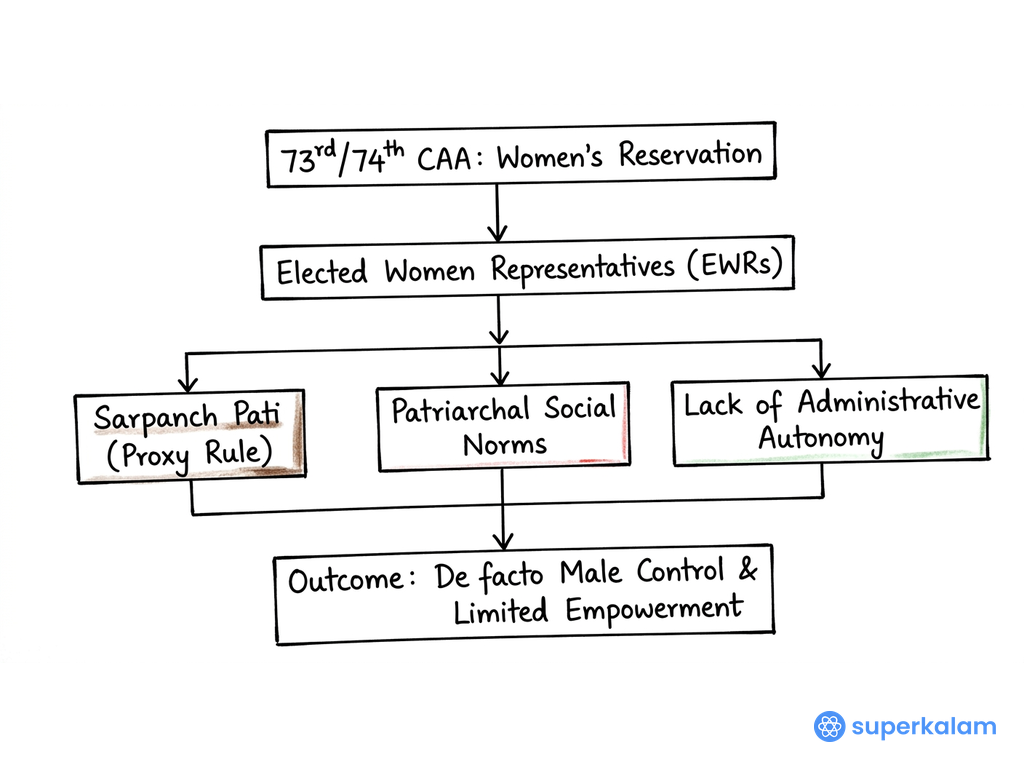
Constitutional Mandate Versus Ground Reality Flowchart
Limited Impact on Patriarchal Character
Proxy Representation:
- "Sarpanch Pati" phenomenon - Male family members exercise actual power while women serve as figureheads
- Decision-making remains concentrated with traditional male power holders
- Women representatives often lack autonomy in policy choices
- Social pressure restricts independent political expression
- Limited participation in gram sabha meetings and public forums
Structural Barriers:
- Financial constraints limit campaign capabilities and political networking
- Rotation of reserved seats disrupts continuity of women's political careers
- Lack of formal political training and administrative experience
- Digital divide hampers access to government schemes and e-governance
- Insufficient support systems for balancing family and political responsibilities
Positive Outcomes and Transformations
Governance Improvements:
- Maharashtra study (2023) shows 23% improvement in maternal health outcomes under women sarpanches
- Enhanced focus on MGNREGA implementation and social welfare schemes
- Better maintenance of public facilities like schools, health centers, and water systems
- Increased transparency in fund utilization through Social Audit processes
- Greater emphasis on Swachh Bharat Mission and sanitation initiatives
Women's Empowerment Indicators:
- Rise in Self-Help Group formations - over 7 crore women in SHGs nationally
- Improved confidence levels and public speaking abilities among women representatives
- Creation of role models inspiring political participation at higher levels
- Gender-responsive budgeting adoption in several states
- Enhanced women's participation in village-level decision-making committees
Way Forward for Meaningful Change
- Implementation of Women's Reservation Bill (2023) extending reservation to Parliament and state legislatures
- Mandatory capacity-building programs through Mission Shakti and Rashtriya Mahila Kosh
- Establishing mentorship networks and peer learning platforms
- Strengthening grievance redressal mechanisms for women representatives
- Creating dedicated fund allocations for women-led development initiatives
While reservation has opened political spaces for women, dismantling patriarchal structures requires sustained cultural transformation alongside institutional reforms. The Panchayati Raj system must evolve beyond numerical representation toward substantive empowerment for lasting democratic change.
Answer Length
Model answers may exceed the word limit for better clarity and depth. Use them as a guide, but always frame your final answer within the exam’s prescribed limit.
Evaluate this PYQ now
Write your answer & evaluate in just 60 seconds




500+ students evaluated
Model Answers from
- 2019Indian Polity15 MarksView Answer
Individual Parliamentarian’s role as the national
the lawmaker is on a decline, which in turn, has
adversely impacted the quality of debates
and their outcome. - 2019Indian Polity15 MarksView Answer
The Attorney-General is the chief legal adviser
and lawyer of the Government of India. Discuss - 2019Indian Polity15 MarksView Answer
Parliament’s power to amend the Constitution is
limited and it cannot be enlarged into absolute
power.” In light of this statement explain whether
Parliament under Article 368 of the Constitution
can destroy the Basic Structure of the Constitution
by expanding its amending power. - 2019Indian Polity15 MarksView Answer
On what grounds a people’s representative can be
disqualified under the Representation of People
Act, 1951? Also, mention the remedies available
to such a person against his disqualification. - 2019Indian Polity10 MarksView Answer
There is a growing divergence in the relationship
between poverty and hunger in India. The
shrinking of social expenditure by the government
is forcing the poor to spend more on non-food
essential items squeezing their food –
budget.- Elucidate. - 2019Indian Polity10 MarksView Answer
Despite Consistent experience of High growth, India
still goes with the lowest indicators of human
development. Examine the issues that make
balanced and inclusive development elusive.
Model Answers by Subject


Crack UPSC with your
Personal AI Mentor
An AI-powered ecosystem to learn, practice, and evaluate with discipline