Individual Parliamentarian’s role as the national
the lawmaker is on a decline, which in turn, has
adversely impacted the quality of debates
and their outcome.
Individual Parliamentarian’s role as the national
the lawmaker is on a decline, which in turn, has
adversely impacted the quality of debates
and their outcome.
The diminishing role of individual parliamentarians in lawmaking represents a critical challenge to India's parliamentary democracy, significantly undermining legislative quality and democratic deliberation.
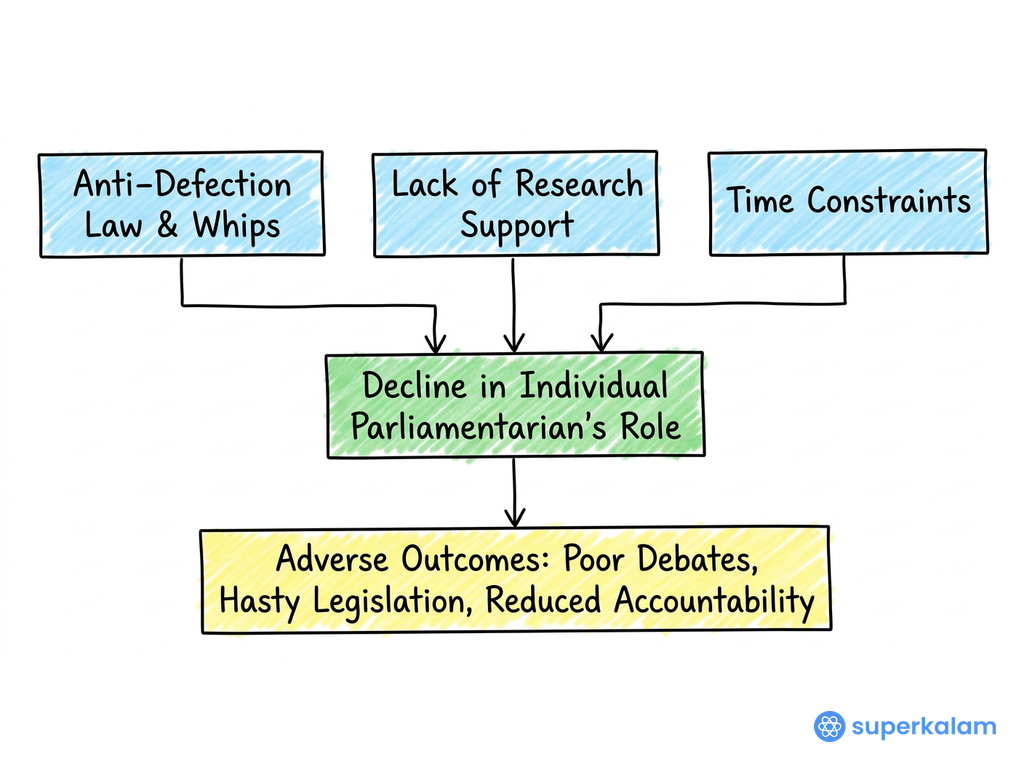
Anti Defection Law Top-Down Flowchart
Reasons for Declining Individual Role
-
Party Dominance and Whip System
- Strict party discipline limiting independent voting
- Anti-Defection Law (10th Schedule) constraining MPs' conscience-based decisions
- Leadership-driven legislative agenda overshadowing individual initiatives
- Coalition politics reducing space for dissenting voices
- Electoral dependencies making MPs toe party lines
-
Institutional Constraints
- Private Member Bills rarely succeed - only 14 passed since 1947, none since 1970
- Limited parliamentary time allocated for individual member initiatives
- Government's legislative dominance through Article 117 (money bills restriction)
- Inadequate research support and institutional backing for MPs
- Complex legislative procedures deterring individual participation
Impact on Debate Quality and Outcomes
-
Deteriorating Legislative Scrutiny
- Reduced committee referrals - only 27% bills referred to committees in recent years
- Perfunctory discussions without substantial amendments
- Question Hour and Zero Hour frequently disrupted, limiting accountability mechanisms
- Declining average debate time per bill from 7.5 hours (1950s) to 2.5 hours (2019-24)
- Rushed passage of legislation without adequate deliberation
-
Democratic Deficit
- Weakened representation of diverse regional and sectoral interests
- Reduced policy innovation from grassroots parliamentary experience
- Limited cross-party collaboration on non-partisan issues
- Decreased public engagement with legislative processes
- Erosion of Parliament's constitutional role as supreme legislative body
Remedial Measures
- Mandatory 48-hour notice before bill introduction
- Strengthening Department-Related Standing Committees with enhanced powers
- Dedicated time slots for private member legislation
- Parliamentary research services modeled on UK House of Commons Library
- Digital platforms for broader public consultation
Revitalizing individual parliamentarians' legislative role requires comprehensive reforms balancing party discipline with democratic representation, ensuring Parliament's effectiveness as India's premier law-making institution.
Answer Length
Model answers may exceed the word limit for better clarity and depth. Use them as a guide, but always frame your final answer within the exam’s prescribed limit.
Evaluate this PYQ now
Write your answer & evaluate in just 60 seconds




500+ students evaluated
Model Answers from
- 2019Indian Polity15 MarksView Answer
The Attorney-General is the chief legal adviser
and lawyer of the Government of India. Discuss - 2019Indian Polity15 MarksView Answer
The reservation of seats for women in the
institutions of local self-government have had a
limited impact on the patriarchal character of the
Indian Political Process. - 2019Indian Polity15 MarksView Answer
Parliament’s power to amend the Constitution is
limited and it cannot be enlarged into absolute
power.” In light of this statement explain whether
Parliament under Article 368 of the Constitution
can destroy the Basic Structure of the Constitution
by expanding its amending power. - 2019Indian Polity15 MarksView Answer
On what grounds a people’s representative can be
disqualified under the Representation of People
Act, 1951? Also, mention the remedies available
to such a person against his disqualification. - 2019Indian Polity10 MarksView Answer
There is a growing divergence in the relationship
between poverty and hunger in India. The
shrinking of social expenditure by the government
is forcing the poor to spend more on non-food
essential items squeezing their food –
budget.- Elucidate. - 2019Indian Polity10 MarksView Answer
Despite Consistent experience of High growth, India
still goes with the lowest indicators of human
development. Examine the issues that make
balanced and inclusive development elusive.
Model Answers by Subject


Crack UPSC with your
Personal AI Mentor
An AI-powered ecosystem to learn, practice, and evaluate with discipline



