Explain the basic principles of the citizens’ charter movement and bring out its importance.
Explain the basic principles of the citizens’ charter movement and bring out its importance.
Citizens' Charter represents a social contract between government and citizens, embodying Rawlsian principles of justice and Gandhian ideals of responsive governance for transparent public service delivery.
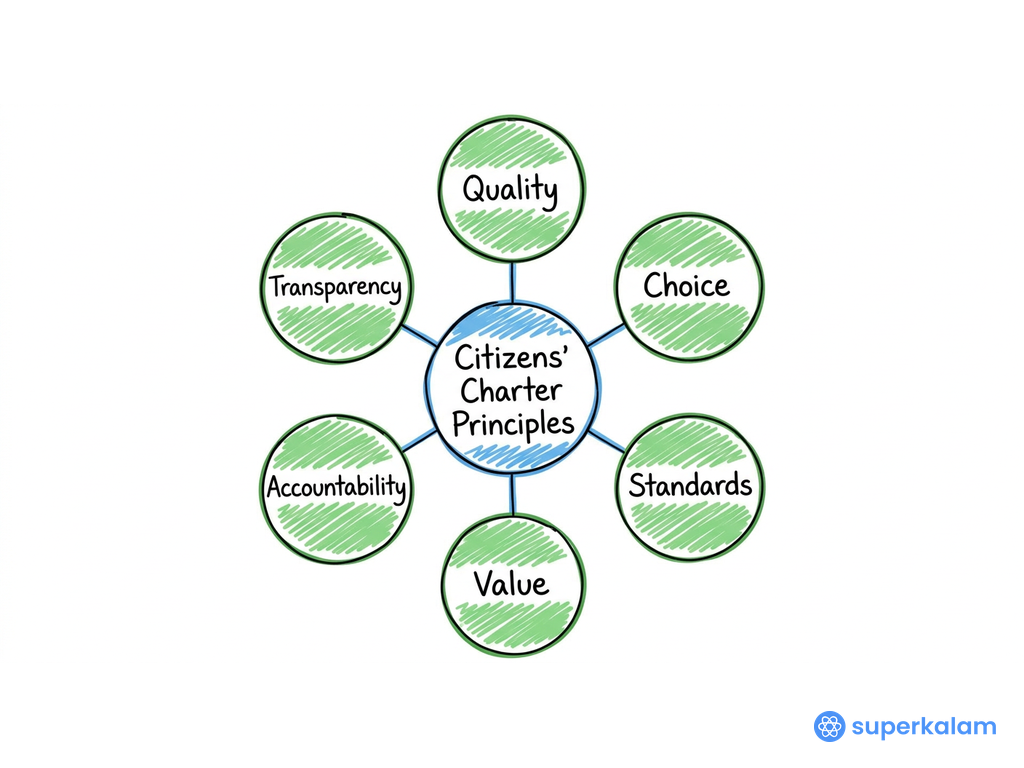
Citizens Charter Principles Radial Diagram 2019
Basic Principles of Citizens' Charter Movement
• Service Standards and Quality Assurance: Establishing measurable benchmarks for public service delivery with defined timelines (e.g., passport issuance within 30 days under Passport Seva Project).
• Transparency and Information Access: Providing clear information about procedures, fees, and timelines, reflecting Kantian categorical imperative of treating citizens as rational beings deserving truth.
• Accountability and Grievance Redressal: Creating mechanisms for complaint handling and officer accountability (e.g., Public Grievance Redressal and Monitoring System (PGRAMS)).
• Citizen Participation and Feedback: Involving citizens in service design and evaluation, embodying Habermasian communicative action principles for democratic governance.
• Non-discrimination and Equity: Ensuring equal access regardless of social status, reflecting Ambedkarian vision of social justice and constitutional equality.
• Continuous Improvement: Regular review and enhancement of services based on citizen feedback and performance monitoring through Sevottam framework.
Importance of Citizens' Charter Movement
• Democratic Empowerment: Transforms citizens from passive recipients to active stakeholders, strengthening participatory democracy and reducing power asymmetries in governance.
• Administrative Efficiency: Promotes Max Weber's bureaucratic efficiency through standardized procedures and performance measurement (e.g., Railway Passenger Charter improving service quality).
• Corruption Reduction: Transparent processes and defined timelines minimize discretionary powers, supporting Chanakya's principles of clean administration and ethical governance.
• Trust Building: Enhances citizen confidence in government institutions through reliable service delivery, fostering social capital essential for democratic functioning.
• Rights-based Approach: Converts government services from privileges to entitlements, aligning with human rights framework and constitutional obligations.
• Innovation Catalyst: Encourages administrative innovation and citizen-centric reforms (e.g., Digital India initiatives improving service accessibility and efficiency).
Citizens' Charter movement represents a paradigm shift toward ethical governance, transforming bureaucratic culture through Gandhian principles of service while ensuring constitutional values of justice, equality, and dignity in public administration.
Answer Length
Model answers may exceed the word limit for better clarity and depth. Use them as a guide, but always frame your final answer within the exam’s prescribed limit.
Evaluate this PYQ now
Write your answer & evaluate in just 60 seconds




500+ students evaluated
Model Answers from
- 2019Ethics: Theory10 MarksView Answer
What is meant by 'crisis of conscience'? How does it manifest itself in the public domain?
- 2019Ethics: Theory10 MarksView Answer
What does this quotation mean to you
“Where there is righteousness in the heart, there is beauty in the character. When there is beauty in the character, there is harmony in the home. When there is harmony in the home, there is order in the nation. When there is order in the nation, there is peace in the world.” – A.P.J. Abdul Kalam - 2019Ethics: Theory10 MarksView Answer
What does this quotation mean to you
“A man is but the product of his thoughts. What he thinks, he becomes.” – M.K.Gandhi - 2019Ethics: Theory10 MarksView Answer
What does this quotation mean to you
“An unexamined life is not worth living.” – Socrates - 2019Ethics: Theory10 MarksView Answer
“Emotional Intelligence is the ability to make your emotions work for you instead of against you.” Do you agree with this view? Discuss. (150 words)
- 2019Ethics: Theory10 MarksView Answer
What do you understand by probity in governance? Based on your understanding of the term, suggest measures for ensuring probity in government. (150 words)
Model Answers by Subject


Crack UPSC with your
Personal AI Mentor
An AI-powered ecosystem to learn, practice, and evaluate with discipline