Explain how the foundations of the modern world were laid by the American and French Revolutions
Explain how the foundations of the modern world were laid by the American and French Revolutions
The American Revolution (1775-1783) and French Revolution (1789-1799) fundamentally transformed global political, social, and economic structures, establishing the ideological and institutional foundations of the modern democratic world.
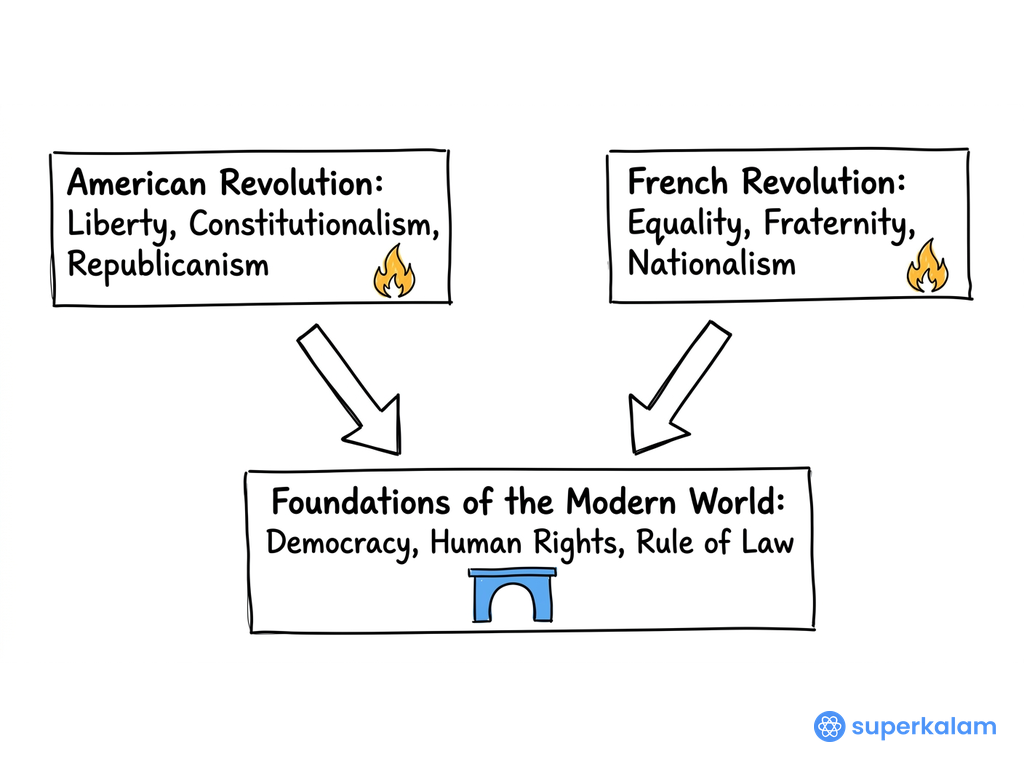
Convergence Flowchart with Two Boxes
Political Foundations of Modern Democracy
- Popular Sovereignty: Both revolutions established the revolutionary concept that political authority derives from the people, not divine right of kings, fundamentally challenging absolute monarchy.
- Constitutional Framework: The American Revolution created the world's first written constitution (1787), while the French Revolution produced the Declaration of Rights of Man and Citizen (1789), serving as templates for modern democratic constitutions.
- Separation of Powers: Implementation of Montesquieu's theory created independent executive, legislative, and judicial branches with checks and balances, preventing concentration of power.
- Representative Government: Both established systems where elected representatives govern on behalf of citizens, laying groundwork for modern parliamentary and congressional systems.
- Rule of Law: Constitutional supremacy over arbitrary rule became fundamental, ensuring equal justice and protection of individual rights.
Social Transformation and Modern Rights
- Abolition of Feudalism: The French Revolution eliminated the feudal system and privileged estates, while America rejected hereditary aristocracy, creating merit-based societies.
- Individual Liberty: Establishment of natural rights - life, liberty, property (America) and liberty, equality, fraternity (France) - became core principles of modern human rights.
- Religious Freedom: Separation of church and state emerged through America's First Amendment and France's Civil Constitution, establishing modern secular governance.
- Social Mobility: Both revolutions created opportunities for advancement based on talent rather than birth, forming modern meritocratic societies.
Economic Foundations of Capitalism
- Free Market Economy: The American Revolution ended British mercantilism, promoting free trade and economic liberalism that became pillars of modern capitalism.
- Property Rights: Constitutional protection of private property and economic freedom encouraged entrepreneurship and innovation.
- Modern Banking: Development of financial institutions like America's First Bank (1791) established modern monetary systems.
Global Revolutionary Legacy
- Nationalism: Both revolutions created the concept of nation-states and citizenship, replacing loyalty to monarchs with national identity.
- International Inspiration: These revolutions sparked independence movements across Latin America (1810s-1820s) and European nationalist uprisings throughout the 19th century.
These revolutions established enduring principles of constitutional democracy, human rights, and economic freedom that continue shaping global governance, evidenced in institutions like the United Nations and modern democratic constitutions worldwide.
Answer Length
Model answers may exceed the word limit for better clarity and depth. Use them as a guide, but always frame your final answer within the exam’s prescribed limit.
Evaluate this PYQ now
Write your answer & evaluate in just 60 seconds




500+ students evaluated
Model Answers from
- 2019Modern History15 MarksView Answer
Assess the role of British imperial power in complicating the process of transfer of power during the 1940s.
- 2019Modern History15 MarksView Answer
Many voices had strengthened and enriched the nationalist movement during the Gandhian phase. Elaborate.
- 2019Modern History10 MarksView Answer
Examine the linkages between the nineteenth century’s ‘Indian Renaissance’ and the emergence of national identity.
- 2019Modern History10 MarksView Answer
The 1857 uprising was the culmination of the recurrent, big and small local rebellions that had occurred in the preceding hundred years of British rule. Elucidate.
Model Answers by Subject


Crack UPSC with your
Personal AI Mentor
An AI-powered ecosystem to learn, practice, and evaluate with discipline



