Effective utilization of public funds is crucial to meet development goals. Critically e examine the reasons for under-utilization and mis-utilization of public funds and their implications. (150 words).
Effective utilization of public funds is crucial to meet development goals. Critically e examine the reasons for under-utilization and mis-utilization of public funds and their implications. (150 words).
Public fund utilization reflects the state's fiduciary responsibility toward citizens, embodying Rawls' distributive justice and Chanakya's principle of Rajadharma.
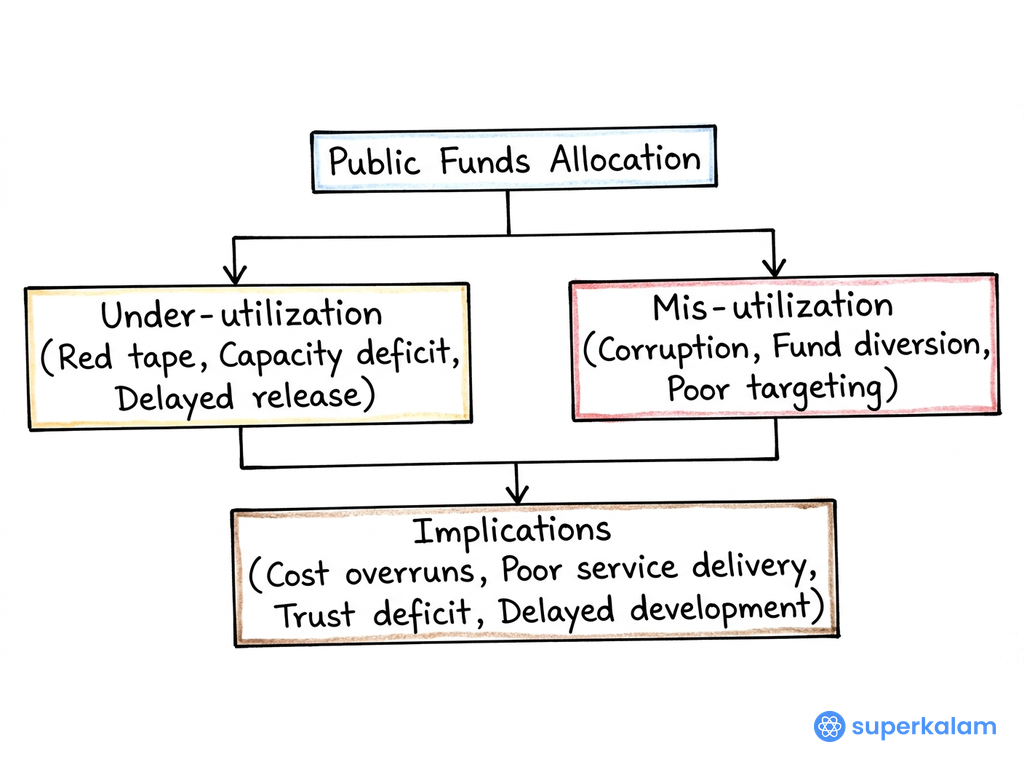
Public Fund Utilization Issues Flowchart Analysis
Reasons for Under-utilization of Public Funds
• Bureaucratic Delays: Complex approval processes and red-tapism delay project implementation (e.g., MPLADS funds remaining unspent due to procedural bottlenecks).
• Capacity Constraints: Inadequate technical expertise and manpower in implementing agencies, particularly in rural areas under MGNREGA.
• Poor Planning: Unrealistic budget estimates and lack of ground-level assessment leading to fund allocation-implementation gaps.
• Inter-departmental Coordination: Fragmented approach between ministries causing delays in flagship schemes like Swachh Bharat Mission.
• Seasonal Constraints: Weather-dependent projects face execution challenges, affecting schemes like Pradhan Mantri Gram Sadak Yojana.
Reasons for Mis-utilization of Public Funds
• Corruption and Rent-seeking: Diversion of funds through inflated contracts and kickbacks, as seen in various CAG reports.
• Lack of Transparency: Weak RTI implementation and inadequate public disclosure enabling financial irregularities.
• Political Interference: Electoral considerations influencing fund allocation over developmental priorities, violating Weber's bureaucratic neutrality.
• Weak Monitoring: Inadequate oversight mechanisms and poor social auditing systems failing to detect misappropriation.
• Fraudulent Documentation: False beneficiary lists and ghost projects undermining schemes like PM-KISAN.
Implications of Fund Mismanagement
• Development Deficit: Delayed infrastructure projects affecting economic growth and SDG achievement.
• Erosion of Public Trust: Citizens losing faith in government institutions, weakening democratic legitimacy.
• Opportunity Cost: Resources diverted from critical sectors like healthcare and education, violating utilitarian principles.
• Intergenerational Injustice: Fiscal irresponsibility burdening future generations with debt and underdevelopment.
Strengthening participatory budgeting, digital governance through GeM portal, and outcome-based evaluation can ensure Gandhian trusteeship in public resource management while achieving inclusive development.
Answer Length
Model answers may exceed the word limit for better clarity and depth. Use them as a guide, but always frame your final answer within the exam’s prescribed limit.
Evaluate this PYQ now
Write your answer & evaluate in just 60 seconds




500+ students evaluated
Model Answers from
- 2019Ethics: Theory10 MarksView Answer
What is meant by 'crisis of conscience'? How does it manifest itself in the public domain?
- 2019Ethics: Theory10 MarksView Answer
What does this quotation mean to you
“Where there is righteousness in the heart, there is beauty in the character. When there is beauty in the character, there is harmony in the home. When there is harmony in the home, there is order in the nation. When there is order in the nation, there is peace in the world.” – A.P.J. Abdul Kalam - 2019Ethics: Theory10 MarksView Answer
What does this quotation mean to you
“A man is but the product of his thoughts. What he thinks, he becomes.” – M.K.Gandhi - 2019Ethics: Theory10 MarksView Answer
What does this quotation mean to you
“An unexamined life is not worth living.” – Socrates - 2019Ethics: Theory10 MarksView Answer
“Emotional Intelligence is the ability to make your emotions work for you instead of against you.” Do you agree with this view? Discuss. (150 words)
- 2019Ethics: Theory10 MarksView Answer
What do you understand by probity in governance? Based on your understanding of the term, suggest measures for ensuring probity in government. (150 words)
Model Answers by Subject


Crack UPSC with your
Personal AI Mentor
An AI-powered ecosystem to learn, practice, and evaluate with discipline



