Assess the impact of global warming on the coral life system with examples.
Assess the impact of global warming on the coral life system with examples.
Recent studies reveal that ocean temperatures have risen by 0.6°C since 1969, triggering unprecedented stress on coral ecosystems worldwide. Global warming represents the most significant threat to coral reef systems, which support 25% of marine biodiversity.
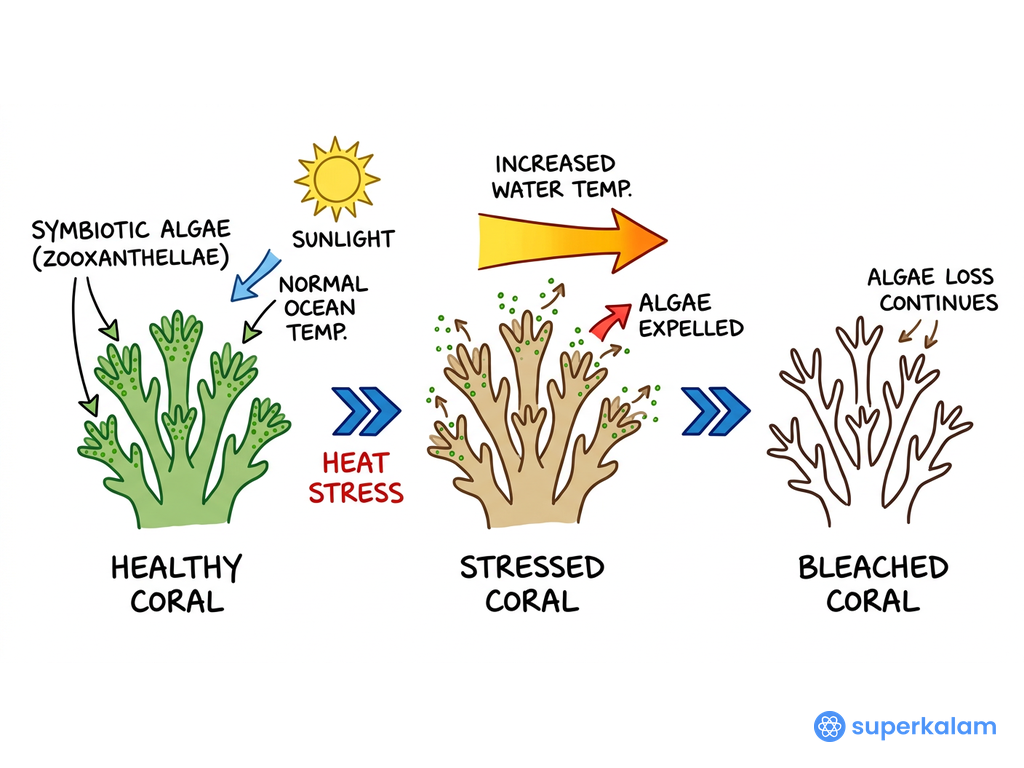
Coral Bleaching Three Stage Process Diagram
Temperature-Induced Coral Stress
Coral Bleaching Mechanisms
- Thermal Stress Response: When water temperatures exceed 1-2°C above normal for 4-6 weeks, corals expel symbiotic zooxanthellae algae, causing white bleaching
- Metabolic Disruption: Loss of algae eliminates 90% of coral's energy source, leading to starvation and potential death
- Recovery Limitations: Severely bleached corals require 5-10 years for full recovery under optimal conditions
- Cascading Effects: Bleached reefs lose structural complexity, reducing habitat for reef fish by 60-80%
- Frequency Increase: Bleaching events now occur every 2-3 years instead of historical 25-30 year intervals
Ocean Chemistry Changes
- Ocean Acidification: Increased CO2 absorption reduces pH by 0.1 units since pre-industrial times, weakening coral skeletons
- Carbonate Saturation: Reduced availability of carbonate ions slows coral growth rates by 10-15%
- Shell Formation: Marine organisms struggle to build calcium carbonate structures in acidic conditions
- Dissolution Risk: Existing coral structures become vulnerable to chemical dissolution
- Synergistic Impact: Combined warming and acidification create compound stress beyond individual effects
Regional Impact Examples
Great Barrier Reef, Australia
- 2016-2017 Bleaching: Consecutive mass bleaching events killed 50% of shallow-water corals
- Northern Section: 70% coral mortality in pristine northern areas previously unaffected by human activities
- Economic Loss: Tourism and fishing industries lost AUD 6 billion annually
- Recovery Challenges: Ongoing heat stress prevents natural regeneration cycles
Indian Ocean Systems
- Lakshadweep Islands: 2023 marine heatwave caused 85% bleaching across Kavaratti and Minicoy atolls
- Andaman & Nicobar: Rising temperatures stress 572 coral species, with staghorn corals most vulnerable
- Gulf of Mannar: Temperature increases of 1.5°C above average triggered widespread bleaching in 2024
Caribbean Region
- Mass Bleaching 2023: Record-breaking temperatures affected 90% of coral reefs from Florida to Venezuela
- Elkhorn Coral Decline: Populations reduced by 98% since 1980s due to repeated thermal stress
- Hurricane Interaction: Weakened corals show reduced resilience to physical storm damage
Current warming trends indicate that 50% of coral reefs may disappear by 2030 without immediate climate action. Conservation initiatives like Australia's Reef Restoration and Adaptation Program and India's coral transplantation projects offer hope, but require global temperature stabilization under Paris Agreement targets to ensure long-term coral ecosystem survival.
Answer Length
Model answers may exceed the word limit for better clarity and depth. Use them as a guide, but always frame your final answer within the exam’s prescribed limit.
Evaluate this PYQ now
Write your answer & evaluate in just 60 seconds




500+ students evaluated
Model Answers by Subject


Crack UPSC with your
Personal AI Mentor
An AI-powered ecosystem to learn, practice, and evaluate with discipline