“In spite of adverse environmental impact, coal mining is still inevitable for development”. Discuss
“In spite of adverse environmental impact, coal mining is still inevitable for development”. Discuss
Despite environmental concerns, coal mining remains crucial for development due to energy security needs and economic imperatives, creating a complex sustainability challenge.
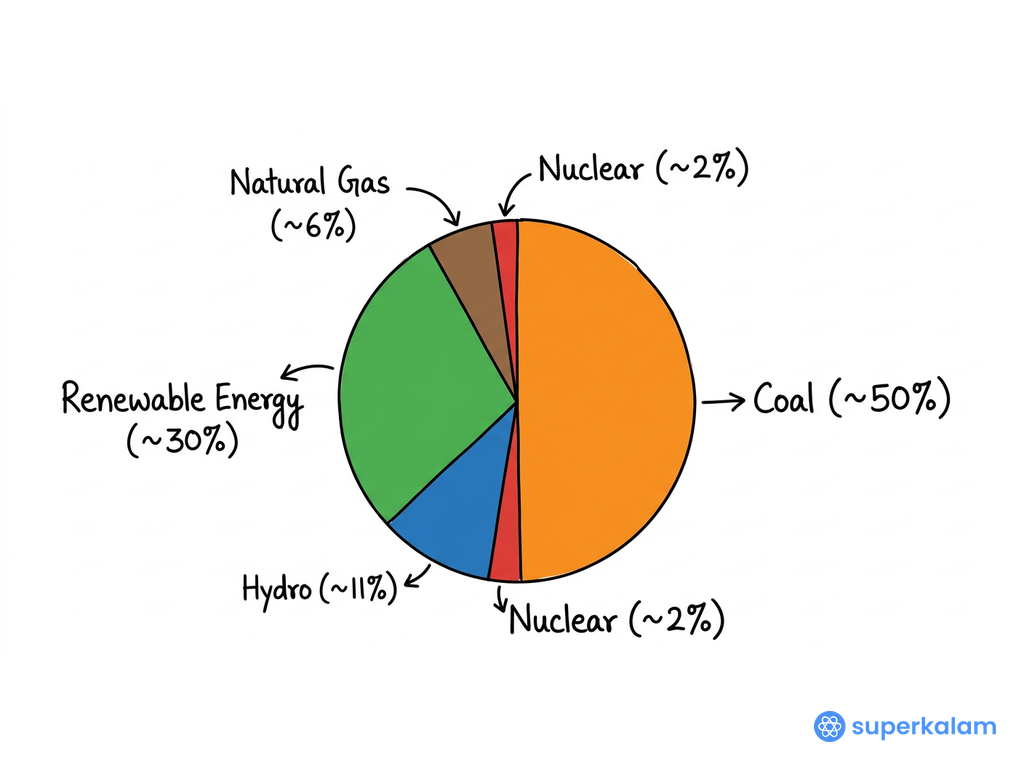
India's Power Capacity Mix Pie Chart
Environmental Impact of Coal Mining
- Air Pollution: Coal mining releases harmful PM2.5 particles and toxic gases, contributing to respiratory diseases and smog formation
- Land Degradation: Open-pit mining causes permanent landscape alterations, leading to soil erosion and loss of biodiversity across mining regions
- Water Contamination: Acid mine drainage contaminates groundwater and surface water, affecting aquatic ecosystems and drinking water sources
- Greenhouse Gas Emissions: Mining operations contribute significantly to global warming through methane releases and CO2 emissions from coal combustion
- Habitat Destruction: Large-scale mining destroys forests and wildlife habitats, disrupting ecological balance
Development Imperatives Making Coal Mining Inevitable
- Energy Security: India's coal production reached 1,047.57 million tonnes in FY 2024-25, meeting 70% of electricity generation needs
- Economic Benefits: Coal mining saved India approximately $7.93 billion in foreign exchange by reducing imports in 2024
- Employment Generation: Provides direct employment to over 4.5 lakh workers and indirect employment to millions in associated industries
- Industrial Foundation: Essential for steel production (requiring metallurgical coal), cement manufacturing, and aluminum smelting
- Rural Development: Mining activities bring infrastructure development to remote areas, improving connectivity and local economies
Balancing Development with Environmental Protection
- Clean Coal Technologies: Implementation of Carbon Capture and Storage (CCS) and cleaner extraction methods to reduce environmental impact
- Regulatory Framework: Strict environmental compliance under Forest Rights Act 2006 and mandatory environmental impact assessments
- Renewable Transition: Countries like Germany phasing out coal while ensuring energy security through renewable alternatives
- Rehabilitation Programs: Post-mining land restoration and afforestation initiatives, with Jharia coalfield rehabilitation as example
- International Cooperation: Technology transfer for sustainable mining practices and global climate commitments under Paris Agreement
Coal mining remains inevitable for development, particularly in emerging economies requiring affordable energy. The solution lies in adopting sustainable mining practices while accelerating the transition to renewable energy, as demonstrated by India's target of 500 GW renewable capacity by 2030.
Answer Length
Model answers may exceed the word limit for better clarity and depth. Use them as a guide, but always frame your final answer within the exam’s prescribed limit.
Evaluate this PYQ now
Write your answer & evaluate in just 60 seconds




500+ students evaluated
Model Answers from
- 2017World Geography15 MarksView Answer
Petroleum refineries are not necessarily located nearer to crude oil producing areas, particularly in many of the developing countries. Explain its implications.
- 2017World Geography10 MarksView Answer
Mention the advantages of the cultivation of pulses because of which the year 2016 was declared as the International Year of Pulses by the United Nations.
Model Answers by Subject


Crack UPSC with your
Personal AI Mentor
An AI-powered ecosystem to learn, practice, and evaluate with discipline