The South China Sea has assumed great geopolitical significance in the present context. Comment.
The South China Sea has assumed great geopolitical significance in the present context. Comment.
The South China Sea has emerged as one of the world's most contested maritime regions, with overlapping territorial claims, strategic waterways, and vast economic resources creating unprecedented geopolitical tensions in contemporary international relations.
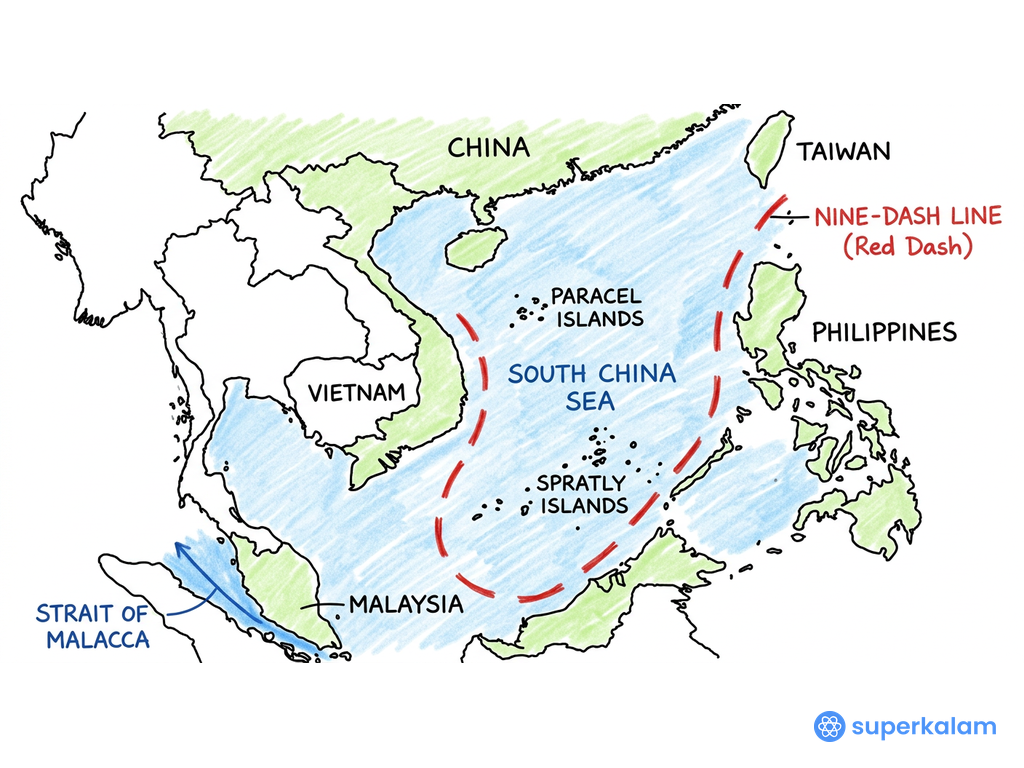
South China Sea Map Coastlines Outlined
Strategic Maritime Importance
- Critical Sea Lane: Controls approximately $5.3 trillion worth of global trade annually, connecting Pacific and Indian Ocean trade routes
- Chokepoint Geography: Narrow straits and passages make it strategically vital for global shipping and energy supplies
- Military Positioning: Provides access to both the Indian Ocean and Western Pacific, crucial for naval power projection
- SLOC Control: Serves as primary Sea Line of Communication (SLOC) for East Asian economies
- Gateway Function: Links major economies including China, Japan, South Korea with Southeast Asian markets
(SK Map: South China Sea Trade Routes and Strategic Passages showing major shipping lanes, chokepoints, and naval bases)
Territorial Claims and Disputes
| Claimant | Claimed Features | Legal Basis | Key Tensions |
|---|---|---|---|
| China | Nine-Dash Line (80-90%) | Historical claims | Artificial island construction |
| Philippines | West Philippine Sea | UNCLOS EEZ | Scarborough Shoal incidents |
| Vietnam | Paracel & Spratly Islands | Historical sovereignty | Oil rig confrontations |
| Malaysia | Southern Spratly features | Continental shelf extension | Fishing rights disputes |
| Brunei | Louisa Reef area | EEZ claims | Overlapping boundaries |
Economic and Resource Significance
- Hydrocarbon Reserves: Contains estimated 11 billion barrels of oil and 190 trillion cubic feet of natural gas
- Fishing Grounds: Provides 12% of global fish catch, supporting millions of livelihoods across littoral states
- Rare Earth Minerals: Seabed contains valuable rare earth deposits essential for modern technology
- Trade Volume: 30% of global maritime trade passes through these waters annually
- Energy Security: Critical for China's 80% imported oil transit route
Current Geopolitical Dynamics
- US-China Competition: Freedom of Navigation Operations (FONOPS) by US Navy challenged by Chinese military responses in 2024
- ASEAN Involvement: Code of Conduct negotiations continue amid individual member state bilateral approaches
- Recent Escalations: Second Thomas Shoal incidents between Philippines and China intensified in 2024
- Militarization: China's construction of artificial islands with military installations alters regional balance
- International Arbitration: 2016 Philippines vs. China tribunal ruling remains unimplemented
The South China Sea's transformation from a regional maritime space to a global geopolitical theater reflects broader shifts in 21st-century power dynamics. Resolution requires balancing UNCLOS principles with regional stability and economic interdependence.
Answer Length
Model answers may exceed the word limit for better clarity and depth. Use them as a guide, but always frame your final answer within the exam’s prescribed limit.
Evaluate this PYQ now
Write your answer & evaluate in just 60 seconds




500+ students evaluated
Model Answers from
Model Answers by Subject


Crack UPSC with your
Personal AI Mentor
An AI-powered ecosystem to learn, practice, and evaluate with discipline