There is no formation of deltas by rivers of the Western Ghats. Why?
There is no formation of deltas by rivers of the Western Ghats. Why?
Rivers of the Western Ghats do not form deltas due to their unique geographical setting and hydrological characteristics. This phenomenon results from distinct physical factors that prevent sediment accumulation at river mouths.
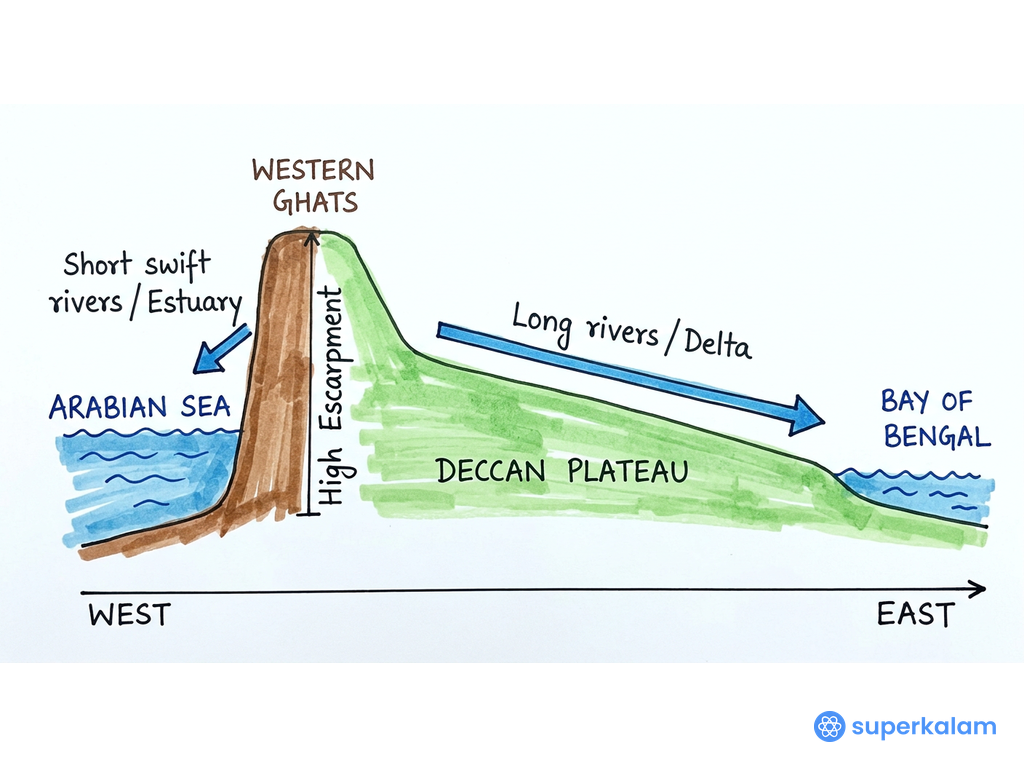
Peninsular India West to East Cross Section
Topographical Constraints
- Steep gradient: Western Ghats create high-velocity rivers with strong erosional power, carrying sediments directly to the sea without deposition
- Short river length: Rivers like Narmada (1,312 km) and Tapti (724 km) have limited sediment-carrying capacity compared to east-flowing rivers
- Narrow coastal plains: The Konkan and Malabar coasts provide insufficient space for delta formation
- Rocky coastline: Hard rock formations prevent natural sediment spreading and accumulation
- High sea cliffs: Vertical coastal relief restricts horizontal sediment deposition
Marine Environment Factors
- Deep Arabian Sea: Ocean depths exceeding 3,000 meters near the coast allow sediments to disperse rapidly into deep waters
- Strong tidal currents: Arabian Sea's powerful currents continuously transport sediments away from river mouths
- High wave energy: Monsoon-driven waves with heights up to 4-6 meters prevent sediment accumulation
- Submarine canyons: Underwater valleys like those off Mumbai facilitate direct sediment transport to abyssal depths
- Limited continental shelf: Narrow shelf width (20-50 km) compared to east coast (120-200 km) restricts delta formation space
Hydrological Characteristics
- Seasonal flow regime: Rivers experience extreme seasonal variations, with 80% discharge during monsoons
- Flash flood nature: Rapid runoff during monsoons creates high-energy conditions unsuitable for deposition
- Limited sediment load: Crystalline rocks of Western Ghats produce less sediment compared to alluvial plains
- Estuarine conditions: Rivers form estuaries and backwaters (like Kerala's Vembanad) instead of deltas
- Rift valley formation: Rivers like Narmada flow through fault-controlled valleys, creating different depositional patterns
This unique combination explains why Western Ghat rivers create distinctive coastal features like the Kerala backwaters and Konkan estuaries, demonstrating India's diverse fluvial geomorphology.
Answer Length
Model answers may exceed the word limit for better clarity and depth. Use them as a guide, but always frame your final answer within the exam’s prescribed limit.
Evaluate this PYQ now
Write your answer & evaluate in just 60 seconds




500+ students evaluated
Model Answers from
- 2013Indian Geography10 MarksView Answer
It is said that India has substantial reserves of shale oil and gas, which can feed the needs of the country for a quarter century. However, tapping the resources doesn’t appear to be high on the agenda. Discuss critically the availability and issues involved.
- 2013Indian Geography10 MarksView Answer
With the growing scarcity of fossil fuels, atomic energy is gaining more and more significance in India. Discuss the availability of raw materials required for the generation of atomic energy in India and the world.
- 2013Indian Geography5 MarksView Answer
Analyze the factors for the highly decentralized cotton textile industry in India.
- 2013Indian Geography5 MarksView Answer
Do you agree that there is a growing trend of opening new sugar mills in the Southern states of India? Discuss with justification.
- 2013Indian Geography5 MarksView Answer
Bring out the causes for more frequent landslides in the Himalayas than in the Western Ghats.
- 2013Indian Geography5 MarksView Answer
The recent cyclone on the east coast of India was called “Phailin”. How are the tropical cyclones named across the world? Elaborate.
Model Answers by Subject


Crack UPSC with your
Personal AI Mentor
An AI-powered ecosystem to learn, practice, and evaluate with discipline