Analyze the factors for the highly decentralized cotton textile industry in India.
Analyze the factors for the highly decentralized cotton textile industry in India.
India's cotton textile industry demonstrates remarkable decentralization, with the sector contributing significantly to employment and exports. Recent data shows India as the world's second-largest textile exporter, with this spatial distribution driven by multiple interconnected factors.
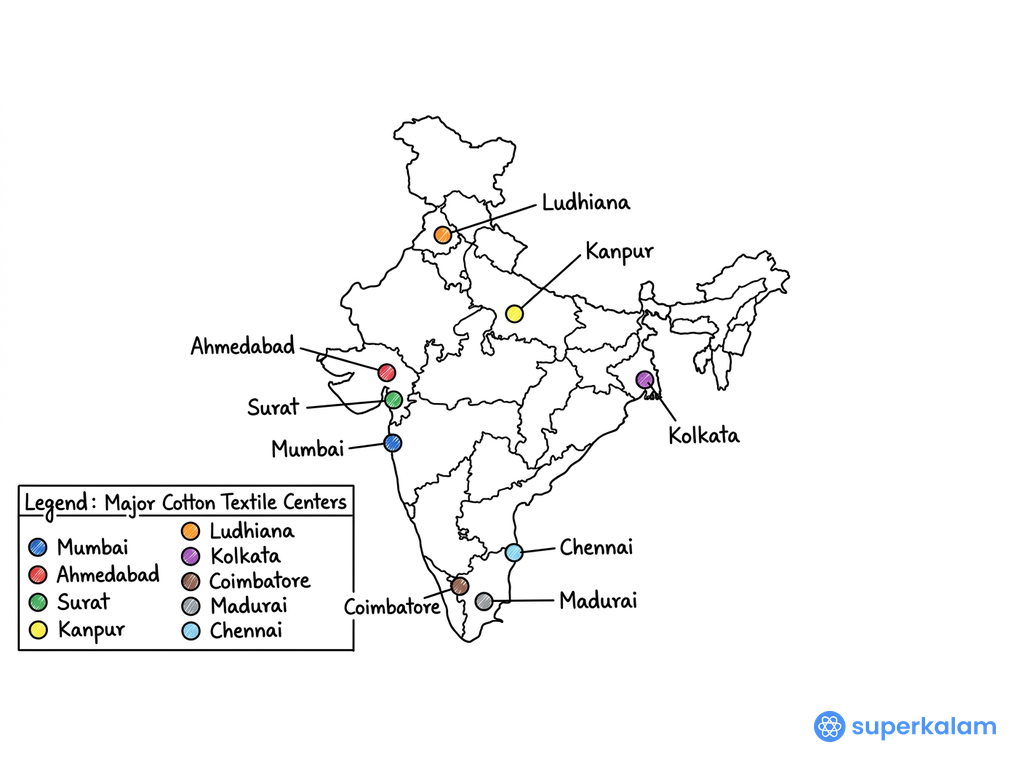
India's Decentralized Cotton Textile Centers Map
Raw Material Availability and Agricultural Base
- Cotton Cultivation Zones: Major cotton-producing states like Gujarat (33%), Maharashtra (26%), and Telangana (13%) naturally host textile clusters
- Quality Variations: Different cotton varieties (long-staple in Gujarat, medium-staple in central India) support specialized textile products
- Seasonal Production: Multiple cropping seasons ensure year-round raw material supply across different regions
- Proximity Advantage: Reduced transportation costs and supply chain efficiency when mills locate near cotton fields
- Agricultural Infrastructure: Established cotton marketing networks and warehousing facilities support decentralized processing
Historical and Colonial Legacy Factors
- Mill Development Pattern: British colonial policies established mills in different presidencies (Bombay, Madras, Bengal) creating multiple centers
- Traditional Weaving Centers: Pre-colonial textile hubs in regions like Tamil Nadu (Coimbatore), Gujarat (Ahmedabad), and West Bengal (Kolkata) evolved into modern industrial clusters
- Skill Heritage: Generations of textile workers and artisans concentrated in specific regions
- Infrastructure Development: Railway networks built during colonial period connected cotton-growing and textile-producing regions
- Market Access: Historical trade routes and port connectivity influenced industrial location patterns
Economic and Market Factors
- Cost Advantages: Lower labor costs in smaller towns and rural areas encourage decentralized production
- Export Facilitation: Proximity to ports (Mumbai, Chennai, Cochin) benefits different regional clusters
- Domestic Market Access: Distributed production centers serve local and regional markets efficiently
- SME Dominance: Over 85% of textile units are small and medium enterprises, naturally promoting decentralization
- Financial Accessibility: Regional banks and cooperative institutions support smaller textile units across various locations
| Factor Category | Key Elements | Regional Examples |
|---|---|---|
| Raw Material | Cotton availability, Quality variations | Gujarat (Surat), Maharashtra (Nashik) |
| Historical | Colonial mills, Traditional centers | Tamil Nadu (Coimbatore), Gujarat (Ahmedabad) |
| Economic | Labor costs, Market access | Karnataka (Bangalore), Telangana (Hyderabad) |
Government Policies and Infrastructure Support
- Cluster Development: Schemes like PM MITRA Parks (2021) promote textile manufacturing across multiple states
- Technology Upgradation: ATUFS and PLI schemes encourage modernization in various regions
- Export Promotion: Multiple textile export hubs reduce dependency on single locations
- Power and Transportation: Improved infrastructure connectivity supports decentralized growth
- State Incentives: Different states offer competitive incentive packages attracting textile investments
This decentralized pattern ensures resilient supply chains and balanced regional development, with recent initiatives like the National Technical Textiles Mission further strengthening India's position as a global textile manufacturing hub.
Answer Length
Model answers may exceed the word limit for better clarity and depth. Use them as a guide, but always frame your final answer within the exam’s prescribed limit.
Evaluate this PYQ now
Write your answer & evaluate in just 60 seconds




500+ students evaluated
Model Answers from
- 2013Indian Geography10 MarksView Answer
It is said that India has substantial reserves of shale oil and gas, which can feed the needs of the country for a quarter century. However, tapping the resources doesn’t appear to be high on the agenda. Discuss critically the availability and issues involved.
- 2013Indian Geography10 MarksView Answer
With the growing scarcity of fossil fuels, atomic energy is gaining more and more significance in India. Discuss the availability of raw materials required for the generation of atomic energy in India and the world.
- 2013Indian Geography5 MarksView Answer
Do you agree that there is a growing trend of opening new sugar mills in the Southern states of India? Discuss with justification.
- 2013Indian Geography5 MarksView Answer
There is no formation of deltas by rivers of the Western Ghats. Why?
- 2013Indian Geography5 MarksView Answer
Bring out the causes for more frequent landslides in the Himalayas than in the Western Ghats.
- 2013Indian Geography5 MarksView Answer
The recent cyclone on the east coast of India was called “Phailin”. How are the tropical cyclones named across the world? Elaborate.
Model Answers by Subject


Crack UPSC with your
Personal AI Mentor
An AI-powered ecosystem to learn, practice, and evaluate with discipline



