The groundwater potential of the Gangetic valley is on a serious decline. How may it affect the food security of India?
The groundwater potential of the Gangetic valley is on a serious decline. How may it affect the food security of India?
Subject: Indian Geography
The Indo-Gangetic Plain, India's agricultural backbone, is confronting an existential water crisis. According to the UN Interconnected Disaster Risks Report 2023, the basin has crossed the "groundwater depletion risk tipping point," threatening the collapse of entire food production systems.
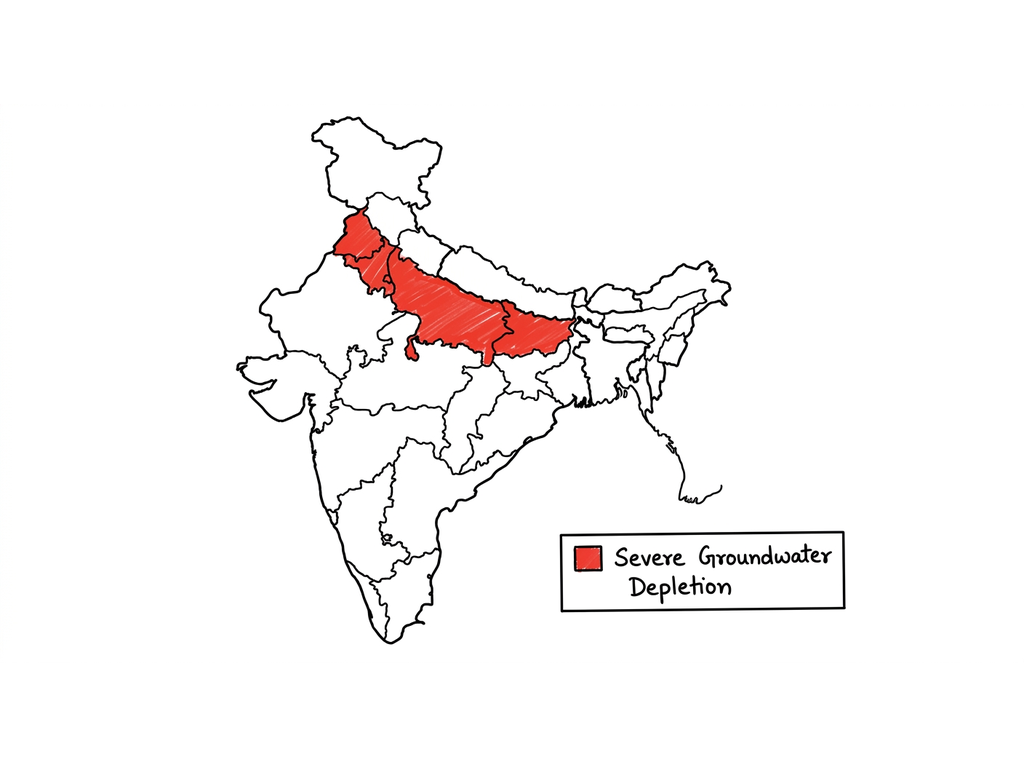
Groundwater depletion in India
Extent of Groundwater Decline in the Gangetic Valley
- Severe Over-extraction: The Central Ground Water Board (2024) highlights critical unsustainability, with Punjab extracting 156.36% and Haryana 136.75% of their available groundwater.
- Irrigation Dominance: An overwhelming 94.74% of extracted groundwater is diverted for irrigation, systematically draining deep aquifers.
- Overexploited Zones: In Punjab alone, 72.55% of assessment blocks are officially categorized as over-exploited, rendering millions of agricultural tubewells increasingly unviable.
- Future Vulnerability: The WRI Aqueduct Water Risk Atlas 2023 projects that continuous depletion in Northern India could cause agricultural production losses of up to 12% by 2050.
Impact on India’s Food Security
- Threat to Buffer Stocks: Plunging water tables in the 'breadbasket' directly endanger the procurement of rice and wheat, threatening the viability of the Public Distribution System (PDS).
- Toxification of the Food Chain: Depleting water levels concentrate heavy metals, leading the NGT to investigate rising arsenic contamination in rice grown in the Indo-Gangetic plains, compromising nutritional security.
- Yield Stagnation: Insufficient irrigation during critical growth stages is causing stunted crops, leading to an estimated 30% yield reduction for staples in Western Uttar Pradesh and Haryana.
- Escalating Cultivation Costs: As water tables plunge, farmers incur massive debts drilling deeper borewells, inflating food production costs and raising the Minimum Support Price (MSP) burden.
- Energy-Food Nexus Strains: Pumping water from greater depths exponentially increases agricultural power consumption, threatening the subsidized power models states use to ensure food affordability.
- Soil Degradation: Pumping deep, mineral-rich groundwater alters soil chemistry, progressively rendering fertile Gangetic soils saline, alkaline, and unfit for cultivation.
- Displacement of Marginal Farmers: Unable to afford the lakhs required for deeper drilling, smallholder farmers are forced to abandon agriculture, threatening their household food security.
- Climate Vulnerability: The loss of the groundwater buffer removes the primary insurance mechanism against erratic monsoons, causing extreme food production volatility.
Way Forward for Sustainable Agriculture
- Strict Judicial Oversight: Implementing stringent penalties against illegal extraction, aligning with the Haryana High Court's 2024 imposition of ₹157 crore in environmental compensation.
- Crop Realignment: Promoting the rapid shift from water-guzzling paddy to climate-resilient millets (Shree Anna), as advocated by the Punjab Water Conservation Initiative Group (2024).
- Technological Adoption: Scaling up Direct Seeded Rice (DSR) and micro-irrigation to reduce agricultural water demand by 40%, meeting obligations under SDG 6.4.
- Watershed Regeneration: Prioritizing the Watershed Development Component of PMKSY (2022–2026) to aggressively scale up rainwater harvesting and aquifer recharge in rainfed regions.
To secure its food future, India must transition from a resource-intensive agricultural model to an ecologically sustainable paradigm. Treating groundwater as a shared national heritage, rather than an infinite private resource, is the only way to ensure food security for the next generation.
Answer Length
Model answers may exceed the word limit for better clarity and depth. Use them as a guide, but always frame your final answer within the exam’s prescribed limit.
Evaluate this PYQ now
Write your answer & evaluate in just 60 seconds




500+ students evaluated
Model Answers by Subject


Crack UPSC with your
Personal AI Mentor
An AI-powered ecosystem to learn, practice, and evaluate with discipline



