Distinguish between gender equality, gender equity and women's empowerment. Why is it important to take gender concerns into account in programme design and implementation?
Distinguish between gender equality, gender equity and women's empowerment. Why is it important to take gender concerns into account in programme design and implementation?
Subject: Indian Society
With India ranking 129th in the WEF Global Gender Gap Report 2024, achieving gender justice requires moving beyond formal equality toward targeted equity and holistic empowerment.
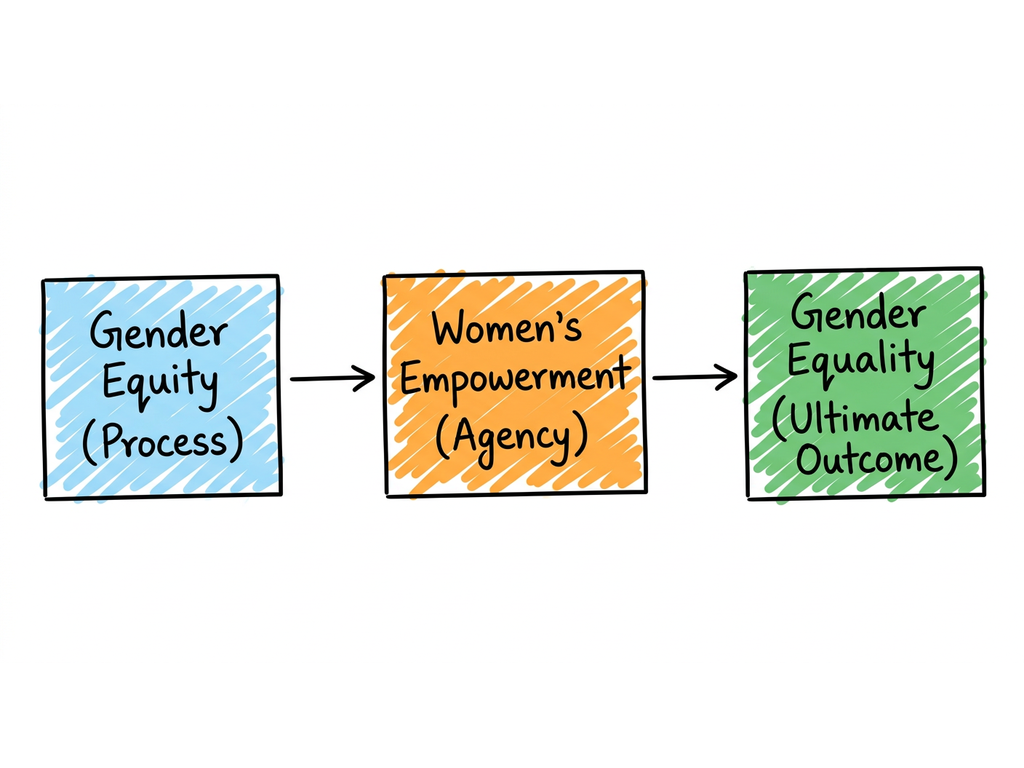
Gender Equity to Gender Equality diagram
Conceptual Distinctions
- Gender Equality (The Baseline): Guarantees identical legal rights and opportunities for all, such as equal pay for equal work under Article 14.
- Gender Equity (The Mechanism): Provides tailored interventions to address historical disadvantages, such as the affirmative action quotas in the Nari Shakti Vandan Adhiniyam.
- Women’s Empowerment (The Outcome): Builds active agency, transitioning women from passive beneficiaries to decision-makers, as championed by the G20 "Women-led Development" agenda.
Importance in Programme Design and Implementation
- Preventing Unpaid Exploitation: As PLFS 2023-24 shows rising female workforce participation driven largely by unpaid agricultural labor, conscious design prevents schemes from masking unpaid labor as empowerment.
- Targeted Financial Tracking: The 2024-25 Union Budget's new 'Part C' gender statement ensures precise monitoring of programs with even partial (up to 30%) female allocation.
- Overcoming Time Poverty: Ignoring women's unpaid care burdens causes scheme failures; mandating worksite crèches under MGNREGA enables mothers' active economic participation.
- Breaking Occupational Stereotypes: Progressive implementation shifts women to modern managerial roles, exemplified by agricultural drone training in the Namo Drone Didi Scheme.
- Addressing Biological Needs: Programmes must cater to physical realities; building separate school toilets under the Swachh Bharat Mission directly curbed adolescent girls' dropout rates.
- Eradicating Administrative Bias: Grassroots execution requires eliminating patriarchal assumptions, guided by the Supreme Court’s 2023 Handbook on Combating Gender Stereotypes.
- Tackling Intersectionality: The expanded Lakhpati Didi Scheme explicitly targets rural SHGs, acknowledging that gender constraints multiply with geographic and social isolation.
Gender-neutral policies in a patriarchal society inadvertently reinforce the status quo. Achieving SDG-5 requires gender-transformative programmes that actively dismantle structural barriers.
Answer Length
Model answers may exceed the word limit for better clarity and depth. Use them as a guide, but always frame your final answer within the exam’s prescribed limit.
Evaluate this PYQ now
Write your answer & evaluate in just 60 seconds




500+ students evaluated
Model Answers from
- 2024Indian Society15 MarksView Answer
Critically analyze the proposition that there is a high correlation between India's cultural diversities and socio-economic marginalities.
- 2024Indian Society15 MarksView Answer
Globalization has increased the urban migration by skilled, young, unmarried women from various classes. How has this trend impacted upon their personal freedom and relationship with family?
- 2024Indian Society15 MarksView Answer
Despite comprehensive policies for equity and social justice, underprivileged sections are not yet getting the full benefits of the affirmative actions envisaged by the constitutions. Comment
- 2024Indian Society15 MarksView Answer
What is regional disparity? How does it differ from diversity? How serious is the issue of regional disparity in India?
- 2024Indian Society10 MarksView Answer
In dealing with socio-economic issues of development, what kind of collaboration between government, NGOs and private sector would be most productive?
- 2024Indian Society10 MarksView Answer
Intercaste marriages between castes which have socio-economic parity have increased, to some extent, but this is less true of interreligious marriages. Discuss.
Model Answers by Subject


Crack UPSC with your
Personal AI Mentor
An AI-powered ecosystem to learn, practice, and evaluate with discipline



