Discuss the significance of the lion and bull figures in Indian mythology, art and architecture.
Discuss the significance of the lion and bull figures in Indian mythology, art and architecture.
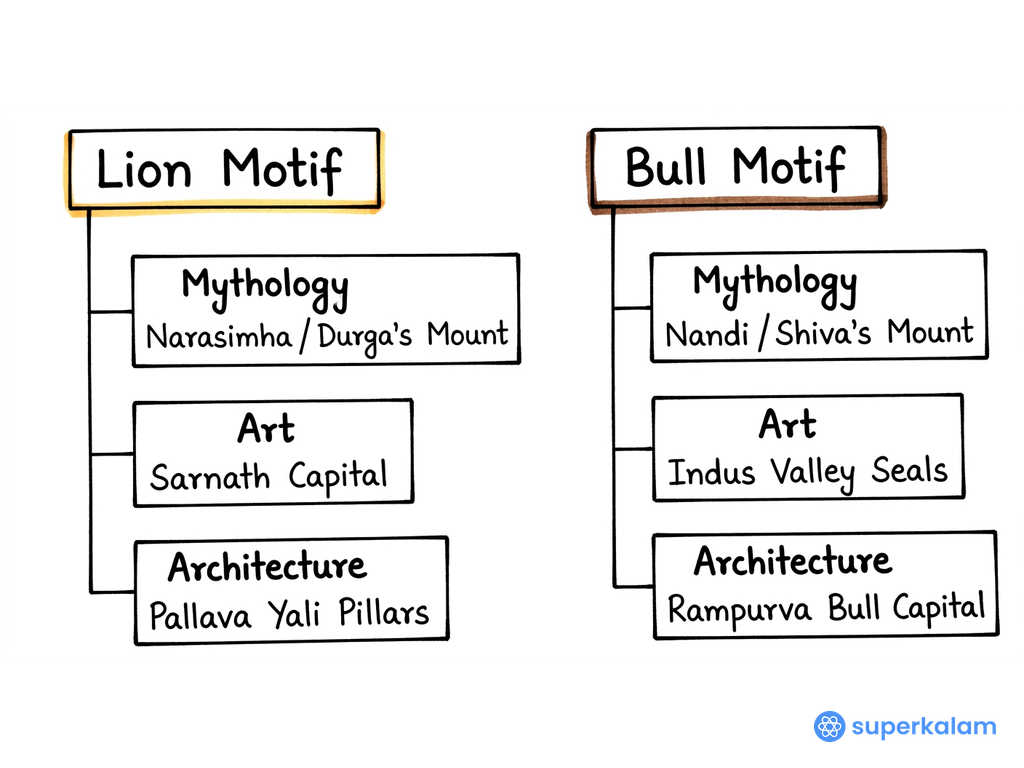
Lion and bull motifs are among the oldest and most enduring symbols in Indian culture, appearing from the Indus Valley Civilization to modern national emblems. They embody deep religious, political, and cultural meanings, shaping the iconography of Indian art and architecture.
I. Lion in Indian Tradition
-
Mythological Significance
- Associated with Narasimha, the lion-man incarnation of Vishnu in Vaishnavism.
- In Buddhism, the lion symbolizes Shakyamuni’s royal ancestry and the Lion’s Roar—fearless proclamation of the Dharma.
- In Jainism, the lion is linked to Mahavira.
-
Symbol of Power and Sovereignty
Asokan Lion Capital
- Adopted by Mauryan Emperor Ashoka in the Sarnath Lion Capital (3rd century BCE).
- Represents courage, leadership, and righteous rule; chosen as India’s National Emblem in 1950.
-
Artistic Representations
- Seen in Mathura school sculptures, temple gateways (toranas), and narrative reliefs at Sanchi and Bharhut.
- Chola bronzes often depict lions at temple entrances as dvarapalas (guardian figures).
-
Architectural Presence
- Frequently carved on pillars, thrones, and capitals in Mauryan, Gupta, and Chola architecture.
- Example: Vijayanagara temples with yali (mythical lion) motifs blending Dravidian and Vijayanagara styles.
II. Bull in Indian Tradition
-
Mythological and Religious Importance
- Sacred in Hinduism as Nandi, the vahana (mount) of Lord Shiva, symbolizing strength, fertility, and devotion.
- In Indus Valley seals (e.g., Mohenjo-daro), the bull appears as a fertility and economic prosperity symbol.
- In Jainism, the bull is primarily a symbol of the first Tirthankara, Rishabhanatha.
-
Symbol of Agricultural Prosperity
- Represents the agrarian foundation of Indian civilization, where cattle rearing and farming were central to livelihood.
- Bull motifs often used in harvest festivals like Pongal and Makar Sankranti.
-
Artistic Depictions
- Iconic monolithic Nandi statues in temples like Brihadeeswarar Temple (Thanjavur) and Lepakshi Temple (Andhra Pradesh).
- Bulls in Ajanta cave paintings depict rural life and ceremonial processions.
-
Architectural Placement
- Always positioned facing the sanctum (garbhagriha) in Shaivite temples as the eternal devotee of Shiva.
- Appears in Hoysala, Pallava, and Chola temple sculptures as a marker of Shaivite identity.
III. Cultural Continuity and Modern Symbolism
- Lion: Continues in national identity through the State Emblem of India and security forces’ insignia (e.g., CRPF, Indian Navy).
- Bull: Appears on modern logos like the Bombay Stock Exchange symbolizing economic vitality.
The lion and bull are not mere artistic embellishments but deeply embedded symbols of India’s spiritual ideals, political authority, and socio-economic foundations. Their repeated appearance across centuries reflects the continuity of cultural values from the Indus seals to the national emblem, uniting India’s past and present.
Answer Length
Model answers may exceed the word limit for better clarity and depth. Use them as a guide, but always frame your final answer within the exam’s prescribed limit.
Evaluate this PYQ now
Write your answer & evaluate in just 60 seconds




500+ students evaluated
Model Answers by Subject


Crack UPSC with your
Personal AI Mentor
An AI-powered ecosystem to learn, practice, and evaluate with discipline



