What are the major challenges of Public Distribution System (PDS) in India ? How can it be made effective and transparent ?
What are the major challenges of Public Distribution System (PDS) in India ? How can it be made effective and transparent ?
The Public Distribution System (PDS), one of the world’s largest food security programmes, ensures access to essential grains at subsidised prices. Covering more than 80 crore beneficiaries under the National Food Security Act (2013), it plays a crucial role in reducing hunger and poverty. However, issues such as leakages, diversion of grains, and poor targeting continue to weaken its efficiency and transparency.
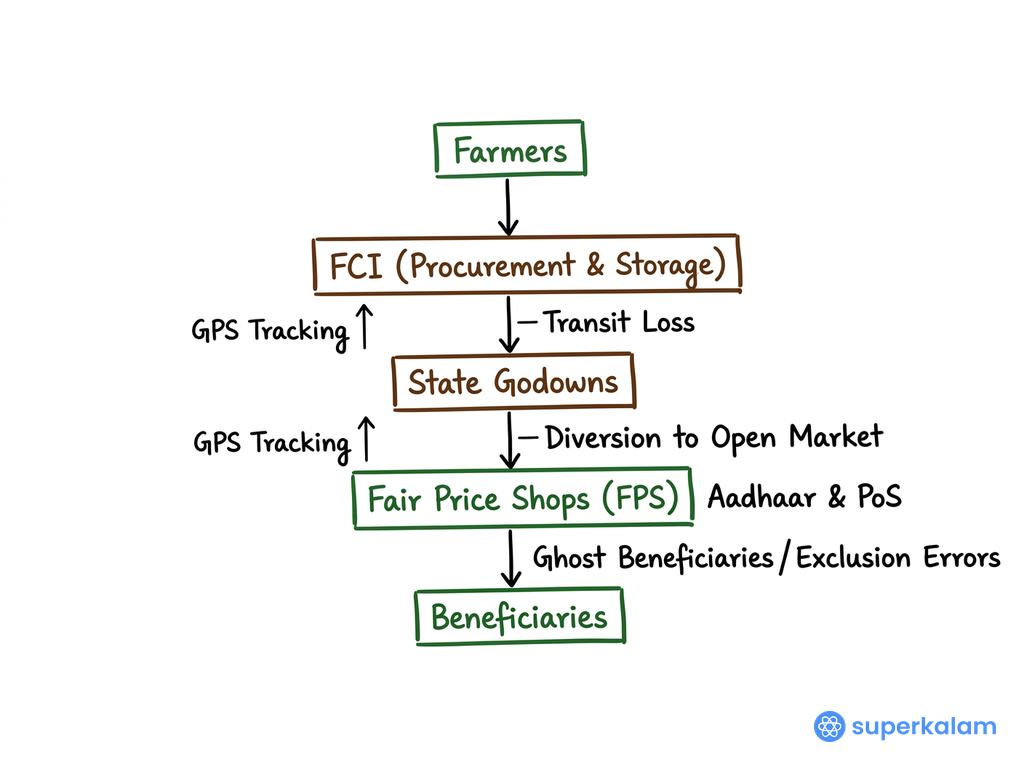
PDS Supply Chain Flowchart of 2022
Major Challenges of Public Distribution System (PDS) in India
-
Leakages and Diversion:
- A significant portion of subsidised food grains gets diverted to the open market by corrupt dealers.
- Exaple: Shanta Kumar Committee (2015) estimated nearly 46% of PDS grain fails to reach intended beneficiaries.
-
Inclusion and Exclusion Errors
-
Many deserving poor are excluded (exclusion error), while ineligible households benefit (inclusion error).
-
Outdated poverty line estimates and errors in beneficiary identification aggravate the issue.
-
-
Inefficient Procurement and Storage
-
Excess procurement by FCI leading to piling up of stocks.
-
Inadequate storage facilities → rotting of food grains, wastage, and high carrying costs.
-
-
Regional Disparities
-
States like Chhattisgarh and Tamil Nadu run highly efficient PDS, but states like Bihar, Jharkhand face weak coverage.
-
Procurement heavily biased towards rice and wheat, neglecting coarse grains.
-
-
Poor Quality of Food Grains: Low-grade grains distributed under PDS → many beneficiaries sell or avoid consumption.
-
Corruption and Lack of Transparency
-
Fake ration cards, ghost beneficiaries, and collusion between officials and ration dealers.
-
Manual record-keeping fosters manipulation.
-
Measures to Make PDS Effective and Transparent
-
Technology Integration
-
Aadhaar-based biometric authentication at ration shops.
-
End-to-end computerisation of PDS supply chain with GPS tracking of trucks.
-
SMS alerts to beneficiaries about grain allocation.
-
-
Improved Beneficiary Identification
-
Use of Socio-Economic and Caste Census (SECC) data for dynamic beneficiary list.
-
Periodic verification to prevent ghost beneficiaries.
-
-
Decentralisation and Community Participation
-
Greater role for PRIs, SHGs, and cooperatives in distribution.
-
Example: Chhattisgarh model with community monitoring improved efficiency.
-
-
Diversification of PDS Basket
-
Inclusion of millets, pulses, oil, and fortified foods for nutritional security.
-
Supports government’s Millet Mission and POSHAN Abhiyaan.
-
-
Social Accountability Mechanisms
-
Social audits, vigilance committees, toll-free helplines for grievance redressal.
-
Greater transparency in allocation through public disclosure.
-
-
Direct Benefit Transfer (DBT)
-
Cash transfer pilots in Chandigarh and Puducherry reduced leakages.
-
Needs to be carefully balanced in poorer states where food security is fragile.
-
The PDS remains the backbone of food security in India, but inefficiencies, leakages, and corruption dilute its impact. By embracing technology, decentralisation, transparency mechanisms, and diversification towards nutrition-sensitive PDS, India can transform it into a robust pillar of inclusive growth and social justice.
Answer Length
Model answers may exceed the word limit for better clarity and depth. Use them as a guide, but always frame your final answer within the exam’s prescribed limit.
Evaluate this PYQ now
Write your answer & evaluate in just 60 seconds




500+ students evaluated
Model Answers from
- 2022Economy15 MarksView Answer
Economic growth in the recent past has been led by increase in labour activity.” Explain this statement. Suggest the growth pattern that will lead to creation of more jobs without compromising labour productivity.
- 2022Economy10 MarksView Answer
The increase in life expectancy in the country has led to newer health challenges in the community. What are those challenges and what steps need to be taken to meet them ?
- 2022Economy10 MarksView Answer
Elaborate the scope and significance of the food processing industry in India
- 2022Economy10 MarksView Answer
Is inclusive growth possible under market economy ? State the significance of financial inclusion in achieving economic growth in India.
- 2022Economy10 MarksView Answer
Why is Public Private Partnership (PPP) required in infrastructural projects ? Examine the role of PPP model in the redevelopment of Railway Stations in India.
Model Answers by Subject


Crack UPSC with your
Personal AI Mentor
An AI-powered ecosystem to learn, practice, and evaluate with discipline



