Is inclusive growth possible under market economy ? State the significance of financial inclusion in achieving economic growth in India.
Is inclusive growth possible under market economy ? State the significance of financial inclusion in achieving economic growth in India.
A market economy is driven by private enterprise and competition, while inclusive growth implies growth that is sustainable, broad-based, and equitable. The challenge before India is whether a market-led growth model can deliver inclusivity for a diverse society with wide socio-economic disparities.
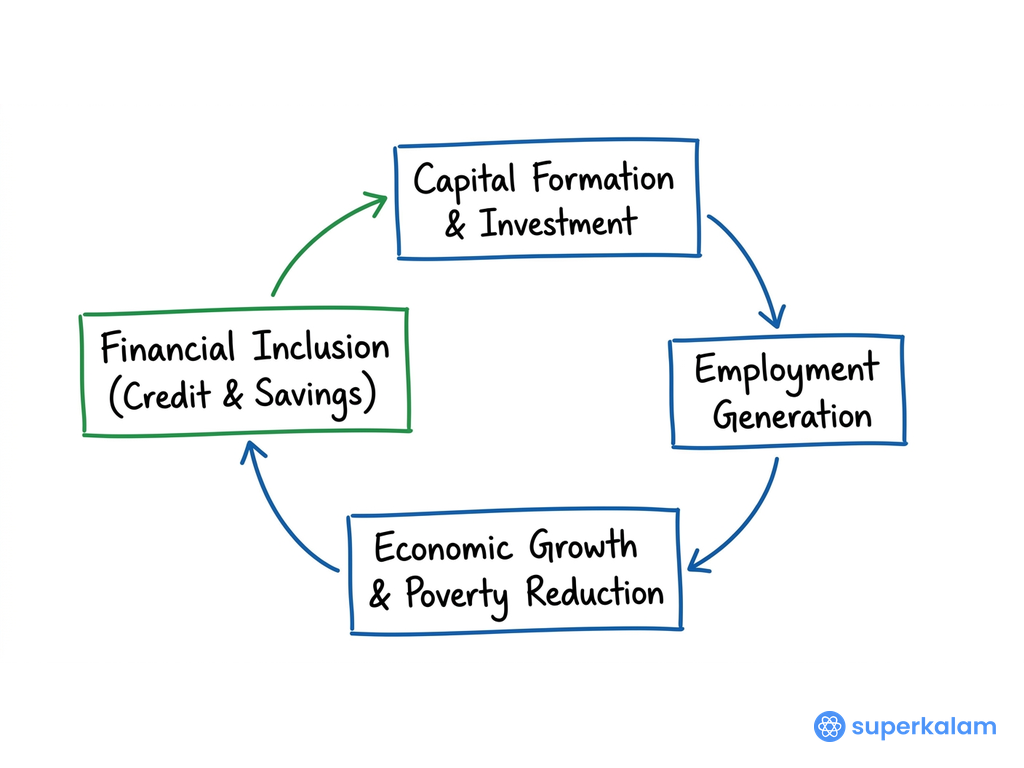
Virtuous Cycle of Financial Inclusion Flowchart
Inclusive Growth under Market Economy
Possibilities
-
Wealth Creation for Redistribution: Markets generate wealth that can be redistributed through taxes and welfare.
Example: Scandinavian countries combine market efficiency with welfare states to ensure inclusivity.
-
Employment Generation: Private investment creates jobs in manufacturing, IT, and services.
Example: India’s IT sector employs 5.4 million people (NASSCOM, 2023), largely market-driven.
-
Attracting Foreign Direct Investment (FDI): A market economy draws global investors, boosting infrastructure and jobs.
Example: India attracted $85 billion FDI in 2022–23 (DPIIT), much of it in tech and manufacturing.
-
Innovation and Technology Transfer: Private competition fosters innovation, reducing costs for consumers.
Example: UPI-based fintech ecosystem, developed through private–public synergy, expanded financial access.
-
Public–Private Partnerships (PPP): Bridges infrastructure gaps in transport, energy, and urban development.
Example: Metro rail projects in Delhi, Hyderabad, and Bangalore under PPP models.
-
Global Market Integration: Export-driven growth brings scale and employment.
Example: Pharmaceutical exports (market-driven) made India the “pharmacy of the world,” valued at $25 billion+ annually.
Limitations
-
Widening Income Inequality: Market economy often benefits the rich disproportionately.
Example: Oxfam India (2023) – top 1% own 40.5% of national wealth.
-
Jobless Growth: Despite GDP growth, employment elasticity is low.
Example: PLFS (2022–23) – urban female LFPR remains 25.8%, showing weak job creation.
-
Regional Disparities: Investments cluster in developed states (Gujarat, Maharashtra, Karnataka), leaving BIMARU states behind.
-
Neglect of Social Sectors: Market incentives focus on profit, under-providing health, education, and sanitation.
Example: Private schools flourish, but ASER 2022 found only 20% of Class 3 children in govt schools can read Class 2 text.
-
Exploitation and Informality: Market-led jobs are often precarious and informal, with poor social security.
Example: 81% of workers employed in informal sector (Economic Survey 2023).
-
Environmental Externalities: Market-driven industrialisation neglects sustainability.
Example: India ranks 8th most polluted country (IQAir, 2022) due to unchecked industrial growth.
Significance of Financial Inclusion in Economic Growth
-
Enhances Savings and Capital Formation
-
Financial inclusion brings the unbanked population into the formal financial system, encouraging savings.
-
Deposits in banks mobilize capital for investments in infrastructure, agriculture, and industry.
-
Example: Pradhan Mantri Jan Dhan Yojana (PMJDY) has led to over 50 crore bank accounts being opened, with deposits exceeding ₹2.1 lakh crore (as of 2024).
-
-
Facilitates Credit Access and Entrepreneurship
-
Affordable credit reduces reliance on moneylenders, helping small businesses, MSMEs, and farmers.
-
Credit availability fosters entrepreneurship and job creation.
-
Example: MUDRA Yojana sanctioned ₹27.8 lakh crore to 62 crore borrowers (2015–2023), empowering small entrepreneurs.
-
-
Promotes Inclusive Growth and Reduces Inequality
-
Financial services reach vulnerable groups (women, rural poor, marginalized), ensuring equitable growth.
-
This reduces regional and social inequalities by integrating excluded sections into the growth process.
-
Example: Self-Help Group (SHG)-Bank linkage programme empowers rural women through collective savings and microfinance.
-
-
Improves Welfare Delivery through Direct Benefit Transfers (DBT)
-
Eliminates leakages, ensures transparency, and delivers subsidies directly into beneficiaries’ accounts.
-
Improves efficiency in welfare schemes like MNREGA, PM-KISAN, and LPG subsidies.
-
Example: DBT saved the government ₹2.7 lakh crore (2014–2023) by plugging leakages.
-
-
Boosts Digital Economy and Formalisation
-
Digital payment systems (UPI, Aadhaar-enabled payments) integrate informal workers and businesses into the formal economy.
-
Expands the tax base and enhances fiscal capacity of the government.
-
Example: UPI transactions crossed 14,000 crore in 2023-24, contributing to digital financial inclusion.
-
-
Strengthens Social Security and Resilience
-
Insurance and pension schemes improve resilience of households against health, income, and climate shocks.
-
Builds long-term financial security, reducing vulnerability to poverty cycles.
-
Example: PM Suraksha Bima Yojana and Atal Pension Yojana cover millions of low-income workers.
-
Inclusive growth under a market economy is feasible only when complemented by financial inclusion, regulatory frameworks, and social safety nets. Financial inclusion is the linchpin that ensures market-led growth translates into broad-based prosperity, aligning with India’s vision of Sabka Saath, Sabka Vikas, Sabka Vishwas.
Answer Length
Model answers may exceed the word limit for better clarity and depth. Use them as a guide, but always frame your final answer within the exam’s prescribed limit.
Evaluate this PYQ now
Write your answer & evaluate in just 60 seconds




500+ students evaluated
Model Answers from
- 2022Economy15 MarksView Answer
Economic growth in the recent past has been led by increase in labour activity.” Explain this statement. Suggest the growth pattern that will lead to creation of more jobs without compromising labour productivity.
- 2022Economy10 MarksView Answer
The increase in life expectancy in the country has led to newer health challenges in the community. What are those challenges and what steps need to be taken to meet them ?
- 2022Economy10 MarksView Answer
Elaborate the scope and significance of the food processing industry in India
- 2022Economy10 MarksView Answer
What are the major challenges of Public Distribution System (PDS) in India ? How can it be made effective and transparent ?
- 2022Economy10 MarksView Answer
Why is Public Private Partnership (PPP) required in infrastructural projects ? Examine the role of PPP model in the redevelopment of Railway Stations in India.
Model Answers by Subject


Crack UPSC with your
Personal AI Mentor
An AI-powered ecosystem to learn, practice, and evaluate with discipline



